


The Team Behind Every Tray
A look at how Shepherd serves close to 1000 nutritious, tasty meals to patients, family, and staff every day.
Shepherd Center’s Food Services team prepares around 380 patient meals each day. That doesn’t include the food served to family members, staff, and community members in the cafeteria. And each meal is carefully planned, prepared, and delivered, taking patients’ dietary needs and restrictions into account. Dietitians, doctors, chefs, cooks, food service aides, and culinary aides are just some of the team members involved in the process. We followed two team members to get a glimpse of what goes into serving up so many healthy meals with a side of Shepherd hospitality.
On the Menu
Rosemary-baked chicken breast or shrimp and cheese grits, new potatoes, cauliflower, mustard greens, and English peas. Chicken and broccoli stir fry or a Philly cheesesteak. Burgers, tenders, pizza, salads, sandwiches, fruit, lemon-lime cake…
Food service assistant Tonika McCoy makes her rounds of patient rooms on the fourth and fifth floors at Shepherd Center. She greets each patient by name and reads their menu options from a tablet. The options are based on the dietary guidelines established by Shepherd doctors and dietitians for each patient.
With patients at various stages of their rehabilitation, dietary needs run the gamut. For people eating solid foods, there are specials for each day, but if those don’t strike a patient’s fancy, there are à la carte options like sandwiches, burgers, chicken tenders, salads, or soup.
McCoy starts collecting orders around 7:45 a.m. each morning so she can catch patients in their rooms before they head to therapy. Anyone she misses in the morning, she revisits at lunchtime to get their meal orders for the following two days. She also makes sure she can describe all the dishes in case a patient is unfamiliar with some of the options.
McCoy stops in Bobbie Ingram’s room. Bobbie is participating in the Spinal Cord Injury Rehabilitation Program, and her husband, Stuart, is staying at the Arthur M. Blank Family Residences down the street.
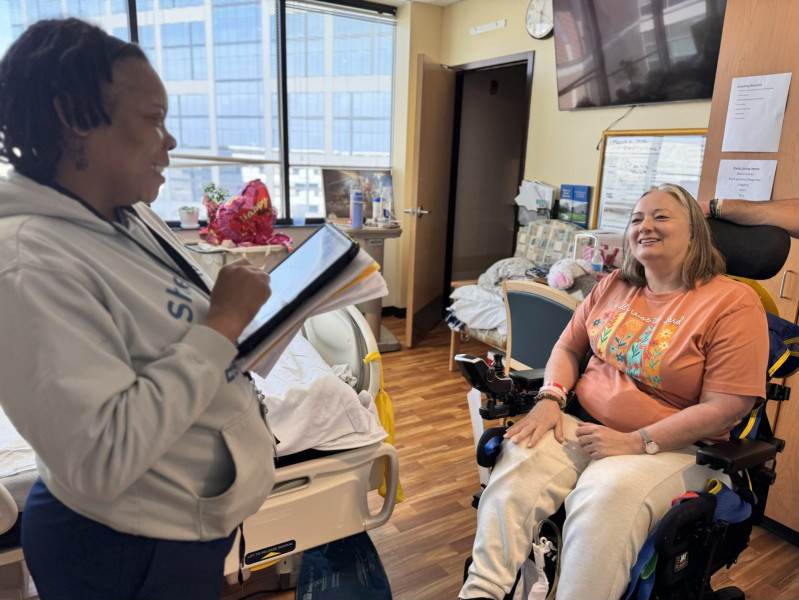 Stuart jokingly tells McCoy he’d like a “big ole filet mignon.”
Both Bobbie and Stuart say the food at Shepherd is quite good. When he heads back to family housing for the night, Stuart says he often grabs meals in the cafeteria rather than stopping at a restaurant.
Bobbie shows off a piece of chocolate layer cake from the cafeteria and marvels at its size.
They all agree the desserts are good. But when McCoy reads red velvet cake off the menu, Stuart says “yes,” and Bobbie responds with a laugh and an emphatic “no!”
It turns out it’s not the hospital’s red velvet that Bobbie objects to, but red velvet in general. Stuart explains that his mom used to make red velvet cake often and “burned [Bobbie] out on it 30 years ago.”
The Ingrams mention that they might eat some meals in the cafeteria, so McCoy explains how meal tickets work. Patients can opt to eat in the cafeteria rather than have a tray delivered to their room. To help them remember the schedule, McCoy circles the meals they plan to use meal tickets for on a paper calendar.
In another room, a patient says he plans to go to the cafeteria for dinner. “I like to go down there. Makes me feel normal,” he explains.
One patient just had some teeth pulled, so he’s thinking of the soft foods he can eat. McCoy suggests eggs or grits, but when he seems uncertain, she says she’ll check with the dietitians for some additional options.
Still another person is looking for protein-rich options — McCoy makes some suggestions, and he decides on eggs and breakfast sausage. He confesses he doesn’t usually eat breakfast, but he’s going to try his best. She enters his order into her tablet.
For many patients, McCoy already knows what they order most often, and all of them seem happy to see her. And the feeling is mutual — she says her favorite part of her role is interacting with patients.
“You see a lot of different things, and … it makes the job fun because I'm able to interact with them, and they tell me stories, and I'm laughing and talking. It's very fun.”
And she’s happy to deliver a little cheer, even before the meals arrive.
“They go through a lot, so food pretty much brightens up their day.”
Made to Order — and Delivered
Once the orders are in and the food is prepared, it’s time to start a tray line to assemble the order for delivery.
Food service aide Maddy Gonzalez likes to keep her workspace in the Shepherd Center kitchen just so. When her shift begins, she meticulously arranges everything she’ll need in the station in front of her and on the racks behind her — containers of fruit, cups of iced tea and lemonade, packets of salt and pepper, condiments, napkins, thickeners for liquids.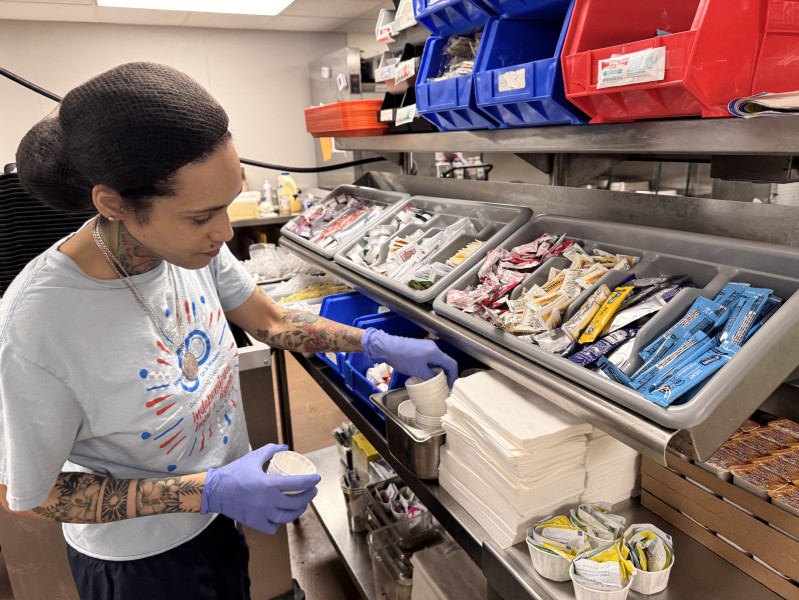
For most of her shifts, her role is “caller.” Beginning with a stack of printed orders, she’s the first stop in preparing all the trays for patient meals — from choosing the right color tray — yellow for swallowing precautions, orange for testing (for patients who are testing foods with different textures under the supervision of a speech-language pathologist), and black for everyone else — to heating the plate warmers to ensure patients get a hot meal.
She looks at the first order, chooses the appropriate color tray, and adds cold items the patient requested — like a fruit cup and a glass of lemonade, pudding, cookies, along with napkins, silverware, condiments, salt, and pepper. Then she adds a hot plate warmer, double-checks the tray to make sure she hasn’t missed anything, and puts it on the conveyor belt for other team members to add hot entrees and sides, check it again, and transfer the tray to a rack. There, her supervisor checks the trays a third time to ensure each order is correct.
Once Gonzalez completes the last ticket, she transfers all the trays for a floor to an insulated rack, working in reverse order by rooms, so her last delivery goes in first. She rolls the tall rack out of the kitchen, looking around the side to navigate as she goes, and heads to one of the floors with patient rooms to deliver the meals.
She chats with patients who are in their rooms, but many are not back from therapy yet, so she leaves the trays on their tables. One room is empty, and it looks like the patient was discharged, so she makes a note to double-check in case they’ve just moved to another room.
Once she’s delivered the last tray, she heads back down to the kitchen to prepare some more. She’ll return to the floor after lunch to collect the trays and enjoy another opportunity to interact with patients.
She loves “cutting up with them,” she says, and “just being a help. That makes me feel good. Just to make other people smile.”
Written by Ruth Underwood
With five decades of experience, Shepherd Center provides world-class clinical care, research, and family support for people experiencing the most complex conditions, including spinal cord and brain injuries, multi-trauma, traumatic amputations, stroke, multiple sclerosis, and pain. An elite center ranked by U.S. News as one of the nation’s top hospitals for rehabilitation, Shepherd Center is also recognized as both Spinal Cord Injury and Traumatic Brain Injury Model Systems. Shepherd Center treats thousands of patients annually with unmatched expertise and unwavering compassion to help them begin again.