


From Idea to Innovation
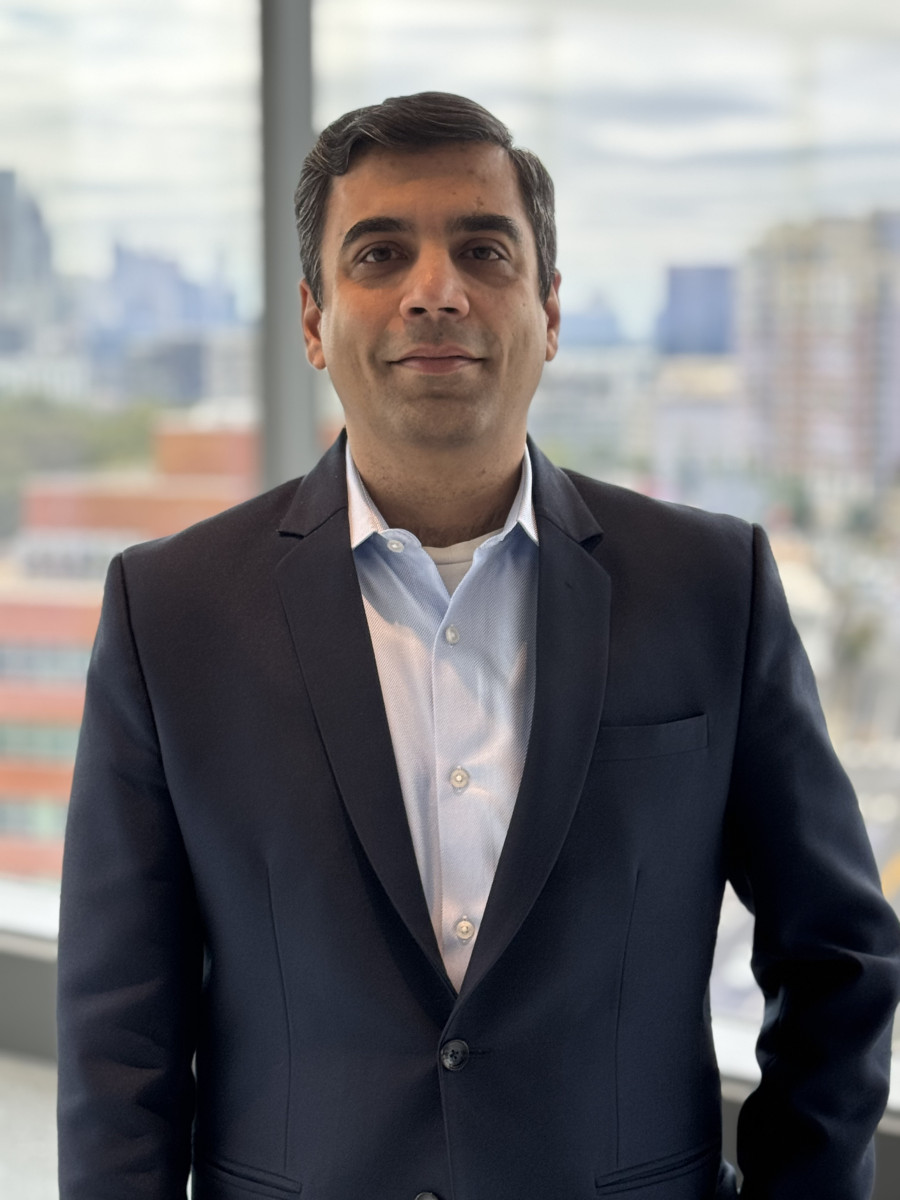
In addition to providing world-class care for people living with neurological injuries and conditions, Shepherd Center also has a robust research and innovation program that aims to push the boundaries of what’s possible, improving the quality of life for people with disabilities at Shepherd and beyond. Hitesh Mehta, M.D., M.Tech, Ph.D., joined Shepherd Center in the spring as director of innovation and translation. We talked to him about fostering innovation at Shepherd and what drew him to the role.
What is your role at Shepherd Center?
My role is to take technologies and bring them to patients. Now, that could be technologies that we are building in-house here from our research, or from our clinicians who are thinking differently, or our patients as well. … And it's not only technology, it could be small things like changes to workflow. My role is to see that and see if we can bring it, not just to Shepherd Center, but to others as well — to see how you can make it more adopted worldwide. So that is a key role, but there's also an element in the other direction, which is, if there are technologies that have been developed for other reasons, can we bring them into rehabilitation and use them for our patients to help them.
What made you want to work at Shepherd Center?
Time is of the essence in rehab medicine. And Shepherd does it so well that they bring patients while in the ICU. So, that's kind of what got me — it’s the only hospital that brings patients early on in the ICU and helps patients [through early rehabilitation]. And innovation is about timing … taking that little extra effort while there are so many unknowns and doing it early on.
Your title is director of innovation and translation. Tell us about how you define innovation.
An idea is a “what-if” condition, an abstract thought. It's a concept. … An invention is when you enable it, you create a prototype or a solution, a method where now that “what if” is “what.” It is an asset. Someone can replicate or reproduce it and see it work. … But innovation is really the acceptance of it in the market where you have scaled it, the doctors, the hospitals are using it. … It has become an ecosystem. There is competition growing along with it.
Sometimes commercialization is frowned upon because you're trying to make it revenue-generating. But that is what drives technologies into systems. If you make it free, no one gets interested, and it doesn't actually get implemented or scaled. So, we do need to realize that part: innovation needs some level of support from the capitalist side of the system [to increase its chances of being implemented.]
What is the process of moving from idea to innovation?
Going from an idea to innovation has a lot of unknowns. These unknowns bring in risk, so it is inherently risky. And these risks cannot be removed. So, what do you do? To overcome the risk, you have to treat innovation as a process. And what that means really is you want to fail fast and build the right mindset. So, if you fail fast and you have the right mindset, you can innovate again and again or create new technologies as you move forward. … It’s not an inbuilt talent; it’s something that you can learn and do, a skill you can adopt … if you treat it as a process.
How does the innovation program support innovation at Shepherd Center?
In three ways: we are a catalyst, a connector, and a facilitator. A catalyst, in the sense that if you have the idea, we can work with you to refine what that opportunity is, understand what the feasibility is, and create the solution to move forward. As a connector, if we identify those risks, can we get experts to help us overcome those risks? Maybe it's clinical, operational, regulatory, whoever that expert is, can he or she help us in facilitating from that idea to innovation? And finally, as a facilitator, it means getting the financial resources … guiding you through that end journey. … which can be a license or a startup. So, help in those parts. Innovation is actually an adoption. It could be in the form that it gets adopted here in the hospital itself, or outside the hospital. ... So, we want to broaden the scope, not just in research, but other places and implement it in clinical paths.
What are you most excited about in your new role?
I like technology, tinkering, and doing it. So, I like playing, and that's what is most exciting, bringing these different, out-of-this-world solutions. … I think that's the cool part — having these technologies and being able to play with them, and ... being able to get them here at Shepherd to help our patients.
What is the most fulfilling part of your role?
I [trained as] a physician academically, then I got into engineering. The goal was to help more patients, and how could I help do more, versus treating one patient at a time? So that's why I went into research and engineering. … The fulfilling part is helping patients, seeing them improve in whichever way [they] can.
Education:
Hitesh Mehta possesses a rare interdisciplinary background bridging medicine and advanced engineering. He earned his Bachelor of Medicine and Bachelor of Surgery (M.B.B.S.) — equivalent to a Doctor of Medicine (M.D.) and license as a family physician from Seth G.S. Medical College, Mumbai, India. He then completed a Master of Technology (M.Tech.) in Biomedical Engineering at the Indian Institute of Technology (IIT) Bombay, followed by a Ph.D. in Biomedical Engineering from the University of Minnesota.
Fun Facts:
- Dr. Mehta has four siblings who live in various countries around the world.
- He and his wife, Vandana Ranka, recently moved from Cleveland to Atlanta.
- He likes to snow ski.
- Dr. Mehta likes to travel, and now that he lives in Atlanta (a gateway to the world), he’d like to travel south of the equator.
Responses have been edited for length and clarity.
Interview by Ruth Underwood
With five decades of experience, Shepherd Center provides world-class clinical care, research, and family support for people experiencing the most complex conditions, including spinal cord and brain injuries, multi-trauma, traumatic amputations, stroke, multiple sclerosis, and pain. An elite center ranked by U.S. News as one of the nation’s top hospitals for rehabilitation, Shepherd Center is also recognized as both Spinal Cord Injury and Traumatic Brain Injury Model Systems. Shepherd Center treats thousands of patients annually with unmatched expertise and unwavering compassion to help them begin again.