


Tackling the Beast
In recognition of Spinal Cord Injury Awareness Month this September, Deontae “Tae” Davis let us tag along on a physical therapy session to see what he’s learning.
Deontae Davis, who goes by Tae, rolls into Shepherd Center's Spinal Cord Injury Day Program gym with a smile on his face and the gift of gab. He chats with other patients while he waits for his physical therapy session to begin.
The 23-year-old from Montgomery, Alabama, is in his second week of the day program after completing 10 weeks of therapy in the inpatient Spinal Cord Injury Rehabilitation Program.
Today, he’s working with physical therapist Heather Jones, DPT, on transfers. First, they tackle transferring from his wheelchair to the floor and back again.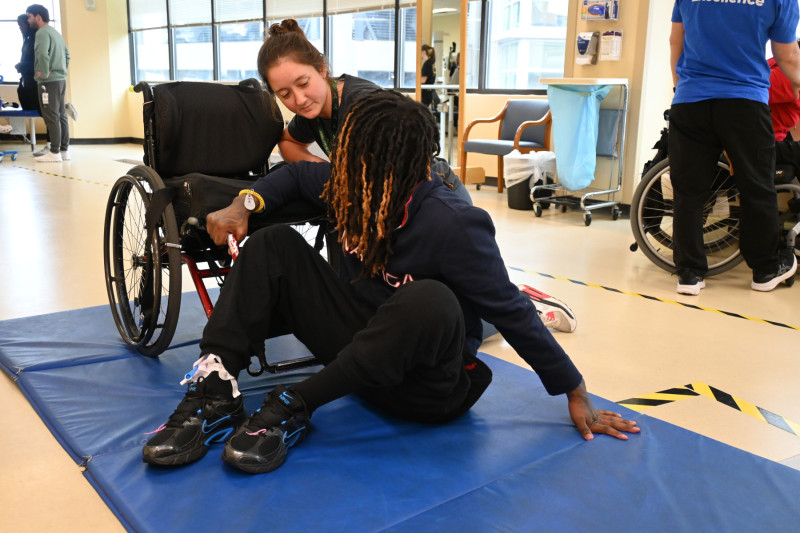
Tae starts by rolling his wheelchair onto a mat, then scoots forward in his chair, holds onto the side, and lowers himself to the floor. Of course, there’s a lot more to it than that. He has to position his feet and legs just right, and as Heather reminds him, he can’t forget the number-one rule, “Don’t let go [of the wheelchair] with your right arm.”
Heather helps Tae think through the process and adjust his foot position to see whether one position makes the transfers easier than another.
“There are a lot of different ways you can set up, so it’s figuring out what's best for each person,” Heather says.
They try again.
“Did that feel easier?” Heather asks.
“It was way better,” declares Tae. “I ain't gonna lie to you — it was way better. I was able to get my arm up faster. I didn’t like the other way we did it before. I couldn't get my arm up quick enough.”
They talk through what worked and what Tae might want to adjust. Tae suggests moving his feet even farther out for an easier lift, but Heather cautions that his legs could get caught on the chair if they’re positioned that way.
He tries again but loses his balance. Heather stops him before he falls. He is unfazed.
“I had launched myself so far. I had to catch myself with my left hand. I was gonna fall hard on my bootie,” he laughs.
Heather gives him a few more tips on positioning, and he repeats the process several more times, transferring smoothly to the floor.
Nailed it.
Tae says he started practicing transfers during his inpatient therapy, but in the day program, “they give me a more advanced way to do it.”
“We worked a lot in the beginning on the technique for his depression transfers (transfers without using a slide board). Really understanding how to use your shoulder blades to get extra lift. Once he understood that, his depression transfers just skyrocketed in how much better they got.”
Since both Tae and Heather are satisfied with his technique for floor transfers, Tae is up for another challenge: transferring into an SUV, so they head to the parking deck.
On his way out of the gym, another patient calls out to greet him, and they check in on each other.
As he rolls down the hall, Tae mentions his yoga class from the previous day.
“Man, I ain't gonna lie, I was so sore from yoga yesterday. I woke up, I thought I was old,” he jokes. “Oh, I did a good job, though, yesterday. I'm very flexible.”
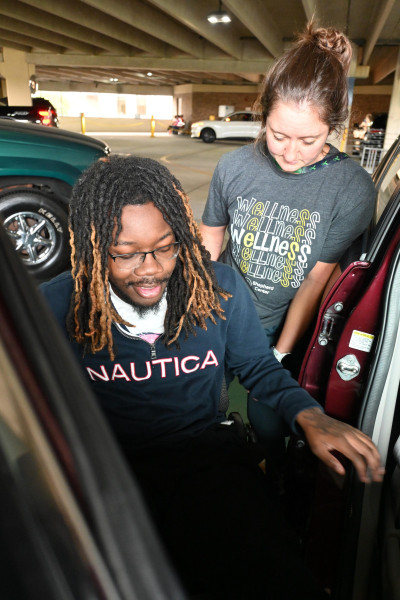 When they reach Shepherd Center’s parking deck, Heather points Tae to a mid-size SUV that’s designated for practicing transfers. Tae has already conquered transfers into and out of the sedan parked beside it.
“Ooh, SUV,” he says, clearly ready for the challenge.
“So, there are a bunch of different ways you can do this,” Heather explains. “Like a floor transfer, we have to figure out what ways are gonna work best for you.”
Heather talks him through the process, with suggestions on where to position his feet, hands, body, and wheelchair for a smooth transfer. Again, she allows Tae to problem-solve, since she will not be there to coach him when he goes home — and every situation will be different.
“As long as it's safe and it's not dangerous, we'll try just about any method they want,” she says. “I'll let them try stuff, and then I'll give my feedback, like, ‘Okay, this is how we can make this better and more successful.’”
“He also really likes transfers,” she adds, “so if I didn’t slow him down…”
Tae does a great job on his first try. While he practices, he suggests that he should’ve been a movie star — and insists that he makes everybody laugh, which seems likely. He’d like to make videos showing others how to do everything he’s learning in rehabilitation.
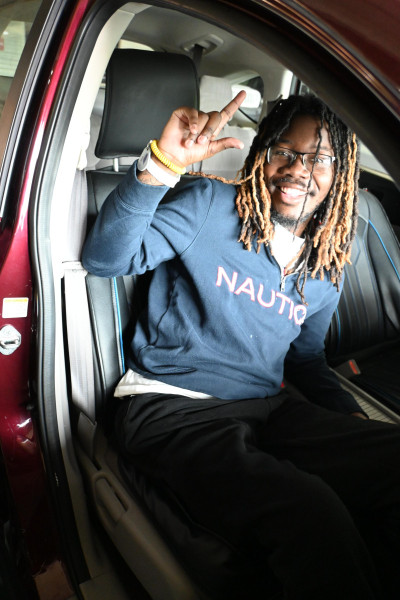 “I can teach people how to do it the right way, instead of doing it the wrong way,” he says. “So, when I get this down pat, it helps me build confidence on, okay, I can go on TikTok and show them this, show them that without messing up, and that makes me happy…. I’m gonna do a little skit. I'm like, ‘Hey, it's my everyday life. You’re living with Tae.’”
Tae makes short work of the mid-size SUV and declares the transfers “easy,” so they decide he’s ready for “the beast” — a Yukon Denali that looks like it hasn’t moved from its spot in years.
The height of the Denali’s seat definitely makes things more difficult, but Tae is undaunted.
“He's making this look really easy,” Heather says. “It's not an easy transfer.”
“I found the technique,” Tae explains, “It's really technique, for real, with everything…. You do need a little upper strength, I can tell you that. But, hey, technique is all that’s key.”
“That makes this PT's heart very happy,” says Heather. “Strength is great, but technique is key.”
Written by Ruth Underwood
With five decades of experience, Shepherd Center provides world-class clinical care, research, and family support for people experiencing the most complex conditions, including spinal cord and brain injuries, multi-trauma, traumatic amputations, stroke, multiple sclerosis, and pain. An elite center ranked by U.S. News as one of the nation’s top hospitals for rehabilitation, Shepherd Center is also recognized as both Spinal Cord Injury and Traumatic Brain Injury Model Systems. Shepherd Center treats thousands of patients annually with unmatched expertise and unwavering compassion to help them begin again.