


‘Profoundly Rewarding’
A Shepherd Center speech-language pathologist on putting the puzzle pieces together.
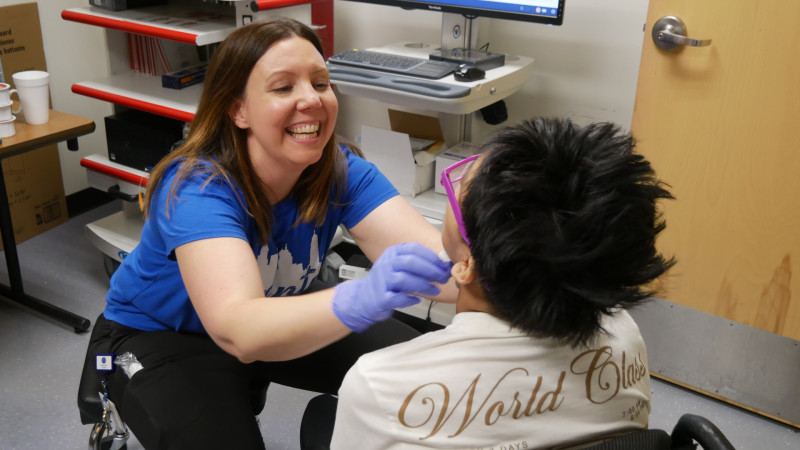
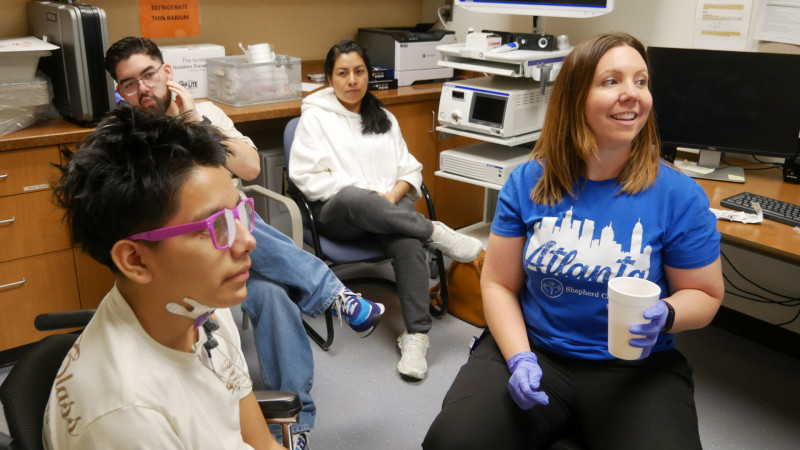
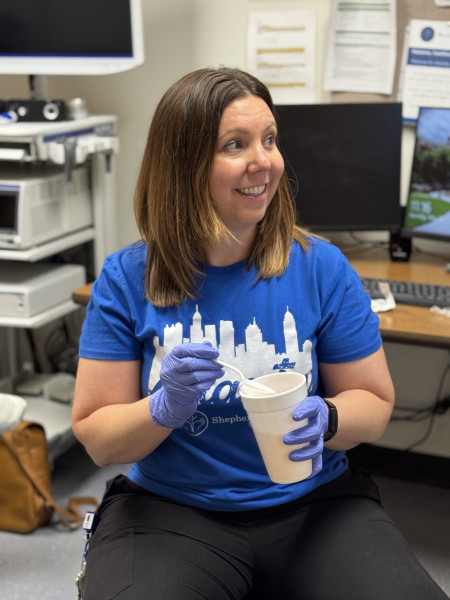
Melissa Kast, MA, CCC-SLP, CBIS, has worked at Shepherd Center for 12 years. As a speech-language pathologist (SLP) in the inpatient Brain Injury Rehabilitation Program, she works with patients on everything from regaining their swallow to problem-solving and executive function. Though people often think of speech therapy as all about talking, Kast explains that speech itself is only one small piece of an intricate puzzle that SLPs work to solve for each patient. She shared a glimpse of what SLPs at Shepherd Center do by explaining the focus areas they work on with patients.
On Cognition
Cognition is a big bucket for us, especially in the brain injury realm, but across the board, speech pathologists work on cognition. It doesn't matter where in the center you are; you may have to address cognitive challenges. There are even certain medications that can impact your cognition.
When it comes to cognition, the main areas we address are attention, memory, problem-solving, and executive functioning.
Attention is something that's really important for pretty much any task. A patient may grapple with questions like:
· “Can I stay focused on a task?”
· “Can I stay focused when there's distraction around me?”
· “Can I do more than one task at the same time?”
· “Can I switch back and forth between more than one task?”
For some of our patients, it's as simple as, “Can I stay focused on the conversation that's happening in front of me and answer some very basic questions about myself?” For others, it's really high-level and we're doing things like, “We're going to start your load of laundry today, and then partway through our task, we're going to have to remember to come back and work on it.”
And then there's a memory component for our patients as well. So, for some of them it's again as simple as:
· “Do I know where I am?”
· “Do I know who I am?”
· “Do I know who my family is?”
And for others, it’s, “I am trying to keep track of five different appointments today. And I'm going to try to do it without writing it down, or I'm going to write it down, and can I keep track of all those written things, follow my schedule, and remember that I have more than one thing going on today?” Because that's real life, right?
Then we also have a lot to do with problem-solving, and executive functioning comes in there because it has to do with decision-making, judgment, reasoning, and safety. Some of our brain injury patients really struggle with noticing, “Hey, my life is not the same as it was before.” So, you do a lot of activities to help them gain that awareness of, “You know what, I'm not thinking the way I was before, or my problem solving isn't as good, or my attention isn't as good. And I need to use strategies like double-checking myself when I’ve completed a task,” or “I'm a little impulsive with decisions, so I need to stop and write down all the steps that I need to make sure happen before I make a decision related to XY or Z…”
Working through all of those components on a daily basis is critical for getting patients back to doing all the things that they really want to do.
On Swallowing
Swallowing is so important because it affects the quality of life for our patients. So much of what we do is based around food in our culture. So, we’re finding ways to bring our patients together, have that socialization with their families, with other patients, but also to keep them safe along the way.
When it comes to swallowing, we do a couple of different testing measures that are really interesting. We do the Modified Barium Swallow Study, which is an X-ray of the swallow, and we do the Flexible Endoscopic Evaluation of Swallowing, which is where you pass a camera through the nose to look down and see the swallow from the inside. Both give us a good idea of what's going on for our patients and good tools to determine how to treat what's not going well. So maybe they're aspirating because the timing of their swallow is off, or the overall strength of their swallow is not good, or some specific structures are not working in the way that they need to, and we target those specifically.
On Speech
There are a lot of motor aspects related to your speech and how your brain and your muscles communicate, particularly via nerves. So, there are motor planning problems — “Can my brain and my muscles actually come together and make the word that I'm trying to make?” Sometimes it leads to groping behaviors — that's apraxia. I may know what I want to say, but I can't get my muscles into the right space.
The other thing we see a lot, particularly with strokes or other nerve-related facial injuries, is another motor speech disorder called dysarthria, which is where you've got a lot of slurred speech or imprecise pronunciation. Maybe the tongue can't get to the right place to articulate the sound, or it's very weak. Our tongue is one of our main articulators, so if your tongue isn't moving or isn't moving as it should, you’re probably not going to be able to make speech that is intelligible to most listeners around you. So, when we have those situations, we're going to be working a ton on the actual muscle movement.
Because apraxia is a coordination-related deficit, if we're having significant difficulty, we’re going to supplement their communication with an augmentative communication option — so if they're writing, some of them may choose to write, and if it's legible, then it's great. For others, it's about giving them high-tech options, so they may want to use their phone to communicate… Other patients use eye gaze technology. We work a lot with our access tech OTs (occupational therapists) to find those access options. But then speech pathology will create the language structure or the keyboard options, or other things like that, to help patients better communicate in those situations.
So, it's teaching all of those different options, working through the ones that are going to work best for that patient, and also creating opportunities and even fun motivation for patients to use their communication skills — for one patient, it was the chance to talk trash to his siblings while playing cards.
On Language
Some of our patients experience difficulty with their language. This is called aphasia. Patients who have strokes and other brain injuries can lose expressive or receptive language capabilities. So, our words may sound very much like a foreign language to them. They can't figure out what we're asking them unless we supplement it with something visual to help them.
The role of the speech-language pathologist in that realm is figuring out exactly where the impairment is, drilling into what we have success with … and then finding ways to help them express whatever is going on if they're not able to come up with the right words at that moment.
So, augmentative communication becomes a piece of that for some patients if they're having trouble with expression, but that implies that they can understand what we're asking, and for some of our patients, that's not the case. So then we're also trying to drill down and find the ways that they can understand — maybe it's use of pictures, maybe it's use of gestures, maybe it's showing them what we're asking them to do — and it's finding strategies to help the overall rehab process with that communication, to help our PTs, our OTs and our nursing staff be able to find ways to successfully communicate with that patient so that they can get the information that they may need. And then training family members to help them be successful as they're working towards communicating with their loved one, however that might look.
Reading and writing fall into that language realm as well. Sometimes, if you say the word to a patient, they may not understand, but if you put the word in front of them, they may have a better understanding by being able to read it, or being able to express a little bit better through writing, than being able to actually say it.
On Voice
One other bucket our outpatient and spinal cord injury therapists hit, probably a little bit more than our inpatient brain injury therapists, is voice. Voice is an important aspect of what we treat because it gives people the ability to communicate their wants and their needs and to do it in a way that they feel is effective — because if they feel people are distracted by the way they sound, then they're likely not going to want to communicate as often. Voice following tracheostomy is one aspect of voice that we all treat. Tolerance of one-way speaking valves and respiratory drive for voice are important aspects of voice that we frequently treat.
Bringing it All Together
There are a few things that will get me really close to happy tears. One, getting a patient eating a regular diet and watching them eat the food they want to eat, that's been their goal. Two, getting a patient who hasn't been able to say anything, the ability to communicate something. Whatever that word is — getting those first words out and being there to be a part of that, is one of the things that will, hands down, make my day amazing. Three, getting a note from a former patient telling me about the amazing things that they're doing now. I got an e-mail from a mom a couple of weeks ago about one of my former patients who's graduating high school — it made my day to see that he's come so far and done so well. And then hearing about other life changes. I have other patients who will follow up — they're getting married, having their first kids, all of those kinds of things, and that I get to be a part of that on some level is just profoundly rewarding. Or, you know, other patients who e-mail me on anniversaries for the day I gave them a pancake for the first time since their injury or something like that. The fact that they even remember that reminds me of just how humbled I am that I get to be a part of that journey for them, and just how profoundly amazing it is to get that opportunity on a daily basis to be in someone's life at that moment that feels really pivotal to them.
Interview by Ruth Underwood
With five decades of experience, Shepherd Center provides world-class clinical care, research, and family support for people experiencing the most complex conditions, including spinal cord and brain injuries, multi-trauma, traumatic amputations, stroke, multiple sclerosis, and pain. An elite center ranked by U.S. News as one of the nation’s top hospitals for rehabilitation, Shepherd Center is also recognized as both Spinal Cord Injury and Traumatic Brain Injury Model Systems. Shepherd Center treats thousands of patients annually with unmatched expertise and unwavering compassion to help them begin again.