


Shepherd Center Launches Chaplaincy Fellowship
Shepherd’s long-standing chaplaincy program expands
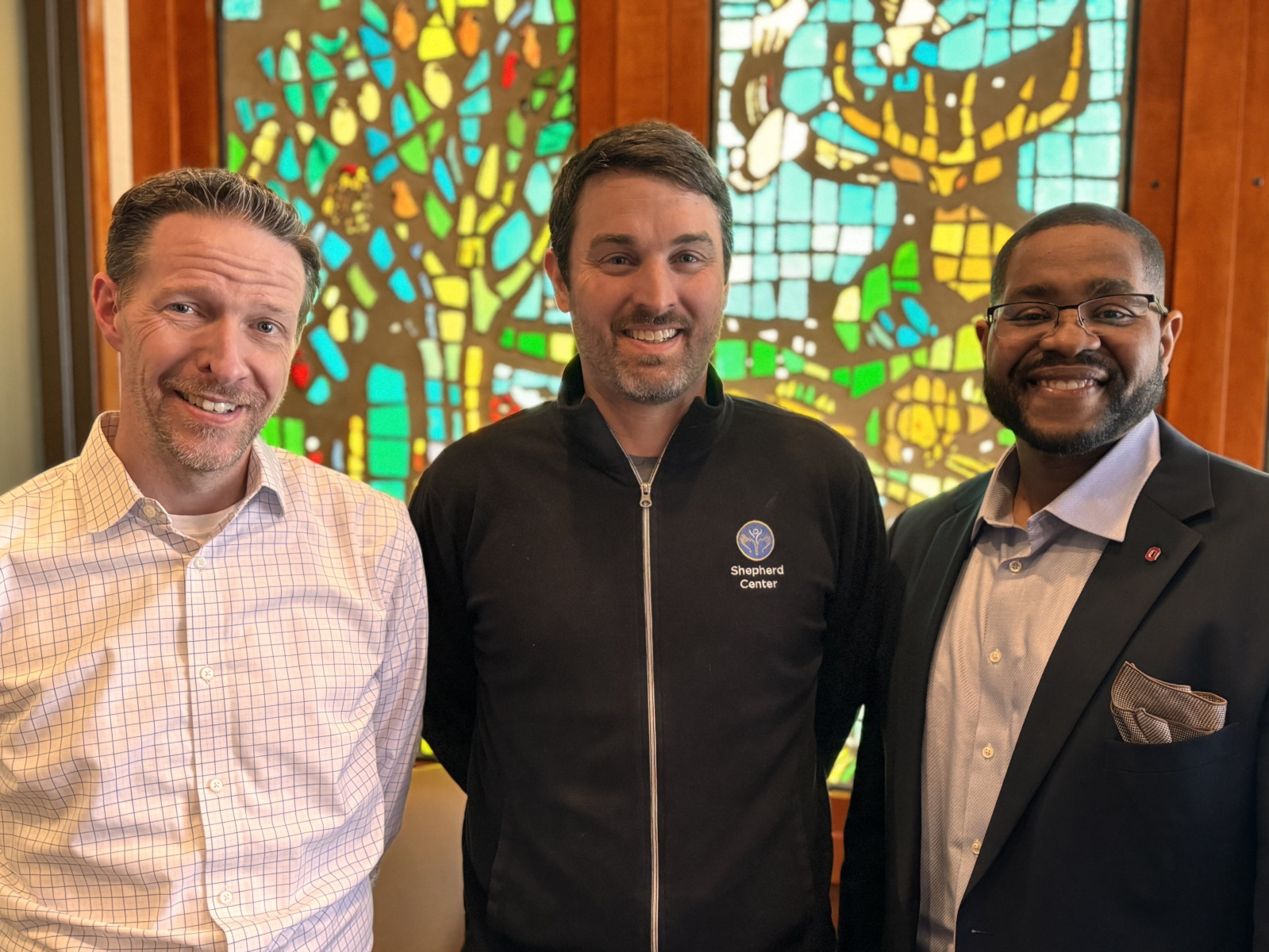
Jasyn Banks, MA, M.Div., is the newest member of the Larry L. Prince Chaplaincy Program at Shepherd Center — and the hospital’s first chaplain fellow. He joins chaplains Ben Rose, M.Div., BCC, and Dave Wethington, MA, BCC, and is working to become a board-certified chaplain.
“These guys [Rose and Wethington] are rock stars. I'm constantly in awe. I'm learning a lot because spinal cord and brain injury is a world unto itself, and … they've been awesome. They’ve allowed me to get in the baby pool first with the little paddlers on my arms before they push me out into the deep end,” says Banks, who earned his master’s in religious studies at Georgia State University and his master’s in divinity at Mercer University’s McAfee School of Theology in Atlanta.
New Growth, Deep Roots
Although the fellowship is new, chaplaincy has played a vital role in patient care at Shepherd Center since soon after its founding in 1975. And in the past several years, as the hospital began planning to grow — adding new buildings and more patient beds — Wethington realized the chaplaincy program needed to grow along with it.
“People embrace chaplaincy,” he says. “We provide spiritual support to patients, families, and staff of all different faiths and backgrounds. It doesn't mean that we're able to meet the exact needs of that patient or family if they're of a different religion than us.
“However, if we can't, we have connections with outside clergy who can come in [to perform certain rites]. And a lot of what we talk about here at Shepherd Center is not just spiritual and religious — it's the meaning, the purpose, the existential. This just happened. This brain injury happened. This spinal cord injury happened. How am I supposed to move forward?”
Wethington, once a patient at Shepherd himself after he sustained a brain injury during surgery to remove a tumor, knows just what it is like to wonder how to move forward. He credits Alan Roof, Shepherd’s chaplain at the time, with helping him find meaning and purpose.
Filling a Need
Both Rose and Wethington, who have served as chaplains at Shepherd for 15 and five years, respectively, are board-certified, a credential that requires the completion of 2,000 hours of work in a healthcare setting after completing their residency. But getting that many hours of on-the-job experience can be challenging.
“It’s a catch-22,” Wethington explains. “You can't get board-certified unless you get a job somewhere. You can't get a job somewhere unless you're board-certified. And around and around we go. And so a lot of people who are probably good chaplain candidates, they get lost.”
Through his connections with the Association of Professional Chaplains, one of the two main certifying organizations in chaplaincy, Wethington has mentored many future chaplains — most of whom are cobbling together hours working PPN (as-needed) at various healthcare facilities. But while that patchwork of jobs can offer a variety of experiences, it can make accumulating the necessary hours very difficult, and Wethington says it doesn’t provide the same opportunities for growth and mentorship that working consistently at one hospital might offer.
And that gave Wethington, who is passionate about seeing chaplains grow in their roles, an idea — a chaplaincy fellowship at Shepherd. Fellowships in chaplaincy are rare, and offering one at Shepherd would enable the hospital to hire an additional chaplain and provide a candidate for board certification the opportunity to complete hours, gain experience, and get to know Shepherd and the hospital’s patient community.
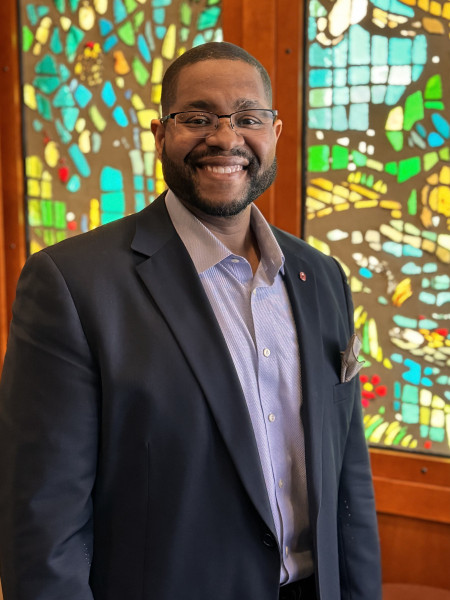 Enter Jasyn Banks.
Banks completed his residency at the Atlanta VA Medical Center and at Fort McPherson, working with veterans in the areas of moral injury, mental health, palliative care, and drug rehabilitation. When he heard from his own pastor that Shepherd was offering a fellowship, he knew he had to throw his hat into the ring.
“It's a pretty awesome environment,” he says, “I think that's also a testament to how great Shepherd is because, in healthcare, it's a trickle-down effect. You know, attitude really plays a big part for patients. I think it also affects their healing while they're here.”
Supporting Patients, Families, and Staff
As Shepherd’s first fellow, Banks is already fulfilling the program’s fundamental goal — supporting Shepherd patients during their rehabilitation journey — and contributing to what makes Shepherd, Shepherd.
“You're a lot like a Swiss Army knife because you're not just helping the patient, you're helping the families, and you're helping the staff,” Banks says. “And so that's a different dynamic in each situation. What you're doing for the person in the bed is not the same as for the parent who's trying to understand, ‘What happened, and when is this going to be better?’ They're adapting to their new normal. … Everybody's at different places at different times.”
Wethington hopes the innovative two-year fellowship program can serve as a model for other healthcare systems and perhaps increase the chaplaincy pipeline even beyond Shepherd. Collectively, it’s already allowing the chaplaincy team to spend more time with patients and their families.
“[Chaplaincy is] like recreation therapy and all the other services we offer here beyond PT, OT, and speech. What else is meaningful to our patient population that's going to help them find hope, meaning, purpose, as they move on from here? And whether it's in their recreational activities, whether it's in their spiritual activities, whether it's in something else,” Wethington says, “[Helping them find that meaning is] the hope and the goal.”
With five decades of experience, Shepherd Center provides world-class clinical care, research, and family support for people experiencing the most complex conditions, including spinal cord and brain injuries, multi-trauma, traumatic amputations, stroke, multiple sclerosis, and pain. An elite center ranked by U.S. News as one of the nation’s top hospitals for rehabilitation, Shepherd Center is also recognized as both Spinal Cord Injury and Traumatic Brain Injury Model Systems. Shepherd Center treats thousands of patients annually with unmatched expertise and unwavering compassion to help them begin again.