


Reflections on Life After Stroke
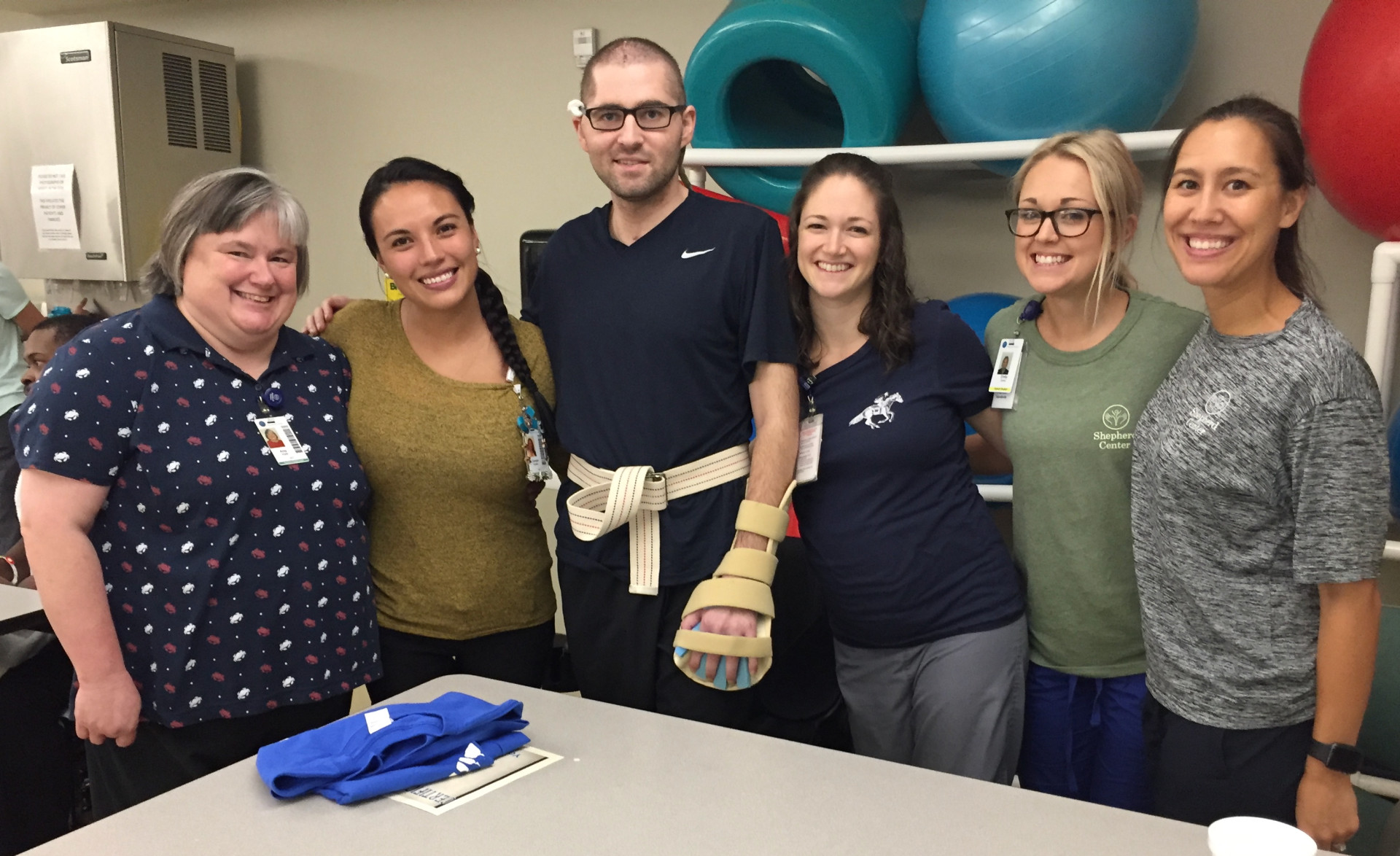
David Tillem had a stroke when he was just 30 years old. He participated in inpatient rehabilitation at Shepherd Center, followed by outpatient care at Shepherd Pathways and later therapy closer to home. Now, seven years later, he has started a Substack, “The Second First Step,” in which he reflects on how the stroke and rehabilitation at Shepherd Center changed his perspective.
With his permission, we’re sharing two of David’s Substack entries below. He said he is glad that sharing his experiences might help someone else.
The 40-Year-Old Head Start: Why My Stroke Was an Unfair Advantage
April 13, 2026
I’ve never been much for big birthday celebrations. Usually, they feel like arbitrary markers on a timeline I’m too busy living to scrutinize. But as my 38th birthday appears on the horizon, the gravity of 40 has started to pull at me. It’s that age people approach with a specific cocktail of dread and apprehension—the supposed peak of the hill where the climb ends, and the steep, accelerated descent begins.
Most men my age are just now starting to worry about their knees clicking when they stand up or their son finally beating them in a foot race. They are bracing for a midlife transition they feel entirely unequipped for. They look at the coming decade as a loss of agency, a slow-motion surrender of the vitality they took for granted in their twenties. But as I sat with that collective anxiety, I realized something unexpected: I’ve already been there. In fact, I’ve been living in that “next stage” for years.
When I was 30, my stroke thrust the physical and mental reality of aging upon me with absolutely no warning. There was no gradual decline, no slow fading of abilities. It was a pattern interrupt of the highest order. Overnight, the invincible version of myself was retired. Bending down to pick something up was no longer a given; getting back up was a calculated victory. My vision blurred, and for a long time, the simple independence of driving a car was a distant dream. I was a young man trapped in a body that had suddenly skipped multiple decades of wear and tear.
At the time, it felt like my life had been reset, similar to a massive construction project being suddenly demolished just before completion. I watched from the sidelines as my peers were still sprinting uphill, hitting career milestones and physical peaks. Meanwhile, I was forced to restart the foundation from scratch. I had to double down on occupational and physical therapy, treating my recovery like a grueling full-time job. I learned the humbling language of incremental progress—the kind of patience most people don’t have to face until their seventies.
But here is the “uncomfortable truth” I’ve discovered: that trauma gave me an unfair advantage. While others are just now packing their bags for the challenges of getting older, I am already well-equipped and incredibly prepared for that “second first step”. When that first colonoscopy rolls around, that procedure will be child’s play to me, who has had two open heart surgeries and was once a frequent flier around the Atlanta hospital system. I skipped the “uncomfortable part of life” where you slowly realize you aren’t invincible because that realization was forced on me in an instant. I have already mourned the loss of my “peak” self, and in that mourning, I found a much more resilient version of who I am.
By reframing this through a positive lens, I’ve gained a wealth of experience in handling the “tricky situations” that leave other dads reeling. I know what it’s like to lose control and, more importantly, I know how to claw it back. I’ve learned that recovery, like life, isn’t a straight line and there are no autosaves. You have to show up every day with a vulnerable posture, willing to fail in order to thrive eventually. This isn’t just about physical recovery; it’s about the psychological armor you build when you’ve already seen the “worst-case scenario” and realized you’re still standing.
So, when the anxiety of forty hits my friends, I won’t join in their panic. Instead, I’ll be the one waiting for them at the top of the hill, ready to show them the way down. I’ve navigated the fog, I’ve felt the knees click, and I’ve mastered the art of the “second first step.” I’ve been there, done that—just a little earlier than I hoped, and with a lot more wisdom than I would have had otherwise. The descent doesn’t scare me; I’ve been practicing my footing for over seven years.
The "Happiest Place on Earth" Is Actually a Rehab Hospital
March 9, 2026
In the chaotic, terrifying blur right after my stroke, I was a passenger in my own life. Mentally unfit, lucid only in fits and starts, I had no say in the torrent of decisions—hospitals, doctors, insurance, therapists. My recovery plan was being charted by others.
But looking back with the crystal clarity of 20/20 hindsight, I realize how profoundly fortunate I was that the worst day of my life happened just a few miles from a sanctuary: Shepherd Center.
It’s no wonder people travel from every corner of the Earth, begging for one of the few available spots at this neuro and spinal rehabilitation facility. If you’ve done even surface-level research, you know Shepherd consistently ranks among the global elite.
But what truly inspires this post isn’t just their world-class ranking—it’s the deep debt of gratitude I owe to the people there, and the palpable, unforgettable feeling you get the moment you step inside.
The Most Optimistic Place on Earth
I’m grateful that my daily in-clinic therapy days are mostly behind me; doing rehab at home beats the Atlanta traffic. Yet, at least once a quarter, I still go to the main campus—or “Big Shepherd,” as we call it—for the Botox injections I receive to manage my spasticity and tone.
Every visit is a reminder of the atmosphere that makes this place unique.
You are instantly surrounded by huge, genuine smiles—from the person opening the parking garage gate to the sanitation staff, to the check-in person at the front desk. It honestly feels like the most optimistic place in the world.
Think about that for a moment. Nearly every patient walking those halls with their family is living through and actively overcoming one of life’s biggest, most unimaginable curveballs. They are in the belly of the beast—a hospital—yet the weight of that negativity is utterly absent. Instead, everyone there, patient and staff alike, is actively choosing to uplift and help.
It’s a bizarre comparison, but my interactions with the people there lead me to believe they might truly give Disneyland a run for its money for the title of “Happiest Place on Earth.”
Beyond the Brain Injury
The relationships I built at Shepherd—with doctors, nurses, and therapists—have extended far beyond the realm of my medical care.
From day one, these professionals saw me as a person, not just a guy with a brain injury. That fundamental respect and human connection are not just part of the care plan; they are the center’s soul. It’s the difference between merely recovering and truly beginning a new, post-stroke life. And for that, my debt to Shepherd Center is immeasurable.
Written by David Tillem, originally for his Substack, “The Second First Step.”
With five decades of experience, Shepherd Center provides world-class clinical care, research, and family support for people experiencing the most complex conditions, including spinal cord and brain injuries, multi-trauma, traumatic amputations, stroke, multiple sclerosis, and pain. An elite center ranked by U.S. News as one of the nation’s top hospitals for rehabilitation, Shepherd Center is also recognized as both Spinal Cord Injury and Traumatic Brain Injury Model Systems. Shepherd Center treats thousands of patients annually with unmatched expertise and unwavering compassion to help them begin again.