


Q&A: A Clinical Pharmacist’s Crucial Role at Shepherd Center
Kristina Carbone explains the role of clinical pharmacy at Shepherd Center and discusses the pharmacy residency program, offering valuable tips for future pharmacy students.
A vital, but sometimes hidden, component of Shepherd Center’s rehab team is the clinical pharmacy. The clinical pharmacy team plays a crucial role in patients’ recovery journeys, helping them achieve their optimal level of health. Clinical pharmacists review patients' charts to ensure they are on the appropriate medications and explore ways to optimize their medication regimens.
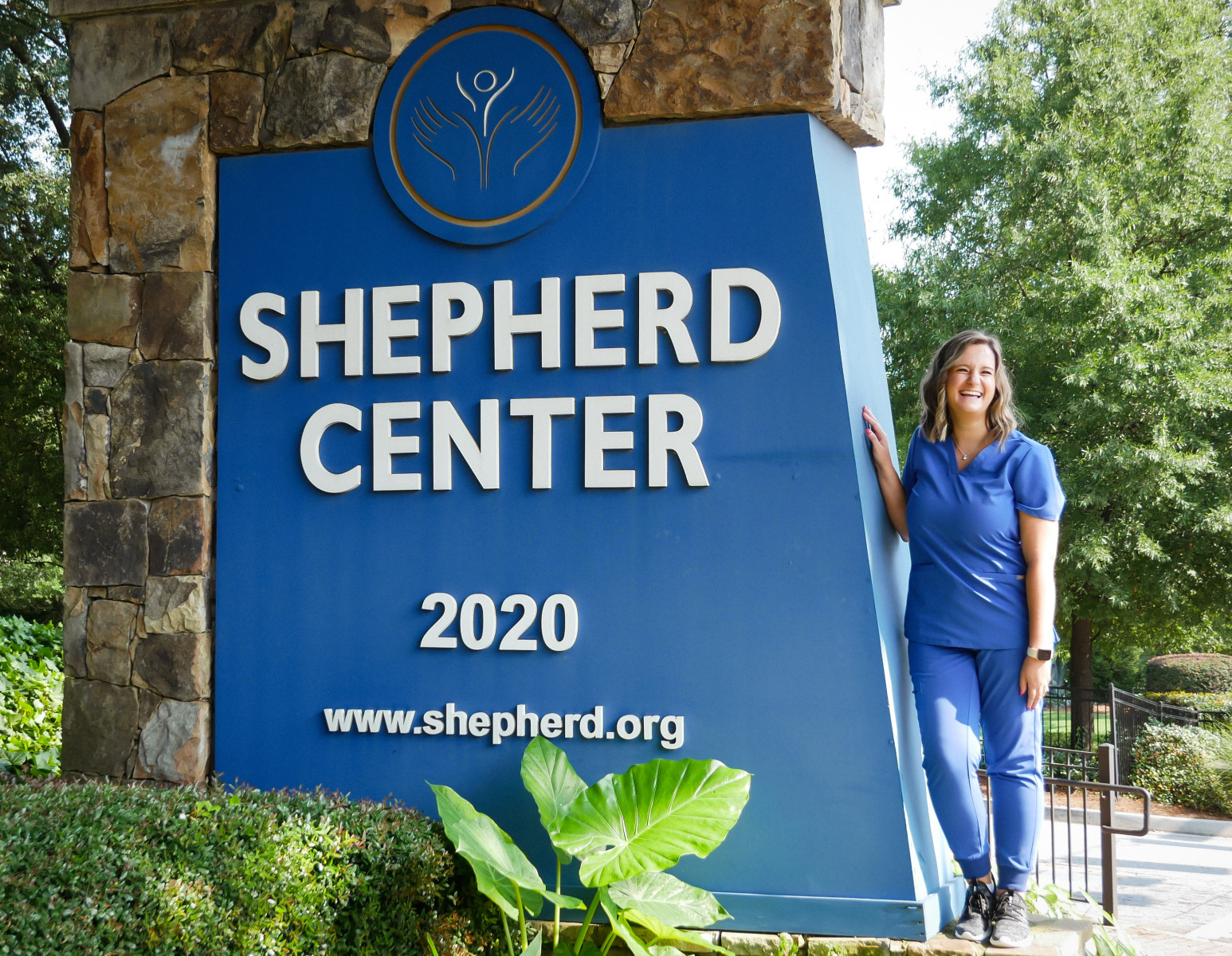
Kristina Carbone, PharmD, a clinical pharmacist, is an essential member of the team. For National Pharmacy Week, we sat down with her for a Q&A to learn more about her background and why she loves her work.
When did you first become interested in becoming a pharmacist?
It started in high school. I participated in Mercer University's Pharmacy Scholars Summer Program (PSSP), and from there, I more or less fell in love, learning about all the different parts of pharmacy. Then, as an undergrad, I started working at Kroger pharmacy and pursuing a pre-pharmacy track while attending Mercer University in Macon.
I spent my undergraduate years in Macon and then attended pharmacy school in Atlanta, both at Mercer. That's what we like to call a “double bear.”
Can you describe the difference between working at a retail pharmacy and working in clinical pharmacy at Shepherd?
So, a retail pharmacy has a focus on filling prescriptions and ensuring that there are no interactions between other medications the patients are already prescribed. It is more of an outpatient setting. Here at Shepherd, I'm more on the inpatient side. I am reviewing patients' charts to ensure they are on the appropriate medication and exploring ways to optimize their treatment plan. I'm in conversation with physicians frequently as we try to determine which medicines will best aid patients in their recovery.
Why the switch between retail pharmacy and clinical pharmacy?
Seeing the impact. You have a direct relationship with the patient. Witnessing how the recommendations you made have helped said patient. That's the unique thing about Shepherd Center that I love. Since patients are here longer than in a typical hospital setting, you can see the results of your work. You can make an intervention one week, then observe the results over the next week or throughout the entire next month to see how it has actually impacted the patient.
That's one of the things that makes working at Shepherd so unique, being a part of your patients’ recovery journey.
For anyone considering applying to Shepherd's pharmacy residency program, what can you tell us about it?
I was in the first pharmacy residency class at Shepherd. And, based on my experience, witnessing the culture here, even during my interview, seeing how close the department was and how motivated they were to get the residency started, I was impressed. Then, as you interact with everyone, seeing how personal they are and how much they care about getting to know me stood out.
Then, once I was actually at Shepherd, working in the culture I had seen in the interview, I realized it was real. It was one of the reasons that made me come back after my residency.
What are some general tips for people looking to apply to pharmacy residency programs?
The most important thing is to find a place that aligns with your interests. For example, at Shepherd, there are specific patient populations that we don't have which may be found in an acute care hospital. So, if there's something like oncology you're interested in, that is not something we specialize in. We have rotations like infectious disease, internal medicine, and cardiology.
It is very important to find areas of rotation that align with your interests. When evaluating programs, it's best to understand what rotations are offered.
What was one of your most memorable accomplishments while you were a part of Shepherd's pharmacy residency program?
I completed a medication-use evaluation (MUE), which examined our usage of a specific broad-spectrum antibiotic class to determine whether there was overuse or inappropriate use, which is a high-risk factor for developing resistance and c diff infections. I looked into whether we needed to be more restrictive. With my preceptor, we analyzed data showing that overuse was occurring with this class. We presented these findings to the antimicrobial stewardship committee (ASP) and pharmacy and therapeutic (P&T) committee.
I worked closely with ASP to establish the basis of an antimicrobial restriction policy for that class. Currently, we have an entire policy in place that was created after the completion of my residency, allowing only infectious disease doctors to order the antimicrobial class assessed in the MUE, along with other broad-spectrum antibiotics.
When I came back and saw the policy being put into place, it was really memorable for me seeing how the project I completed was being put into place and even expanding.
Interview by Dominique McPhearson
With five decades of experience, Shepherd Center provides world-class clinical care, research, and family support for people experiencing the most complex conditions, including spinal cord and brain injuries, multi-trauma, traumatic amputations, stroke, multiple sclerosis, and pain. An elite center ranked by U.S. News as one of the nation’s top hospitals for rehabilitation, Shepherd Center is also recognized as both Spinal Cord Injury and Traumatic Brain Injury Model Systems. Shepherd Center treats thousands of patients annually with unmatched expertise and unwavering compassion to help them begin again.