


Moving Toward Greater Independence
How Shepherd Center's physical therapists help patients reach meaningful goals.
Physical therapy (PT) is an essential element of rehabilitation at Shepherd Center. During PT, patients work on strength, balance, and mobility so they can get back to what they love. We tagged along with a few patients for their PT sessions to see how PT is helping them reach their goals.
Mitch Parker
PT Goals — Golf, pickleball, work
It’s Thursday afternoon, and Shepherd’s Spinal Cord Injury Day Program gym buzzes with activity. 54-year-old Mitch Parker, from Chattanooga, Tennessee, maneuvers his wheelchair to one of the therapy mats, grabs his crutches, and stands up beside the mat, ready for the activities that his physical therapist, Daniel Schaeffer, PT, DPT, has planned for their session. This is Mitch’s first week in the Day Program after a month as an inpatient. He came to Shepherd Center after sustaining an incomplete spinal cord injury when he hit a curb while riding an e-bike and went over the handlebars.
Mitch says that when he arrived at Shepherd, “I kind of looked like a fish out of water. I could hardly move, my hands either. Even turning myself in bed was impossible.”
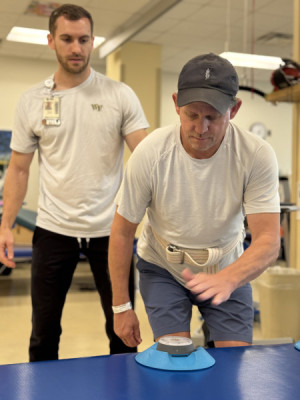 Since then, Mitch has made considerable progress. Today, he’s working on stance stability and building up his overall strength and endurance. He wears a brace on his right foot that helps him keep his toes from dropping. Schaeffer explains that therapists aim to use bracing that provides the necessary stability and support, but allows for as much flexibility as possible so that patients can safely increase their strength and range of motion.
From a duffle bag, Schaeffer pulls a set of light-up buttons that nestle into rubber gaskets. This reaction light training system is often used to train athletes to increase speed and agility. Schaeffer spreads them out on the gym floor and demonstrates how Mitch should step on each button as it lights up.
“We figured out we could use these for various purposes, working on balance, working on reach, I mean, you name it, whatever you can come up with, you can do,” explains Schaeffer, adding that he enjoys taking a creative approach to physical therapy.
Mitch tries the exercise, seeing how many lights he can stomp out in a 30-second window. He tries a second round and improves his “score.” Mitch likes the competitive aspect of the therapy, joking, “He [Schaeffer] has found out what motivates me.”
His workout continues with other variations that incorporate side-shuffles, squats, and stepping backwards — all focusing on balance and strengthening Mitch’s right side.
Mitch is excited to get back to his active lifestyle, which includes golf and pickleball. He also wants to return to work full-time at his drywall business.
“It’s demanding, and I don’t do so much of the hands-on, but the repairs and the field management work, I usually do it, so I’ve got to be able to get in and out of kind of rough terrain, in new construction. But I’m going to get there,” he says. “The people here are so professional, but they push you, but it’s kind of like with love, they’ve got a good spirit, which makes you want to do better and push yourself harder.”
Schaeffer, meanwhile, is busy setting up another exercise.
“This one looks harder,” Mitch observes good-naturedly. But he’s ready for the challenge.
Teana “Tee” Jackson
PT Goals — Walking independently, hand grip
Later the same afternoon, Teana Jackson uses her power chair to cruise over to a mat in another corner of the gym. She has a big smile and her mom, Wanda, by her side. Teana greets the team of therapists and aides who await her by name or by nicknames she created for them. They help her into the harnesses she needs for locomotor training, cracking jokes and laughing with her as they prepare. The harness will support some of Teana’s body weight and aid her in improving her muscular strength, endurance, and neurological coordination while practicing her gait pattern on the treadmill.
Teana’s physical therapist, Sandy Alexander, PT, DPT, NCS, has her start by using Bioness functional electrical stimulation on her lower leg to help her improve her leg swing with gait training. After a few minutes of working with the team to guide her as she walks on the treadmill and evaluating her gait, Alexander switches gears and outfits Teana with alternative leg braces, explaining that the electrical stimulation was good for part of her stride, but not all of it. The braces will help her maintain improved knee stability in stance and provide her greater independence when walking.
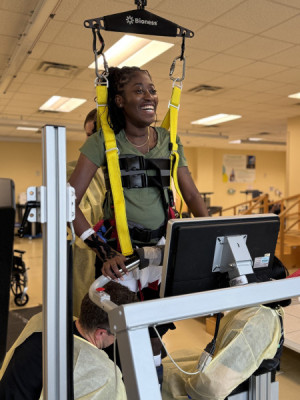 “Neurological rehab is about appropriately balancing the encouragement of natural movement patterns from prior to injury, for recovery, with compensations as needed to maintain safety and promote independence,” Alexander explains.
Teana has come a long way since she arrived at Shepherd about three months ago. She sustained an incomplete spinal cord injury and mild traumatic brain injury when she was involved in a car crash with an 18-wheeler.
“I really should not be alive,” Teana says, “But by the grace of God, I’m here.”
“[When I got here] I wasn’t able to move anything besides my hands. I could just clap my hands, but not move anything else,” she says. “Within the first three months of being here alone, I can now move fingers; I just can’t grip anything still. I can walk a little bit with help, and I can do a mean squat pivot.”
Teana says she keeps a positive attitude for herself and for the other patients around her. Her mom says Teana gives 100% to her therapy and, “she’ll have you laughing,” which seems true from the sounds of her physical therapy session.
And she is ready to put in the work.
“I’m still looking to accomplish a lot, so I give myself another three months to start moving some legs really well, as far as walking without assistance and hopefully a walker.”
Jeff Millican
PT Goals — return to work and outdoor activities like hiking, running, paddleboarding, and fishing
On a Tuesday morning, Jeff Millican and his wife, Heather Millican, are in Shepherd’s Comprehensive Rehabilitation Unit (CRU) gym. Jeff, a fire battalion chief in Bonita Springs, Florida, arrived at Shepherd Center a week earlier. He sustained a traumatic brain injury (TBI) along with broken bones and multiple internal injuries when he was hit by a car while helping with a crash on the interstate.
Jeff’s physical therapist, Sarah Dubois, PT, DPT, guides him through a series of exercises. In the first set, Jeff practices standing on one foot, with the added challenge of a cushioned mat underfoot, engaging his ankle muscles. Heather is thrilled to see that Jeff’s stability has improved significantly since last week.
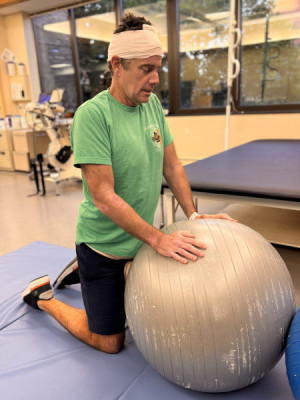 Next, they move to a mat on the floor. Using an exercise ball, Dubois demonstrates exercises designed to help Jeff keep mobility in his injured shoulder. As it heals, extra bone has grown, affecting his range of motion.
Heather sits on a nearby therapy mat table, taking notes about exercises Jeff can do in his room later in the day and on the weekends for “homework.”
Dubois says she frequently gives patients assignments to work on independently.
“I give them one or two things to do that will help them progress towards our goals for that week. One, if they have to do it with a caregiver, it helps involve their caregiver more in their rehab process, and two, it gives the patient something to do in their downtime. … It will be something they can do in five or 10 minutes, whether they do it once a day, twice a day. It gives them something to do over the weekend, too, and it gives the patient a little more of a sense of responsibility, ‘I gotta do my homework!’”
Jeff is no stranger to exercise. He and Heather have always been very active, and he wants to get back to work at the fire department and to the outdoor activities he loves, including running, hiking, fishing, kayaking, and paddleboarding.
He’s ready for the next challenge in the day’s PT session, a recumbent cross trainer, kind of a cross between an elliptical trainer and a recumbent bike — to increase strength and endurance in his legs.
He’s pleased with his progress in his first week at Shepherd.
“The first thing I remember at Gulf Coast Medical Center was, ‘We’ve got to get you stabilized and get you to Shepherd.’ That’s what they said over and over again,” Jeff recalls. “I see why now.”
Written by Ruth Underwood
With five decades of experience, Shepherd Center provides world-class clinical care, research, and family support for people experiencing the most complex conditions, including spinal cord and brain injuries, multi-trauma, traumatic amputations, stroke, multiple sclerosis, and pain. An elite center ranked by U.S. News as one of the nation’s top hospitals for rehabilitation, Shepherd Center is also recognized as both Spinal Cord Injury and Traumatic Brain Injury Model Systems. Shepherd Center treats thousands of patients annually with unmatched expertise and unwavering compassion to help them begin again.