


Mission Moment: When Your Therapy Buddy is a Very Good Boy
Visits with Shepherd Center's facility dogs result in new skills and big smiles.
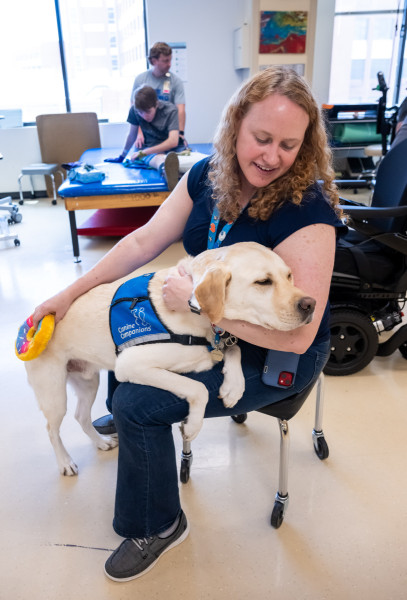
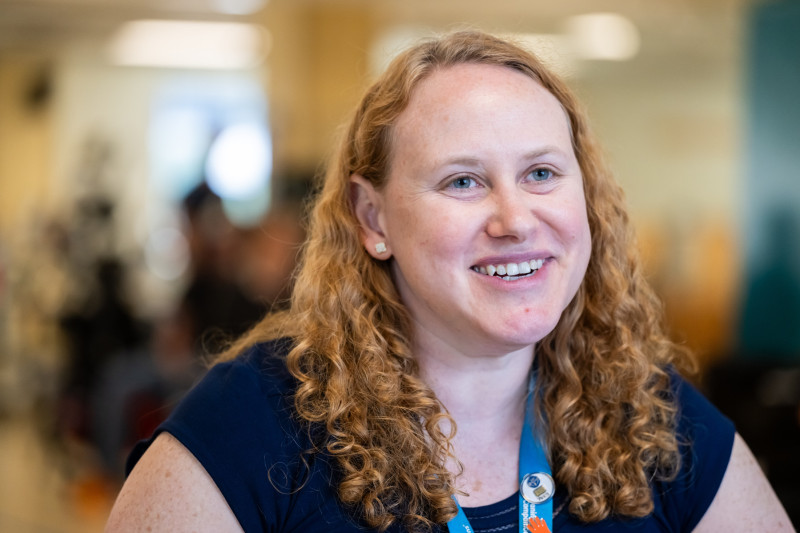
This story is an excerpt from “Mission Moments: 50 Years of Rebuilding Lives One Moment at a Time,” a book celebrating Shepherd’s 50th anniversary in 2025. Sadly, facility dog Lanza passed away at the end of February, soon after this story was written. During his time at Shepherd, Lanza participated in therapy sessions, shared cuddles, and brought smiles to countless faces, leaving a lasting impact on everyone he met. We are grateful to Lanza and his handler, Julie Shepherd, for 5 years of service to Shepherd Center’s patients and staff. He will be greatly missed.
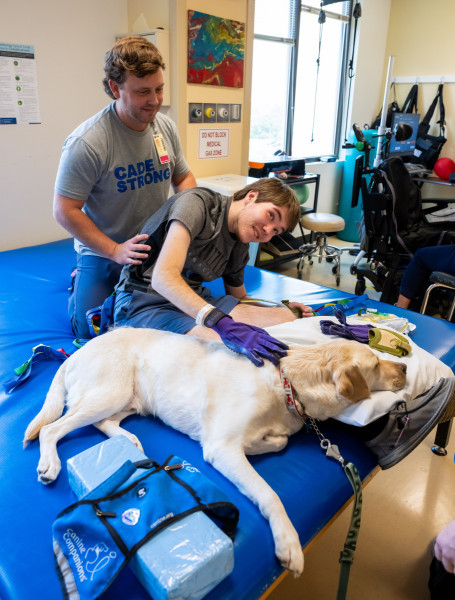
Lanza, a sweet-faced Golden Retriever-Labrador mix, jumps gently onto the therapy mat and nuzzles Gunnar Burns, a 16-year-old with a spinal cord injury from Fredericksburg, Virginia. Using a specially adapted brush with a Velcro handle, Gunnar begins stroking the dog’s back.
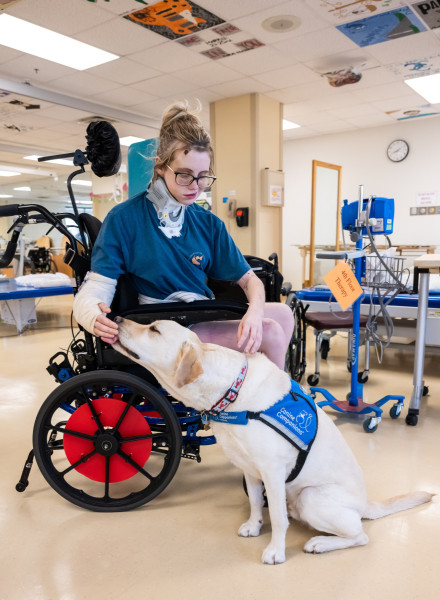
In Shepherd’s donor-funded Facility Dog Program, even snuggles have a rehabilitative purpose. Facility dogs take part in physical therapy, occupational therapy, speech therapy, and recreational therapy, in addition to providing emotional support and simply bringing joy.
“When you show up with a dog, you get the biggest smile,” says Julie Shepherd, CCM, LMSW, CLCP. “Sometimes you get tears. Even if patients can’t move or feel anything, they get so excited.”
Many patients at Shepherd are motivated to work on skills so they can have a dog when they return home, which means that therapy activities often include leash management—from a power chair, manual chair, walker, or standing—verbalizing commands, grooming, bathing, and picking up poop.
Julie is the daughter and granddaughter of Shepherd Center’s co-founders. She has worked at the center for 15 years, beginning as a case manager. Now she is director of Shepherd’s Founding Family Relations initiative and leads the Facility Dog Program, a labor of love in a proud family legacy.
Therapy dogs are a common sight in the hallways of Shepherd.
“In ICU, we do a lot of comfort visits — for patients and staff,” Julie says. “I think ICU is one of the hardest jobs here. If I know the staff has been having an especially difficult day, Lanza and I will just go hang out there and check on them. And then in the therapy room, the dogs can help with any goals. A patient who needs to work on balance can sit on the edge of the mat and throw toys for the dog to retrieve. Or grooming the dog can help strengthen arms.”
Shepherd’s facility dogs arrive fully trained from Canine Companions®, a nationally accredited nonprofit organization that matches service dogs with individuals with disabilities and professionals in healthcare settings. In the latter case, each dog is assigned to a Shepherd employee, who also goes through extensive training and commits to keeping the dog at their home.
The emotional benefits of the Facility Dog Program are obvious, as a dozen adolescents gravitate toward the therapy mat where Gunnar is grooming Lanza. One by one, they speak to the dog, pat him on the head, and tell him what a good boy he is.
Gunnar sustained a spinal cord injury in a high school lacrosse game in May 2024. Julie and Lanza visited him during his first week at Shepherd Center, when he was still in the intensive care unit. Gunnar had just lost his dog, Sunny, a few months earlier. “He looked exactly like Lanza,” Gunnar recalls. Gunnar isn’t sure yet whether he wants a new dog when he returns home. But today, he is finding comfort and motivation in the uncomplicated act of brushing a dog. When Julie asks if he needs a break, he shakes his head and says quietly, “My arms won’t ever get tired from doing this.”
Written by Teresa Weaver
With five decades of experience, Shepherd Center provides world-class clinical care, research, and family support for people experiencing the most complex conditions, including spinal cord and brain injuries, multi-trauma, traumatic amputations, stroke, multiple sclerosis, and pain. An elite center ranked by U.S. News as one of the nation’s top hospitals for rehabilitation, Shepherd Center is also recognized as both Spinal Cord Injury and Traumatic Brain Injury Model Systems. Shepherd Center treats thousands of patients annually with unmatched expertise and unwavering compassion to help them begin again.