


Mission Moment: Shepherd's Vision 2025 and Beyond
Expanding access to Shepherd's services and delivering world-class experience and outcomes.
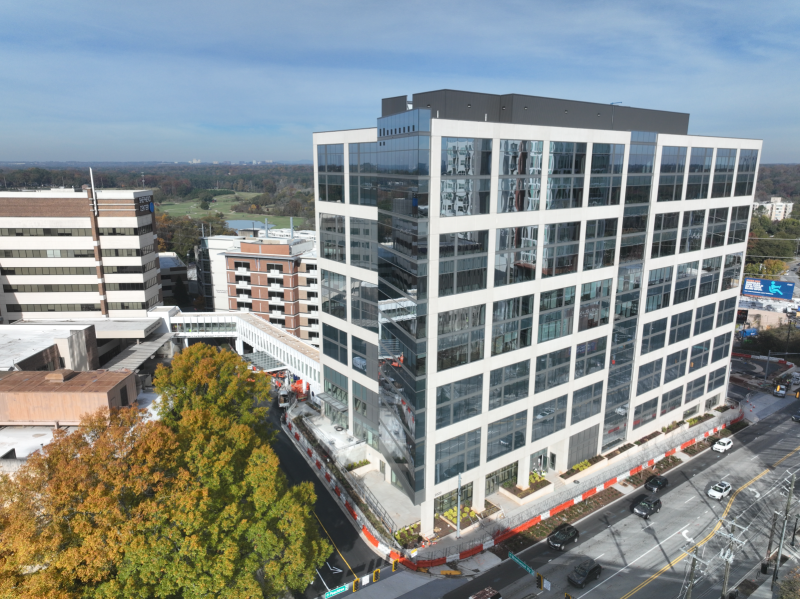
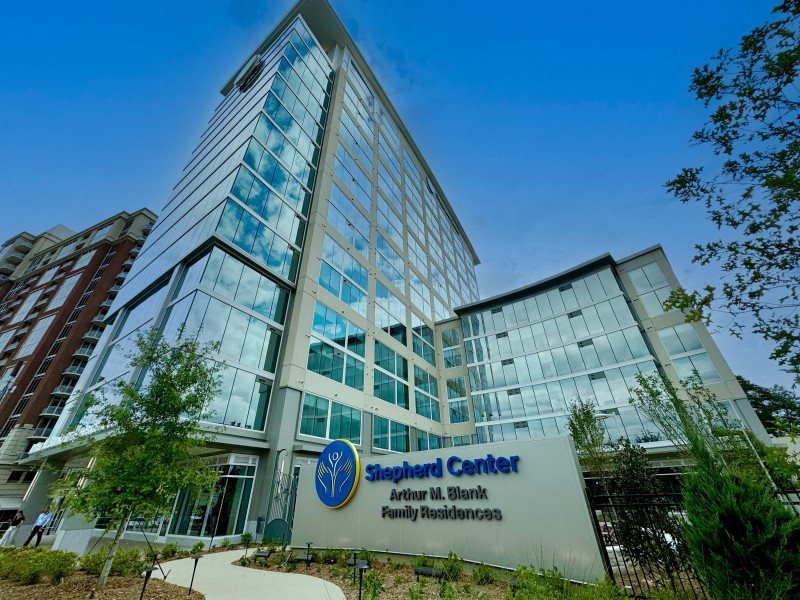
Shepherd Center begins its 51st year in the midst of a $400 million building boom that increases the hospital’s ability to accommodate more patients, expand community services, and supercharge research. The two transformational priorities laid out in Shepherd’s Vision 2025 are to: expand access to all services and deliver world-class experience and outcomes. Through Pursuing Possible: The Campaign for Shepherd Center, generous donors, volunteers, staff, and a community of supporters have turned that vision into steel, concrete, and glass. Two striking new buildings have sprouted on Peachtree—the Arthur M. Blank Family Residences, which opened in September 2024, and the Marcus Center for Advanced Rehabilitation (MCAR), which followed in the spring of 2025. The residence tower more than doubles Shepherd’s housing, which is donor-funded and ensures that family members and patients have a place to live throughout the full length of their stay. And MCAR, with the 30,000-square-foot James M. Cox Innovation Institute on the top floor, is a major investment in expanding capacity for clinical services, research, and innovation. Overall, this expansion allows the center to serve hundreds more patients at the time of their need. In recent years, Shepherd has had to turn away hundreds of medically appropriate inpatients because of limited bed capacity. And the wait time for many outpatient programs is months rather than days.
Building MCAR allows Shepherd to transition activities from the main hospital, which opens up space for a new Acquired Brain Injury Unit on the sixth floor of the main building in spring 2026 that will expand capacity from 152 to 175 beds. Additionally, all inpatient rooms will become private and be equipped with smart technology to enhance the patient experience and their ability to control their environment independently. There is room to eventually add another inpatient unit on the third floor of the main building, which will increase capacity to 210 beds—a plan that will ensure Shepherd Center is poised to care for generations to come.
Outpatient capacity grows as well. Moving the Dean Stroud Spine and Pain Institute to MCAR will allow for the expansion of both the Pain Institute and the Andrew C. Carlos Multiple Sclerosis Institute. The 2024 renovations at 80 Peachtree Park will expand capacity for the SHARE Military Initiative, making it possible to support more service members and first responders who struggle with traumatic brain injuries and mental health concerns. Also, new facilities in the Innovation Institute will more than double the space for the Center for Assistive Technologies, including adding the Travis Roy Ability Bar. This will enable community members with disabilities to learn about and access technologies that enhance their ability to perform daily activities such as accessing electronic devices, controlling their home environment, driving, and moving around.
Written by Teresa Weaver
This story is an excerpt from “Mission Moments: 50 Years of Rebuilding Lives One Moment at a Time,” a book celebrating Shepherd’s 50th anniversary in 2025.
With five decades of experience, Shepherd Center provides world-class clinical care, research, and family support for people experiencing the most complex conditions, including spinal cord and brain injuries, multi-trauma, traumatic amputations, stroke, multiple sclerosis, and pain. An elite center ranked by U.S. News as one of the nation’s top hospitals for rehabilitation, Shepherd Center is also recognized as both Spinal Cord Injury and Traumatic Brain Injury Model Systems. Shepherd Center treats thousands of patients annually with unmatched expertise and unwavering compassion to help them begin again.