


Mission Moment: Seeing Is Believing — The Power of Peer Support
A low-cost intervention that has a direct impact on patient outcomes.
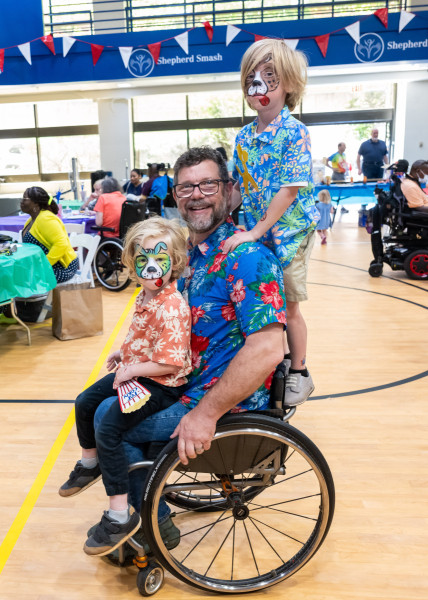
When Pete Anziano arrived at Shepherd Center as a patient in 2004 with a spinal cord injury from a motorcycle accident, he needed to see what success looked like. “I didn’t know how to be me,” he recalls. “That’s the big question for all the patients here: ‘How can I be me under these new circumstances?’ I didn’t want to feel like I was transitioning to a clinical lifestyle as Paraplegic Pete.”
Before his injury, Pete was an intrepid world traveler, a mountain climber, and a daredevil who barreled into every day with the hubris of youth. Using a wheelchair for mobility meant reimagining all of this. At Shepherd, he began learning all the new life skills he needed to take care of himself, but he was not yet able to picture himself in this new reality.
Minna Hong, Shepherd’s peer support manager at the time, who had sustained a spinal cord injury in a car crash, was the first to break through to Pete. “When Minna came in and was able to actually execute all these skills I was learning, that’s when it turned from a fairy tale into a real-life story,” Pete says. “If she could do all these things in a wheelchair, I could be successful at this, too.”
When Minna retired in 2018, her mentee Pete assumed the role of peer support manager, leading a team of eight “representatives of success” — four people with spinal cord injuries, three family members of people who sustained brain injuries, and one military veteran who came home with a traumatic brain injury and post-traumatic stress.
Research—some done at Shepherd — has proven what the Shepherd team already knew anecdotally — that people learn better from others who have “been there, done that.” And the low-cost intervention of peer support has a direct impact on patient outcomes. With data in hand, Shepherd began engaging peer mentors throughout the continuum of care, offering more opportunities to bridge the theoretical and the practical.
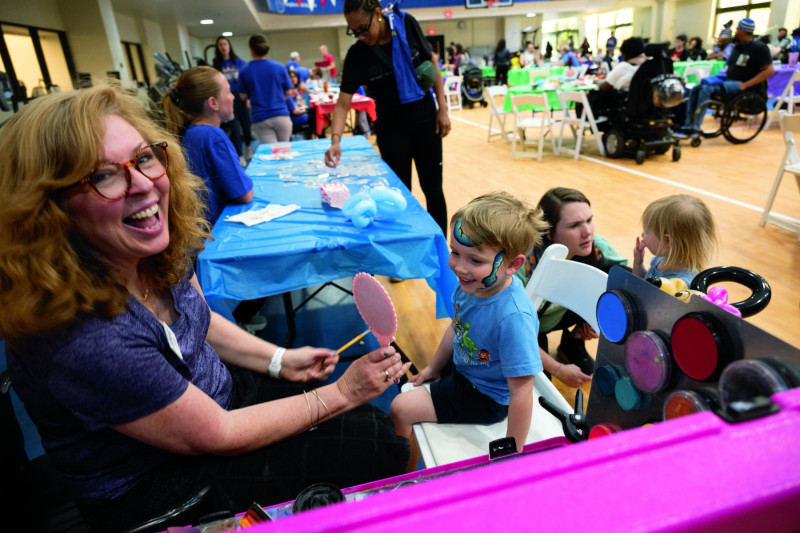
Peer mentors work with nurse educators to teach patients about skin issues, bowel and bladder management, prevention of urinary tract infections, high blood pressure, blood clots, spasms, infection control, and more. They also assist with patients’ psychosocial adjustment. In addition, Shepherd sponsors various peer support groups for anyone in the community with specific conditions, and their families and caregivers. There are monthly dinners as well, along with Zoom groups designed to build inclusive, supportive communities.
“For some patients who come through here, there are days where the light at the end of the tunnel can be just a pinhole,” Pete says. “You don’t even know what you’re working toward, and it’s easier to measure what you’ve lost—what you can’t do anymore. But the most rewarding thing is to see a person regain their sense of self. ‘No, I am me. I can go back to work or protect my family or whatever.’ Once they realize they can do that, it starts the flood of transformative thinking.”
Two decades ago, horticulture lessons at Shepherd helped Pete begin to reclaim his life. “We went out and found this gigantic, beautiful hydrangea—full bloom, full grandeur,” he recalls. “We reduced it to a tiny fraction of itself, then nurtured and loved it so it grew into a whole new bush — back to full grandeur. That became a metaphor for my experience that I share often with patients. Nature wants us to thrive. All we have to do is tend to our soil.”
Written by Teresa Weaver
This story is an excerpt from “Mission Moments: 50 Years of Rebuilding Lives One Moment at a Time,” a book celebrating Shepherd’s 50th anniversary in 2025. You can explore the full eBook or purchase a hardcover copy here.
With five decades of experience, Shepherd Center provides world-class clinical care, research, and family support for people experiencing the most complex conditions, including spinal cord and brain injuries, multi-trauma, traumatic amputations, stroke, multiple sclerosis, and pain. An elite center ranked by U.S. News as one of the nation’s top hospitals for rehabilitation, Shepherd Center is also recognized as both Spinal Cord Injury and Traumatic Brain Injury Model Systems. Shepherd Center treats thousands of patients annually with unmatched expertise and unwavering compassion to help them begin again.