


Mission Moment: Life Beyond Injury — Playing the Long Game
Since the early days of the hospital, recreation therapy at Shepherd Center has helped patients live their lives to the fullest.

If therapy is the main course at Shepherd Center, recreation therapy is the dessert, albeit an exceptionally healthy one. Barb Leidheiser, Shepherd’s first recreation therapist, put it this way: “Everything we did was empowering for the patients. I had one man tell me, ‘The rest of the therapists taught me how to live. You showed me why I want to live.’”
David Apple, M.D., the first medical director of Shepherd Center, believed in recreation therapy so deeply that he paid Barb’s salary out of his own pocket in 1979. “We thought that getting the patients out of the hospital and into the community for outings was an integral part of their recovery,” Dr. Apple says.
Now, Shepherd Center boasts the largest Recreation Therapy Program in the country, with a staff of more than 30 (when the industry norm is about two), 10 competitive sports teams, several annual trips, and dozens of opportunities to get involved in the community. Seven specialists offer instruction in arts, sports, aquatics, horticulture, exercise physiology, outdoor activities, and music.
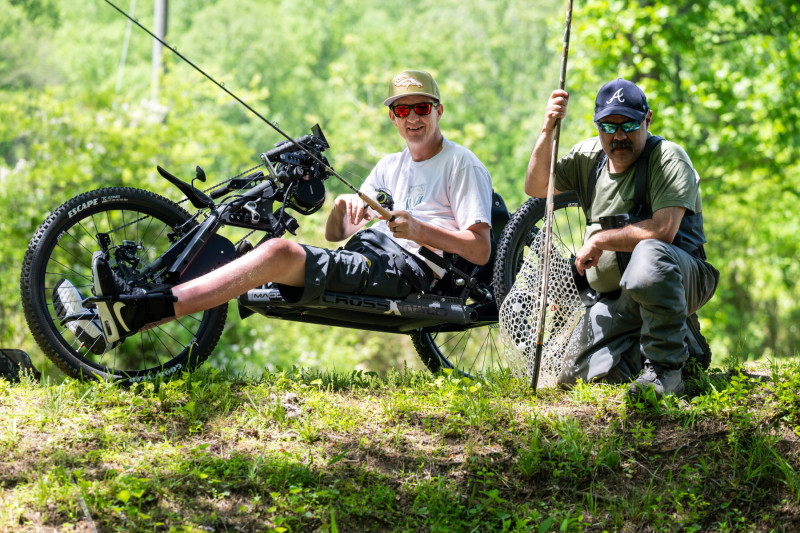
“Physical therapists work on mobility, occupational therapists work on activities of daily living (ADLs), and speech therapists work on cognition, swallowing, voice, and breathing techniques,” says Kelly Edens, CTRS, manager of the Recreation Therapy Program since 2008. “Rec therapy really puts all those capabilities in the Nathan Harmon, who was injured in a diving accident, enjoys a fly-fishing excursion to Clarkesville, Georgia, with guide Jason “Chico” Garrett. 64 community setting. It puts a bow around all the therapy and sends a person home to really live their life.”
Sometimes patients want to resume doing activities they loved before they were injured, and others want to discover altogether new things. If a patient wants to try kayaking, for instance, their recreation therapist will figure out the best way to make that happen, whether it’s at a nearby lake or in the pool at Shepherd’s ProMotion Fitness Center. Once outfitted with whatever special gear they need, patients are then supported to explore options near their home to make sure they can keep doing the things they love.
Research has shown the profound benefits of healthy activity and a positive attitude in recovering after a traumatic injury. Involvement in positive and meaningful recreation activities helps reduce medical complications and the need for re-hospitalization, and it is one of the best ways to adjust to lifestyle changes caused by a disability.
Health and Wellness Clinics, which are open to community members with disabilities, are held throughout the year, ranging from virtual art to adaptive hiking, from birdwatching at the Atlanta Botanical Garden or skiing in Colorado to scuba-diving in the Caribbean. Every spring, Shepherd hosts the Adventure Skills Workshop, an action-packed weekend camp in Alabama that attracts people from more than a dozen states.
Like every other program at Shepherd Center, recreation therapy is patient-centered, which means that therapists tailor outings to each individual. Therapists have taken patients on college campus tours, for instance, or shopping for a wedding dress, or to a fast-food restaurant for the first time since they were injured.
“One therapist just told me she took her patient to Taco Bell,” Kelly says. “When she was able to transfer into a booth on her own, it brought tears to her eyes. To me, that is a mission complete. Just to bring normalcy to people, so they know they can do the things they love—and they can enjoy life. Every day is a new day.”
Written by Teresa Weaver
This story is an excerpt from “Mission Moments: 50 Years of Rebuilding Lives One Moment at a Time,” a book celebrating Shepherd’s 50th anniversary in 2025.
With five decades of experience, Shepherd Center provides world-class clinical care, research, and family support for people experiencing the most complex conditions, including spinal cord and brain injuries, multi-trauma, traumatic amputations, stroke, multiple sclerosis, and pain. An elite center ranked by U.S. News as one of the nation’s top hospitals for rehabilitation, Shepherd Center is also recognized as both Spinal Cord Injury and Traumatic Brain Injury Model Systems. Shepherd Center treats thousands of patients annually with unmatched expertise and unwavering compassion to help them begin again.