


Mission Moment: Finding Beauty
While Stacy Williams participated in rehabilitation at Shepherd Center, her husband Zach found some comfort in music.
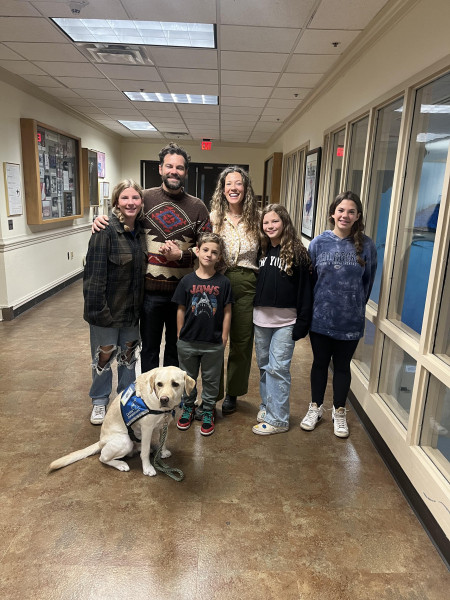
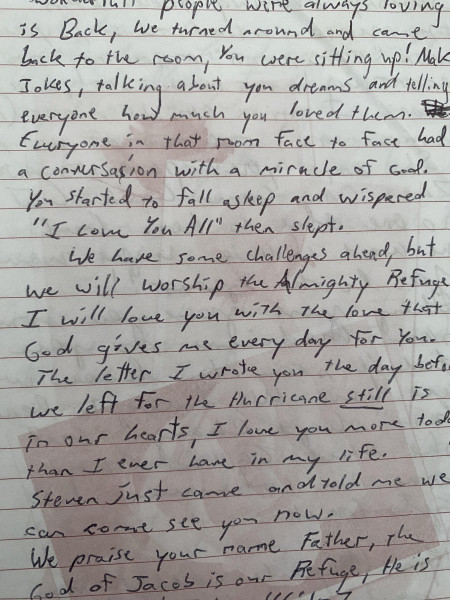
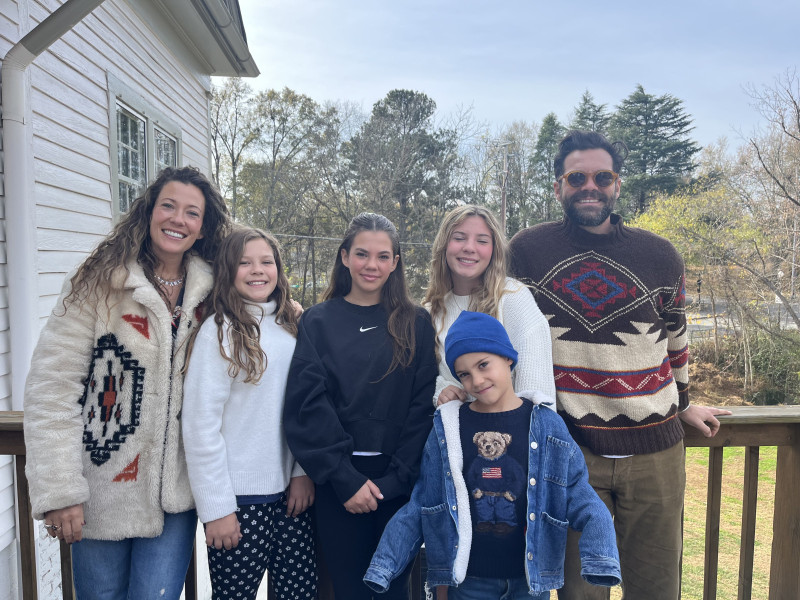
A catastrophic injury has a ripple effect, creating tides of anguish, uncertainty, and fear among family and friends. But recovery after a trauma also sets off a chain of events that can have profound impacts.
On Labor Day weekend in 2004, twenty-something newlyweds Zach and Stacy Williams had gathered a dozen close college friends at a family horse farm near Atlanta. They were a tight-knit group, bound by their love of art, theater, music, and spirituality. The weekend had barely begun when the horse Stacy had been riding returned with an empty saddle. Zach and others raced to the trail to find Stacy lying unconscious and bleeding. At the emergency room, doctors found four broken vertebrae just beneath the skull, two of them shattered. Shortly after emergency surgery at Atlanta Medical Center, Stacy was moved to Shepherd Center.
Zach, who had kept a journal for much of his life, began writing in earnest while spending long days in Stacy’s hospital room and longer nights in a small apartment provided by Shepherd. He shared his writings with friends, who encouraged him to set his words to music, so he dug out an old Les Paul guitar he had never really mastered. “And there was a Starbucks down the street from Shepherd Center that had an open mic night on Wednesdays,” Zach recalls. “I don’t think I had really even cried yet about Stacy’s injury, but when I tried to sing in front of people, that’s when I finally wept. And all these strangers wept with me. It was cathartic, and that’s where I fell in love with songwriting.”
As Zach was finding some comfort in music, Stacy’s injured body was beginning to awaken. First, she moved an index finger, then her hands, then her arms, and finally, her legs. Doctors discovered that her spinal cord had not been severed or pierced by bone fragments, but was severely bruised. About a month after arriving at Shepherd, Stacy was able to walk out, slowly and not for a great distance, but walking, nonetheless.
Stacy’s memories of Shepherd start off hazy but take shape in the tender moments. “I had two physical therapists,” she says. “One was sweet and coddling, and the other one was like, ‘No, you’re doing this today.’ I love the staff there. They would let my mom sneak in a little early, so she was there with me when I woke up. That was so comforting.”
When it was time to go home to continue her rehabilitation, Stacy almost didn’t want to go. “It’s a very scary feeling to leave all that safety and comfort,” she says.
But it was time to look to the future. The friends who were there when Stacy was hurt had made a pact: If she gets better, they vowed, let’s all move to New York together and pursue our dreams. When she was able to walk out of Shepherd, they all moved to Brooklyn. One started a little church; one became a Broadway star; and one started a nonprofit organization that teaches children chess and other complex subjects through storytelling. “And I started a little band,” Zach says.
That little Americana band, The Lone Bellow, burst onto the music scene in 2013, earning popular and critical acclaim for their “transcendent harmonies, serious musicianship, and raucous live performances.” Several years later, Zach and Stacy—and the band—relocated to Nashville, Tennessee, where they’re raising their three daughters and one son. The second daughter, Elizabeth Pearl, is named after the horse that Stacy was riding when she got injured.
“Like a pearl in an oyster, beauty is birthed from something that hurts,” Stacy says. “That resonated so perfectly with everything we went through at Shepherd. There’s a lot of beauty in this really hard, painful stuff.”
Two decades after her injury, Stacy has only occasional stiffness in her neck. In addition to managing a household of four children and a traveling musician husband, she and a friend opened an antique store called Patina + Co. in Nashville that showcases her flair for interior decorating. “I do it because I love it,” she says. “But it’s also important that our kids are seeing both of us provide, both of us work, both of us follow what we love.”
Before Stacy’s injury, Zach seemed destined to work in the family’s real estate business and settle down in metro Atlanta. But at Shepherd Center, he became a singer-songwriter. After she left the hospital Stacy was able to read through all the carefully kept journals, including words of love and inspiration from everyone who visited. “I was just sleeping a lot and trying to get better,” Stacy says. “I loved seeing everybody and felt so supported. But I don’t think I realized the full scope of all the beauty that was happening in that hospital room until I got home and read through those journals.”
Written by Teresa Weaver
This story is an excerpt from “Mission Moments: 50 Years of Rebuilding Lives One Moment at a Time,” a book celebrating Shepherd’s 50th anniversary in 2025.
With five decades of experience, Shepherd Center provides world-class clinical care, research, and family support for people experiencing the most complex conditions, including spinal cord and brain injuries, multi-trauma, traumatic amputations, stroke, multiple sclerosis, and pain. An elite center ranked by U.S. News as one of the nation’s top hospitals for rehabilitation, Shepherd Center is also recognized as both Spinal Cord Injury and Traumatic Brain Injury Model Systems. Shepherd Center treats thousands of patients annually with unmatched expertise and unwavering compassion to help them begin again.