


Laughter is the Best Medicine
Tristan Thompson faces his spinal cord injury with a signature sense of humor and hard work.
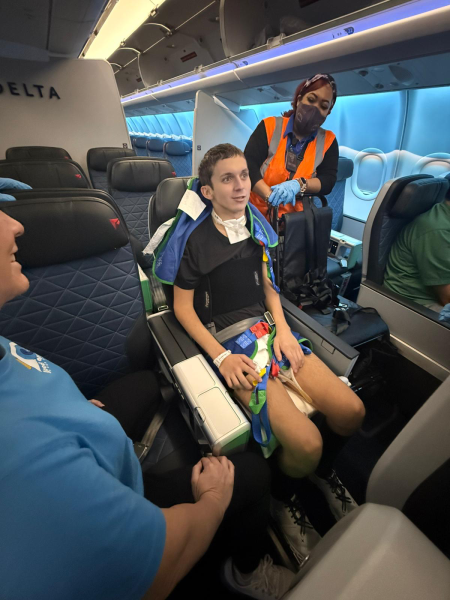
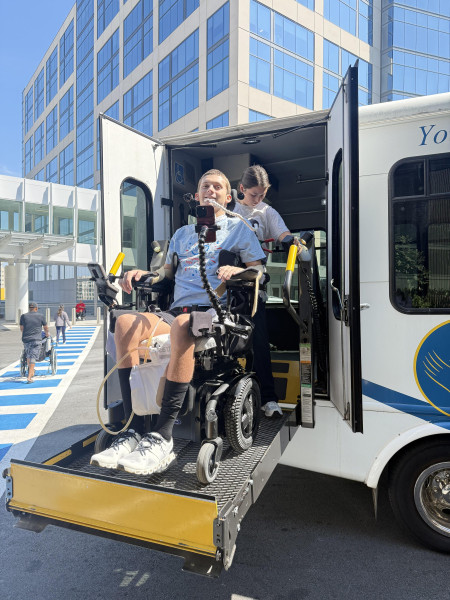
You may have heard the expression, “Laughter is the best medicine.” In Tristan Thompson’s case, a sly sense of humor has been a key ingredient in his rehabilitation after sustaining a C3-C5 spinal cord injury (SCI).
Every year, Tristan, 19, and his dad leave San Antonio, Texas, to go mountain biking in Bentonville, Arkansas. On July 2, 2025, Tristan went down a significant drop where he says he braked too late and was flung over his handlebars. Following his injury, he was life-flighted to the Mercy Hospital ICU in Springfield, Missouri.
His family knew about Shepherd Center because the hospital was highly recommended by two of Tristan’s friends who had received care there. After 22 days, he was transferred to Shepherd’s ICU for specialized treatment, with his mom Jennifer by his side. His level of injury limited his movement from the neck down, and when he first arrived at Shepherd, he required assistance from a ventilator and trach to breathe.
“We got to Shepherd, and they immediately had him sitting up out of bed and began motivating him,” Jennifer explains. “He even had a welcoming crew of kids who were patients. They wheeled into his ICU room, introduced themselves and their injuries, and talked about what they had gotten back so far. It was very uplifting.”
On Aug. 6, Tristan graduated from the ICU to the inpatient unit, where the medical team put him right to work. Among the therapies Tristan recalls as most impactful was electrical stimulation, where stimulation was used over the spinal column to activate his muscles. His team helped him use a tilt table to regulate his fluctuating blood pressure. And they did speech therapy with breathing exercises, which helped him wean off the ventilator a month after arriving at Shepherd. But beyond the focused therapies Tristan received, he appreciated the hospital staff the most, and he showed them that appreciation with his signature sense of sarcasm.
“I didn’t have a problem psychologically at Shepherd because it was so positive there,” Tristan recalls. “We would just make fun of each other and laugh – there was never an awkward moment. And whenever I’d see a therapist from my team working with another patient, I’d make sure to give them crap by reminding them, ‘Hey, that’s my therapist, give her back!’”
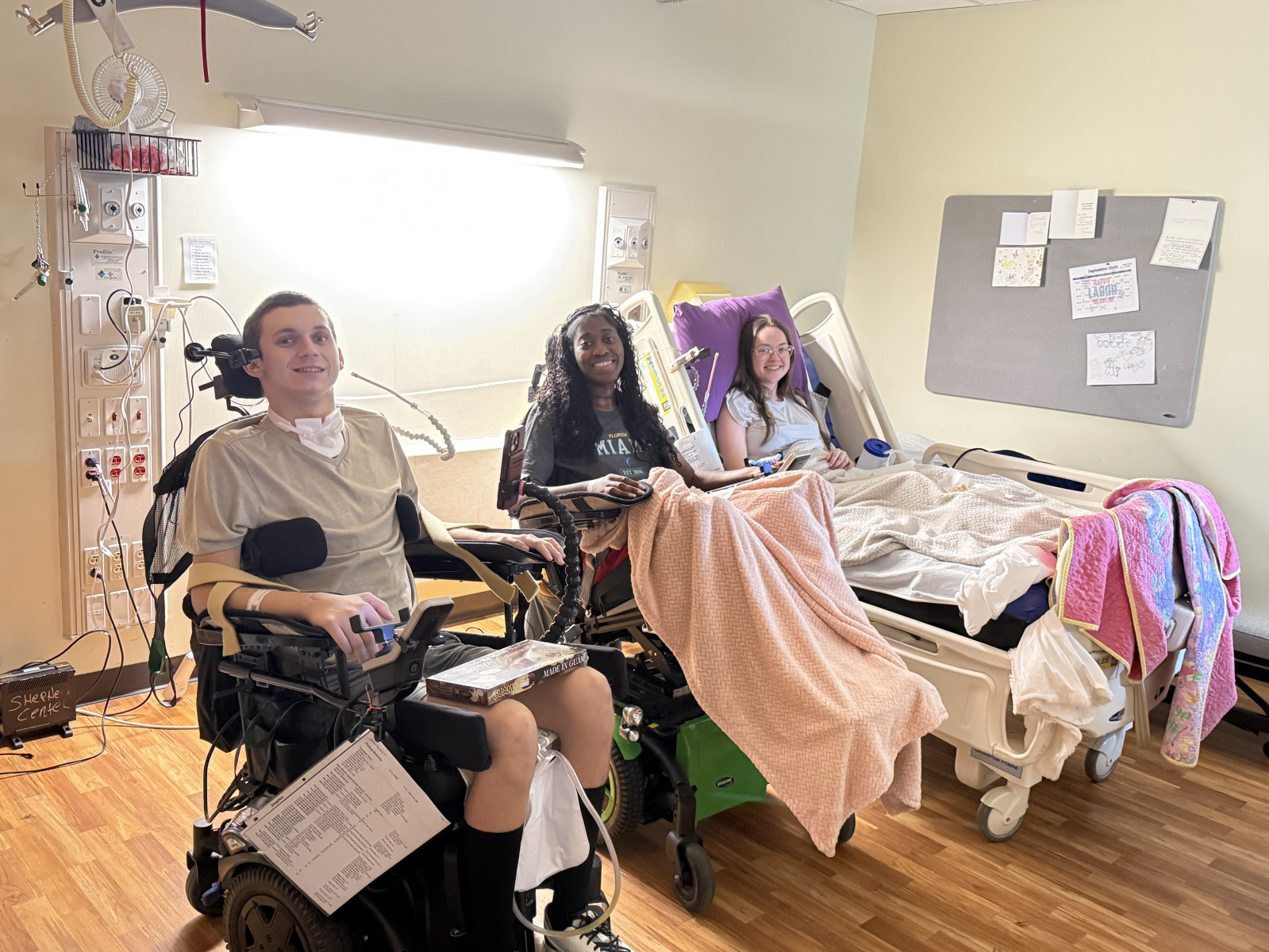 Tristan not only made friends with his medical team. He quickly made two new best friends, fellow patients Teana Jackson and Libby Presnell. The trio found ways to poke fun at each other at every opportunity.
“I remember we all went to church one day, and I told [Chaplain Ben Rose] that it was Libby’s birthday, even though it wasn’t. Everyone in the chapel sang happy birthday to her and kept doing it throughout the day. It was the best. We were crying laughing,” Tristan recalls. (Libby got him back later during one of Shepherd’s Tuesday night “family dinners,” where she told attendees it was Tristan’s birthday.)
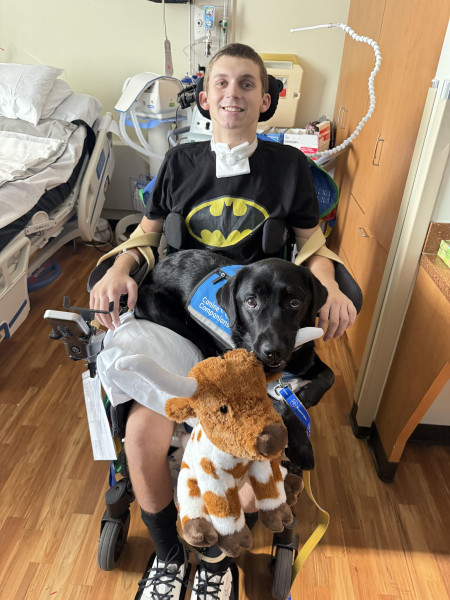
In addition to human friends, Tristan loved the furry friends he made at Shepherd Center.
“I loved every second with the facility dogs. Pippy was my favorite. Every other Friday, dogs that were in training would come up to the workout room and visit everyone,” Tristan says.
While Tristan worked hard toward his goals, Jennifer was able to stay in family housing at Shepherd Center’s new Arthur M. Blank Family Residences. The donor-funded housing is provided to families and loved ones of patients who are in inpatient rehabilitation who live more than 50 miles from the hospital.
“That was fabulous,” Jennifer says. “It was only two blocks away, but it was great for me to get breaks, sleep in a real bed, and do things like laundry for Tristan and me. It also gave him a little freedom from me being there all the time!”
On Sept. 22, Tristan discharged from Shepherd and returned to his hometown in San Antonio. With help from the skills and care he received at Shepherd, he is making progress toward regaining independence. He is working with a pulmonologist to get his trach out and fully breathe on his own. He still experiences some blood pressure issues, but with the tilt table skills he learned with Shepherd’s physical therapists, the family knows how to manage it at home.
Prior to his injury, Tristan attended college at Texas Tech with his girlfriend, Paula Brame. Paula stopped attending school in-person so she could be there for him, but now, the pair plan to return to school in-person together. They even talk about applying to work at Shepherd Center after completing their degrees. But perhaps the most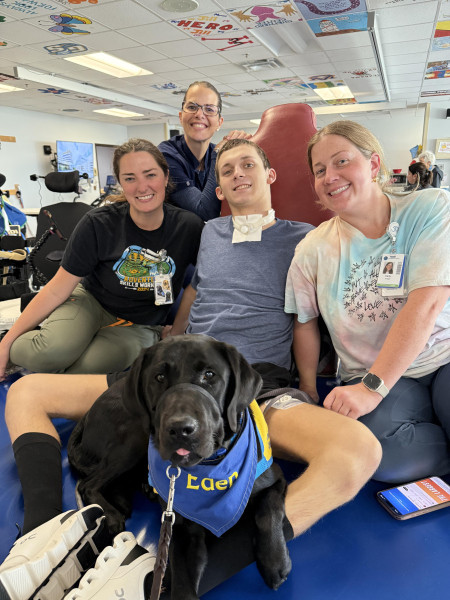 exciting near-future milestone involves Tristan getting his own service dog.
“I am not a dog person,” Jennifer says. “But my sister started this whole operation to peer pressure me to get a service dog, and they broke me down. I told Tristan he can apply for his own dog at the one-year mark of his injury.”
Tristan continues to face his future with hope, humor, and determination. He encourages others to do the same.
“Wake up and work hard. Every day is a new day and opportunity to keep the faith and stay positive.”
Written by Damjana Alverson
With five decades of experience, Shepherd Center provides world-class clinical care, research, and family support for people experiencing the most complex conditions, including spinal cord and brain injuries, multi-trauma, traumatic amputations, stroke, multiple sclerosis, and pain. An elite center ranked by U.S. News as one of the nation’s top hospitals for rehabilitation, Shepherd Center is also recognized as both Spinal Cord Injury and Traumatic Brain Injury Model Systems. Shepherd Center treats thousands of patients annually with unmatched expertise and unwavering compassion to help them begin again.