


‘Always keep your head up’
How Keshavious Tumbling’s time as a student-athlete helped him in the SCI Day Program
When Keshavious Tumbling was in the Spinal Cord Injury (SCI) Day Program at Shepherd Center, a typical day usually went something like this: he’d wake up and get dressed, complete a couple of morning physical therapy sessions, grab pizza from the cafeteria for lunch (his favorite), then spend time with an occupational therapist before working on his studies.
The charismatic high school senior excelled in the Day Program. As a talented student-athlete — his high school baseball team won the state championship in May — he was committed to his therapy and staying on top of his schoolwork, not to mention befriending everyone he met. His dedication and positive outlook played a key role in his recovery from his SCI.
The morning Keshavious sustained his SCI started as any other day. He was at football practice, doing drills, and hanging out with his teammates. But then, in one drill, he had an awkward collision with another player.
“I felt my neck snap,” he says. “I fell on the ground in slow motion.”
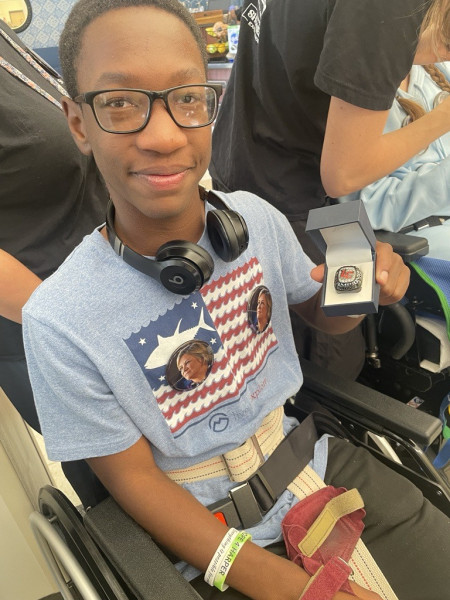 He was immediately transported, first by ambulance, then helicopter, to UF Health Shands Hospital in Gainesville, Florida. After nine days, he transferred to Shepherd Center. He had sustained an incomplete C3-C4 injury.
When he initially arrived as an inpatient in the Adolescent Spinal Cord Injury Rehabilitation Program, he didn’t expect to make any friends during his rehab. Then came Cam Rhoden.
“When I got here, I got room 428. My first day, Cam came in to say, “this was my old room,’” Keshavious says. “I didn’t think I was going to meet new people — I thought I was going to be by myself. But he came to tell me that this is a good place.”
Cam, another adolescent patient, was the fourth-floor mayor during part of his rehab, a title given to an adolescent patient by their peers. Cam and Keshavious hung out on “Fun Friday” outings, and Cam showed him the ropes.
Once he started therapy, Keshavious’ mobility improved rapidly — he went from using a powerchair on his arrival to using no mobility aids at all. In Day Program, his therapists introduced skipping and jogging. Now, he has his sights set on running again.
When Keshavious prepared to go home in September, he was eager to return to school, to support his teammates, and to keep working toward his goals of joining the Air Force and becoming an orthopedic surgeon. But he was looking forward to the little things, too, like sleeping in his own bed again. No matter what comes next, he feels ready for the future.
“You never know when bad things will happen,” he says. “Always keep your head up. Always be nice to others, and you’ll get through life.”
By Erin Kenney
With five decades of experience, Shepherd Center provides world-class clinical care, research, and family support for people experiencing the most complex conditions, including spinal cord and brain injuries, multi-trauma, traumatic amputations, stroke, multiple sclerosis, and pain. An elite center ranked by U.S. News as one of the nation’s top hospitals for rehabilitation, Shepherd Center is also recognized as both Spinal Cord Injury and Traumatic Brain Injury Model Systems. Shepherd Center treats thousands of patients annually with unmatched expertise and unwavering compassion to help them begin again.