


Jump Start January: Fitness
Fitness Tips from Shepherd Staff
For the 79% of Americans who make New Year’s Resolutions, at least one of their goals for the new year focuses on health, exercise, or diet. Even for those who don’t make New Year’s resolutions, the start of a new year is a good time to check in with your health and well-being. And Shepherd Center’s expert staff members have you covered. 
In this week’s Jump Start January, Shepherd’s Research and Innovation Best Health Wellness Team shares advice for making movement a habit, and Jasmin Brumby Smith, an occupational therapist in the Eula C. and Andrew C. Carlos Multiple Sclerosis Rehabilitation and Wellness Program, offers tips she often shares with patients on ways to conserve energy to reach goals and prevent burnout.
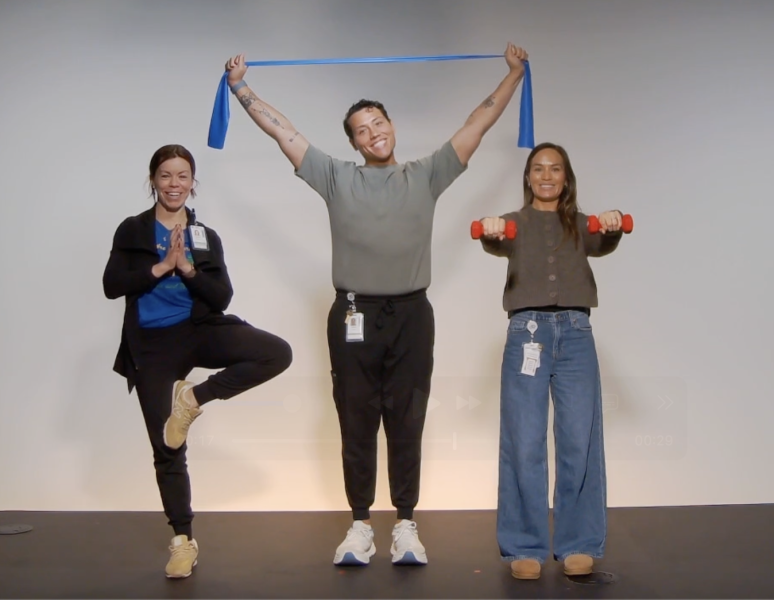
Alexandra (Allie) Juarez, EP, RYT 200 HR; Nathan Kimmel, EP; and Marina Moldavskiy, EP, ACRP-CP, RYT 200 HR
Shepherd’s Research and Innovation Best Health Wellness Team
- Identify purposeful movements and physical activities that you enjoy and make an exercise plan out of them. For resources to create your plan, check out the Best Health Suite webpage.
- Schedule time in your planner to move your body like you would schedule a haircut or oil change — you wouldn’t want to skip those, right?
- Lean on your peers and find an accountability buddy with whom you check in (even if you missed a movement session).
- Anything is better than nothing at all. Even if you only have five minutes to move your body, that is still more than zero.
- If you don’t feel like exercising, try to at least commit to the warmup. Most of the time, once your mind becomes focused, you will find it easier to stay and finish the workout. If you complete the warmup and still have no interest in the workout, it may be time to give yourself a break.
- Keeping your goals in mind, ask yourself what you can do today to get closer to them. Small things like filling your water bottle and making sure you’re drinking water throughout your day, taking time to move for a few minutes at the end of each hour, or packing your lunch and making healthier food choices during meals, can add up.
Jasmin Brumby Smith, MOT, OTR/L
Shepherd Center Occupational Therapist
- Plan ahead to reduce effort.
Organize tasks, gather supplies first, and think through steps to avoid unnecessary movement or repeated trips. Make a schedule of your tasks for the day or week to make sure that you don’t pack too many heavy tasks into one day. Spread heavy tasks and errands throughout the week. Alternate heavy tasks with lighter tasks to allow time for rest periods during your day.
- Prioritize what matters most.
Focus your energy on essential or meaningful activities and let go of non-urgent or non-essential tasks. Decide what activities have to be done and which can wait. Also, decide which tasks can be done by someone else: Delegate. - Pace yourself.
Break tasks into smaller steps, take rest breaks, and avoid rushing to prevent fatigue and burnout. Do the hardest activities when you are feeling your best. Alternate between high-energy and low-energy tasks and listen to your body’s signals to prevent overexertion. - Use proper body mechanics.
Sit instead of standing when possible and position items within easy reach to reduce physical strain. Use good posture when standing and sitting. - Use powered devices and labor-saving tools.
Use adaptive equipment and power-assisted devices to help you complete a task. These devices can provide extra leverage and reach, keep your joints in the most functional position, prevent strain on your muscles and joints, and save your energy. Some examples include a tub bench, a reacher/grabber, a power wheelchair, electric appliances, and a wheeled cart. Also, don’t hesitate to ask others for help.
Advice from staff has been edited for length and clarity.
With five decades of experience, Shepherd Center provides world-class clinical care, research, and family support for people experiencing the most complex conditions, including spinal cord and brain injuries, multi-trauma, traumatic amputations, stroke, multiple sclerosis, and pain. An elite center ranked by U.S. News as one of the nation’s top hospitals for rehabilitation, Shepherd Center is also recognized as both Spinal Cord Injury and Traumatic Brain Injury Model Systems. Shepherd Center treats thousands of patients annually with unmatched expertise and unwavering compassion to help them begin again.