


Hearts & Rec
Recreation Therapists Get Patients Back to What They Love with Heart & Hope
Shepherd Center has the largest recreation therapy program in the country. Just like it sounds, recreation therapy uses recreational activities and tools — like an outing to a park, an adaptive tennis lesson, or an art class — to restore and rehabilitate patients’ levels of function, independence, and involvement in life activities.
Whether it’s learning how to do a long-enjoyed activity in a different way or finding a new interest, involvement in positive and meaningful recreation promotes physical and mental health and helps reduce medical complications and the need for further medical intervention or hospitalization.
Beginning while patients are inpatients and continuing through potential involvement in the Alias Family Sports Teams and attendance at Shepherd’s health and wellness clinics post-discharge, the hospital’s recreation therapists ask patients what they love to do, what puts smiles on their faces, what goals they have, and what makes them feel alive. Then, with the right tools, they help them prepare for those adventures.
Trying Out New Wheels
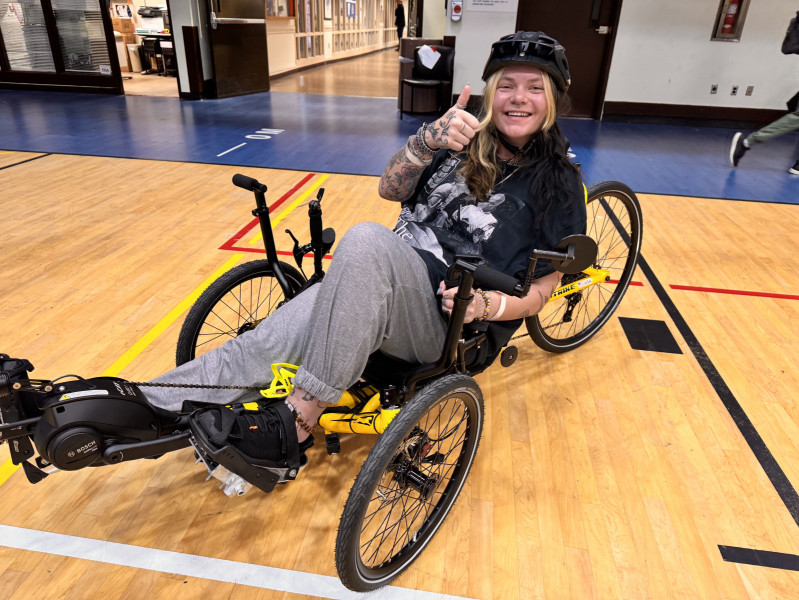 On a recent winter morning, patients had the opportunity to test their adaptive cycling skills when Shepherd Center’s Recreation Therapy Program partnered with Catalyst Sports to host a clinic showcasing adaptive cycling gear in our Livingston Gym. There were plenty of adaptive bikes, including handcycles, to choose from based on patients’ interests and abilities, provided by Charles Stanley, of Catalyst Sports and Shepherd Center.
As part of Shepherd’s goal to create opportunities for patients to rediscover their passions and purpose, adaptive cycling clinics are typically held each month. They are often integrated into patients’ schedules based on their goals and interests. And that’s not all – when the weather is warmer, Shepherd partners with Catalyst to take patients on monthly group rides on paved trails just outside Atlanta.
“These clinics and outings are a great opportunity for essentially every patient we serve. There are many different configurations, adaptations, and styles for bikes that make cycling suitable for almost any type of injury or disability,” says Brandon Clift, BS, ACSM EP-C, ACSM CIFT, CASC, sports specialist in Shepherd Center’s Recreation Therapy Program. “Cycling allows people to get outdoors, improve their cardiovascular fitness and overall function, and socialize with friends and family.”
Playing in the Dirt
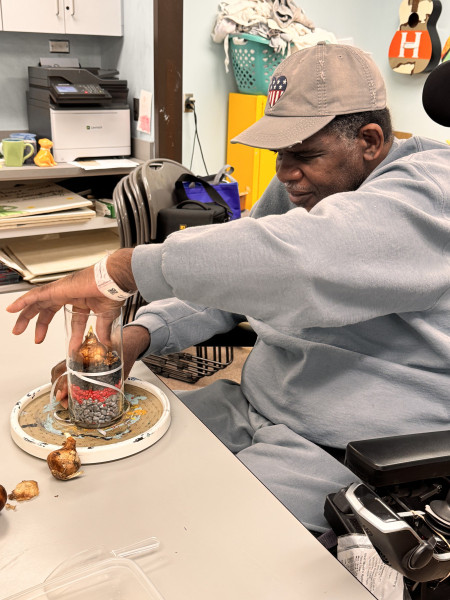 When the weather outside is frightful (or at least cold!), horticulture therapist Wendy Battaglia has plenty of ideas for how to experience horticulture indoors. She puts those ideas to good use, coming up with horticulture lessons and activities for patients like Roger Alexander.
This is Alexander’s fourth horticulture therapy session since he arrived at Shepherd after sustaining a spinal cord injury. Battaglia offered a few options for activities, and Alexander chose to plant a paperwhite bulb, or as Battaglia explains, he’s “forcing” the bulb, because rather than planting it in dirt, he placed it in a vase with pebbles and water. As he opened and closed lids to jars of colorful stones, Alexander shared his excitement about the progress he has made since his first horticulture therapy session with Battaglia a month ago.
“The first time, I couldn't even open the jars. The second time, I could open them, but it was still hard,” he explains.
He continued the task, nestling the bulb into the pebbles, writing on a label, and tying a bow — all actions that required fine motor skills.
“I was nervous the first day I came, and all I was doing was planting sunflower seeds. I could barely move my hands,” Alexander says.
On this day, he was able to clearly label his paperwhite.
“I find for so many patients this is the first time they’re trying handwriting, and they’re always surprised at how well they do,” Battaglia says.
By the end of the session, Alexander has his paperwhite planted and has instructions for its care — over the coming weeks, he’ll be able to see the roots and the shoot as they grow.
“All is well in horticulture,” Alexander says. “I love it.”
Taking a Swing
 For Shepherd Center patients, just looking out the window might spark a therapy goal. In some patient rooms and clinics, that means looking over the nearby Bobby Jones Golf Course. When the weather is good, Shepherd Center recreation therapists take groups to the golf course to try out adaptive golf. And even in the winter months, volunteers from the Georgia State Golf Association (GSGA) Adaptive Golf Program visit the hospital to introduce patients to adaptive golf equipment and share pointers to help them improve their game, regardless of their injury or illness. They, along with Shepherd Center’s recreation therapists, also help patients look for adaptive resources closer to home.
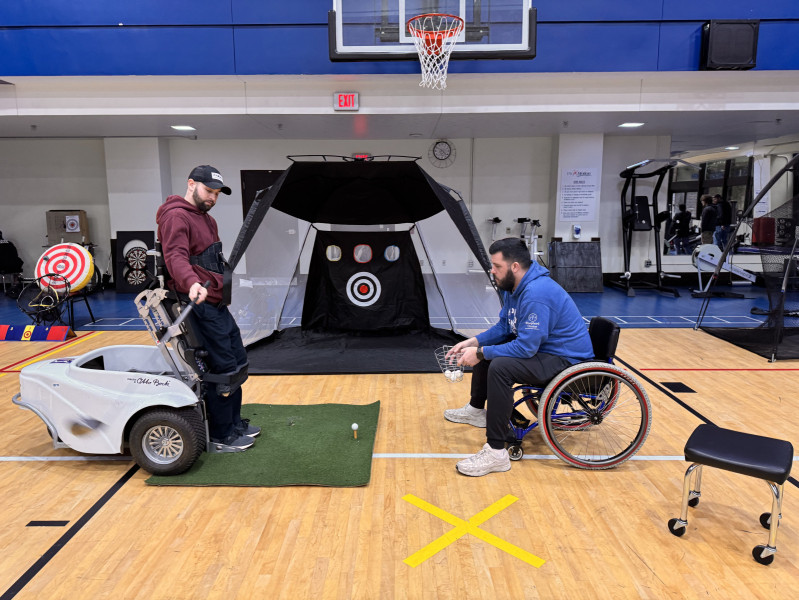
Sam Taylor, who sustained a spinal cord injury when he was shot while on duty as an Evansville, Indiana, police officer, is attending one of the golf clinics in the Livingston Gym on his last day as a Day Program patient. He practices his swing while using a ParaGolfer, an adaptive golf wheelchair that allows him to swing from a standing position. Taylor enjoyed golf before his injury and is eager to get back on the course — he saw the golf clinic as a great opportunity to give it a try. 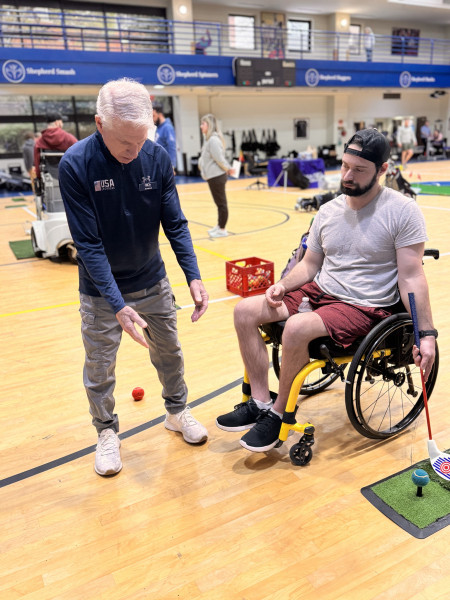
“Being in a controlled environment where I can get instructions based upon my injury ... I figured the best chance I had to start golfing again would be to learn from people who know the adaptive portion.”
In addition to trying the ParaGolfer, Taylor got some pointers on improving his swing while using his own wheelchair.
Other patients join in on the clinic too, like Josh Smith. To see Smith’s swing, you wouldn’t know this is only his second time playing golf, the first being during the previous month’s clinic in the gym. Smith is also wrapping up his time in the SCI Day Program. A putt-putt outing piqued his interest in golf, so he tried the golf clinic.
“Getting in the ParaGolfer and working with [the instructors], I was like, 'Oh, this is sweet, I definitely want to come back,’ Smith says. "My grandpa's a big golfer, too, so maybe this will be something we can have fun with, and it turns out I'm not bad at it. They're great teachers, and it's a lot of fun.”
Throwing a Pot
The walls of the art room at Shepherd Center are decked with brightly painted guitars, paintings on canvas, and colorful collages. Counters are covered with projects in progress, and shelves are filled with ceramic mugs and figurines waiting to be glazed.
Twenty-year-old Maddie Snyder rolls her wheelchair up to an adaptive pottery wheel situated in a nook at the edge of the room, the pottery studio. She pushes back her sleeves and puts on a plastic apron. Claire Tadeo, an art specialist at Shepherd Center, adjusts the table height to a comfortable level for Snyder, and her lesson on throwing a pot on the wheel is ready to begin.
After a brief pause so Snyder can text her dad a lunch takeout order, Tadeo shows her how to adjust the wheel’s speed and hands her a ball of clay, instructing her to throw it with some force at the center of the wheel. Snyder takes aim and gets the clay in a good spot on the first try.
A sophomore at North Carolina State University in Raleigh, North Carolina, Snyder came to Shepherd Center in mid-December after she was diagnosed with Guillain-Barré Syndrome. Soon, she’ll wrap up her inpatient rehabilitation and continue in the Day Program.
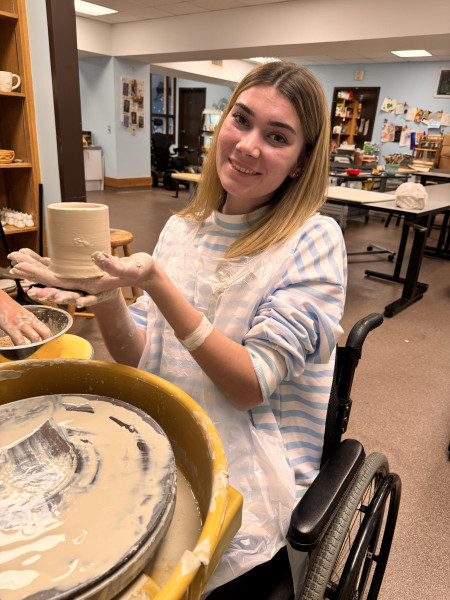 This is Snyder’s first time in the art room at Shepherd. “I felt like it would be fun and satisfying to do my own pottery,” she says.
Tadeo talks Snyder through how to center the clay on the wheel, sometimes guiding her hands to show how much pressure to apply, while telling her about the adaptive tools that are available if she needs them.
“In addition to the pottery wheel often being a new experience, it also helps work on upper body strength and upper extremity range of motion,” Tadeo explains. “To center the clay, you are utilizing your upper body to push and pull it toward the middle of the wheel. There is also a large focus on fine motor skills when creating an opening in the clay and building up the walls of your piece.”
With Tadeo’s guidance, Snyder centers the clay, presses a hole in the center, and pulls it upward, to create a cup, which she says she’ll use for pencils. She contemplates the height and decides to pull a little more clay from the bottom, to make the cup taller.
As she cleans the clay off her hands and arms, Snyder adds another reason she chose to try pottery.
“My hands were kind of shaky, and I knew I couldn’t paint pretty like I used to, so I thought, ‘Oh, that might make me sad, so I’ll try pottery, and if it doesn’t work out, oh well,’ but it was really fun.”
Snyder is working on standing and walking with some of her other therapists. She’s gotten good at transferring from her wheelchair, so next time, she might try the traditional wheel, which, Tadeo explains, requires more balance and core strength.
For now, Tadeo sets the cup on a shelf to dry. When Snyder returns for her next art therapy sessions, she’ll trim the cup, add her initials, and glaze it. Once it’s fired in the kiln, the cup will be ready for pencils — and to go home with her.
Hunting Wild Hogs
On a recent, warmer-than-usual January evening, Adam Cope sat quietly in a hunting blind with Gavin McClintock, Shepherd Center’s outdoor recreation specialist, and Brandon Clift, BS, ACSM EP-C, ACSM CIFT, CASC, sports specialist. This Shepherd Center Health and Wellness Clinic took place on a 225-acre farm in Reynolds, Georgia, owned by a former Shepherd patient, who also provided lodging for the night.
As night fell, the men had their eyes trained on the field in front of them, awaiting the arrival of wild hogs.
Cope, who has always enjoyed outdoor activities and has grown up hunting, first heard about trips like this one when he came to Shepherd Center for rehabilitation after sustaining a spinal cord injury (SCI). McClintock told him to keep an eye on the Health and Wellness Clinic calendar after his discharge and to join a trip if he could.
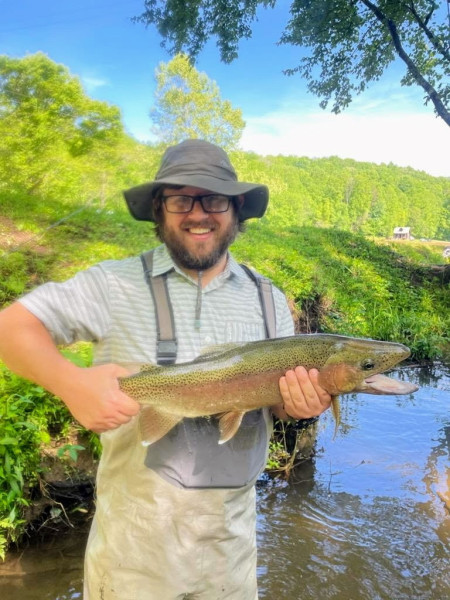 Cope says he was fortunate — now five years post-injury, he can walk independently and doesn’t have many lingering effects of his SCI beyond general weakness in his legs. He sees recreation therapy as an essential part of rehabilitation.
“I would say it's vital. I know that while I was still unsure of what my future was going to look like, one of the things I was the most anxious about was what was my recreation going to be?” he explains. “I've personally never been satisfied with just doing things at the house or, you know, arts and crafts and that sort of thing. I enjoy that stuff, but it’s never been fulfilling like getting outside.”
On this night, the group spent several hours in the ground blind. Finally, 10 to 15 hogs wandered into the area, but not for long. “I learned that hogs are actually very easy to spook,” Cope explains.
Cope has also participated in Shepherd’s fly-fishing clinics — his favorite.
“I've enjoyed the events I've come to. The fly-fishing event was the first time I've ever done that, too. So, the program has exposed me to things that I otherwise may not have done, and it adds that layer of comfort, being able to do it partnered up with Shepherd Center.”
Joining a Jam Session
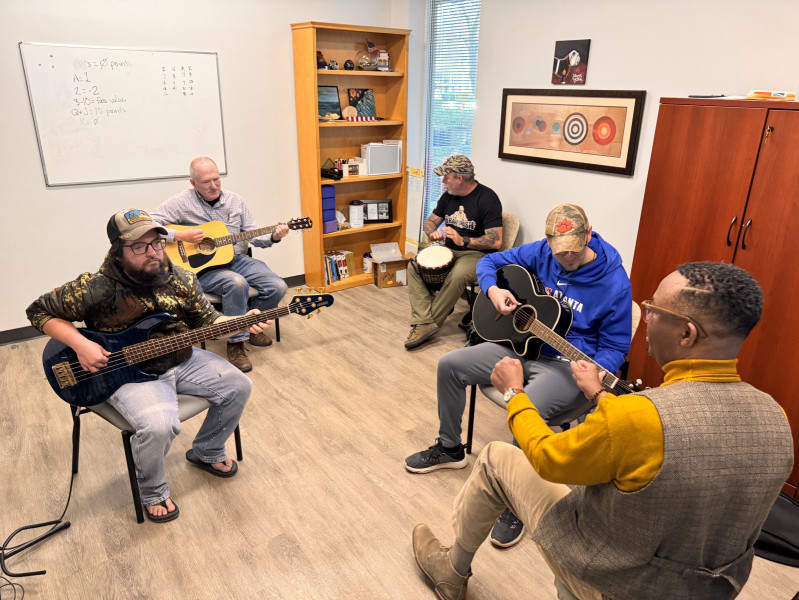 It’s a Monday morning at 9 a.m., but the recreation room at the SHARE Military Initiative is already rocking as guitar riffs and drumbeats fill the air.
SHARE clients Collin Tubbs, Corey Hickman, and Joe Merritt, along with volunteer Bruce Warren, have gathered for music therapy. Board-certified music therapist Thomas Miller checks in with everyone as they arrive. This session is Tubbs’ first, and Miller asks him what instrument he’d like to play. Tubbs suggests he might just sit and listen today, but Miller isn’t having it, encouraging him to play — Tubbs chooses a bass guitar.
As they settle in, Miller reminds another participant, “Elephants and donkeys grow big ears,” to help him remember the order of the strings on his acoustic guitar: E-A-D-G-B-E.
Miller remarks upon how comfortably Tubbs holds the bass guitar.
“Well, I used to play bass,” he admits. The group laughs since he had almost opted to observe.
They try out a Bill Withers song some members of the group worked on the previous week. Hickman, who has been at SHARE for a couple of months, says this is only his second music session. He appears to have learned a lot and says that’s because Miller is a good teacher.
“I enjoy music, and I enjoy working in a team setting — it’s more relaxing than playing on your own,” Hickman says. “And I wanted to expand my horizons a little.”
Beside him, Merritt drums on a djembe — his own. His dog, Trigger, sits beside his chair.
“Over the last two years, as my symptoms got worse, I turned to music and drumming,” Merritt shares later. “I try and play every day, when the rhythm hits. I’ve only been drumming a few months, and always on my own. I was so excited about music group!”
Warren, who is new to volunteering at Shepherd but seasoned on the acoustic guitar, accompanies them.
The group jokes with one another as they play through one song, then another, with Miller giving tips on hand position and posture, clapping out rhythms, and, once the group has the hang of it, even singing along to one of the tunes.
As they work their way through a new song, clearly enjoying the combination of focus and fun, Tubbs tells him, “I haven’t played in forever, and it’s my brain trying to keep up with all this stuff.”
“I’m glad I didn’t let you just sit and listen,” Miller replies.
Building Community
Birdwatching, horticulture, jewelry making, book club, yoga — Pam Gavin has attended dozens of Shepherd Center’s Health and Wellness Clinics.
“I’m very outgoing, I like people, I like to try new things, and I really love Katie [Harmon, CTRS, health and wellness program lead],” she explains. “And I love life!”
That love for people and zest for life are evident in how she spends her time. Now 70 years old, Gavin, who was born with cerebral palsy, has lived independently for most of her adult life. After graduating from college and earning a master’s degree in social work, she began volunteering three days a week at St. Vincent Hospital in Indianapolis, where she lived until recently. She served thousands of hours at the hospital and won a “Health Care Heroes” award for her service.
So, when family and life circumstances made moving to Georgia to be closer to her sister, Lynn, seem like a wise choice, Gavin had to leave her volunteer role and the support system she had built. When she got to Atlanta, she saw Shepherd’s Health and Wellness Clinics as an opportunity to try new things, meet new people, and create a new community.
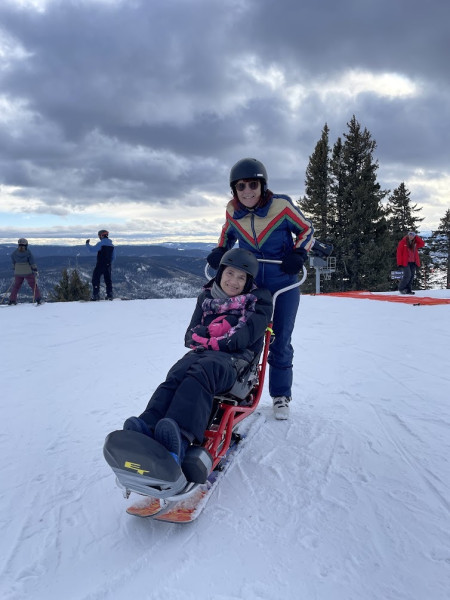 And she’s doing just that. She’s been to Chastain Park for a horsemanship clinic where she rode the aptly named “Elvis,” a mechanical horse who “rocks and rolls,” helping her work on her balance. She’s attended craft-making workshops, a weekend at Camp Twin Lakes for outdoor and adventure-based activities, and, one of her favorites, joined trips to the Atlanta Botanical Garden. She especially enjoys the horticulture clinics and says many of the same people attend each session.
"Everyone who gets to know Pam loves her — clinic participants and staff alike,” says Harmon, who organizes Shepherd’s health and wellness clinics.
Recently, Gavin and her sister went on a bucket-list ski trip to Steamboat Springs, Colorado, organized by Shepherd in partnership with Steamboat Adaptive Recreational Sports (STARS) and sponsored by the Jack Trottier Foundation, which helps offset the trip’s cost for participants.
“[The group] stayed together in a nice big lodge, and they’ve got big rooms with nice bathrooms, and everything is accessible,” Gavin says.
"I had never been skiing in my life because I didn’t think it was possible — and what I’m learning about Shepherd is that they make everything become possible — I don’t know how they do it, but they make everything become possible."
Written by Ruth Underwood
With five decades of experience, Shepherd Center provides world-class clinical care, research, and family support for people experiencing the most complex conditions, including spinal cord and brain injuries, multi-trauma, traumatic amputations, stroke, multiple sclerosis, and pain. An elite center ranked by U.S. News as one of the nation’s top hospitals for rehabilitation, Shepherd Center is also recognized as both Spinal Cord Injury and Traumatic Brain Injury Model Systems. Shepherd Center treats thousands of patients annually with unmatched expertise and unwavering compassion to help them begin again.