


Food for the Body and Soul
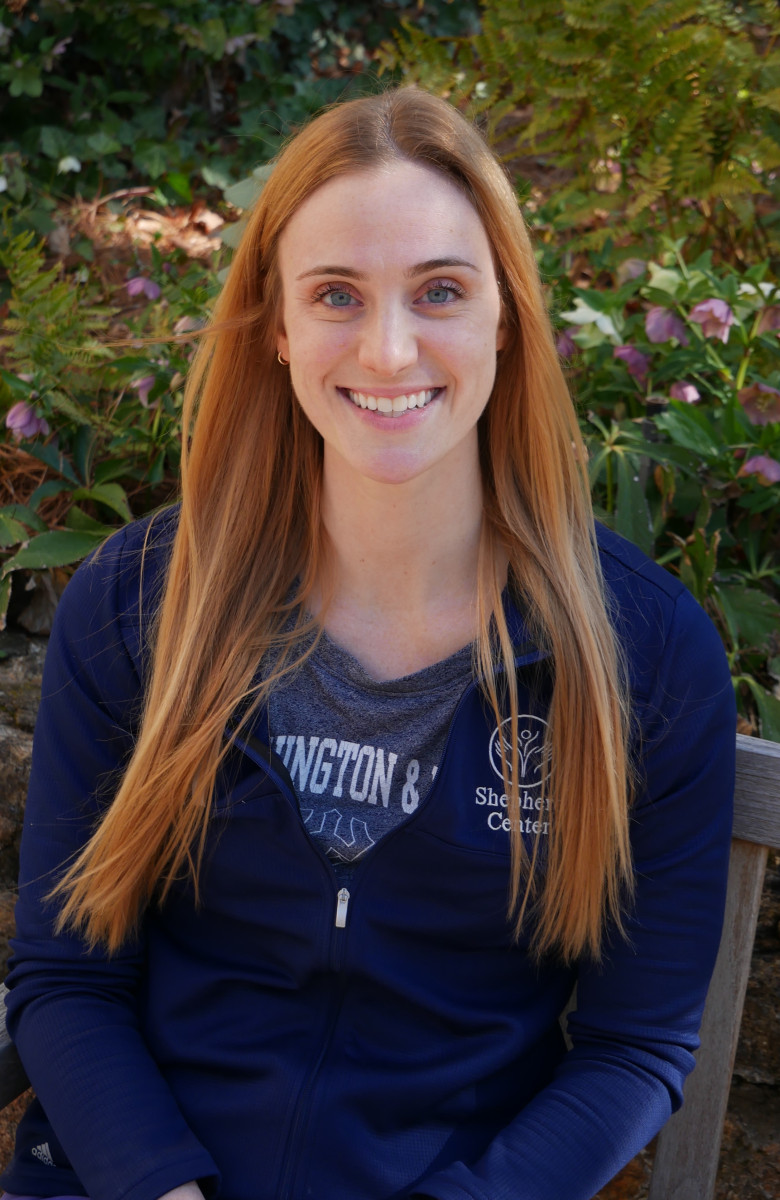
Clinical dietitian Allison Biumi, RD, LD, CNSC, appreciates the difference nutrition makes in Shepherd patients' health and healing.
How long have you worked at Shepherd, and what is your role?
I just hit eight years at Shepherd in January. I am a dietitian, and I primarily work with patients with brain injury, but I also work with some patients with spinal cord injury. I tend to care for patients with brain injuries with lower-level function, so it's a lot heavier on the tube feeding, more mathematical side of stuff — looking at labs, looking at medications — and then also education with patients who have had a stroke, need weight management, or have diabetes.
How did you choose this career?
I have always loved to cook. I love to eat. I'm a big foodie, so when I was exposed to how nutrition can be a big part of the healing process, too, and how it can impact your overall health, it was really interesting. So that initially drew me in — that food can taste good and still be good for you — but also balancing the stuff that tastes good but may not be as good for you because I'm a big believer that nothing's off-limits. Everything can be included in a healthy diet. Sometimes, food is more for the soul than heart health or nourishment, so just educating people on how to balance it all has been a passion of mine.
What made you want to work at Shepherd?
I was working PRN (as needed) at Shepherd and another hospital. Then, I switched over to full-time when a position opened here. I did see — especially working at two hospitals at the same time — a big difference in the quality of care and the interest in nutrition a lot of times, too. In the acute care setting, it would feel like nutrition would be an afterthought. But since we work with patients with traumatic injuries and illnesses at Shepherd, I feel like there’s a lot more interest in nutrition. The families and patients see how nutrition can have such a big impact on the healing process and progression of therapies. The continuation of care is really nice, too — just getting to know the family more deeply here with the extended stay times.
What were your impressions when you first started working at Shepherd?
Since I was PRN, I was in and out, but people remembered me. Even if I'd go long stretches without working, they remembered, at least that I was a nutritionist. Nurses I talked to would care and ask, ‘Oh, where's Jill?’ or ‘Where's Erin?’ when I would be covering for another dietitian. That family camaraderie feeling was one of the big things that stood out to me here.
What was one of your best days at work?
One that comes to mind recently was we had a patient with a sacral wound who had two flap surgeries that failed. He had done everything — he was a healthy weight, he was doing the supplements that we do post-op for skin, his appetite was good. We couldn't figure out why he had two failed flaps. So, we ended up running a test using research called indirect calorimetry. It's a really specialized testing system that not every hospital's lucky enough to have access to. And the patient’s protein needs ended up coming back a good bit higher than we thought. So, we adjusted the nutrition intervention we were doing. We significantly increased his protein supplementation and saw almost overnight improvement in his skin. The team was just so in awe. The wound care nurse came up to me and said, ‘I've never seen skin close five centimeters in a week,’ and the nurse said, ‘You guys did awesome with this!’ So, that was really rewarding to see the difference that you made for the patient. The team was really appreciative of how a small change in a nutrition intervention made a huge impact on this guy's health and healing.
What do you love most about your job?
I really like that I feel like a valued member of my team. I know the nurses and the doctors will come to me, asking questions and looking for advice. They recognize the importance of nutrition, and they want to hear my opinions and thoughts. And the staff I work with — the other dietitians — are great, too. They're super supportive. We’re always asking each other how we can help each other. We're always looking to improve. We've made some changes to the formulas we've carried over the years to make sure we're offering our patients the best. I like that we've been able to make changes and improve the quality of care we're giving patients — and that we're staying up to date with the most updated recommendations for people.
Education
University of Georgia, Bachelor of Science, Dietetics
Graduate internship for nutrition at Emory University Hospital
Certified Nutrition Support Clinician (CNSC) certification, 2023
Fun Facts
Allison minored in French.
She has two cats, Kobe and Nessa (short for Vanessa, after Kobe Bryant’s wife).
She and her husband love to travel and have visited close to 20 different countries.
They also love trying new restaurants and have an ongoing list they update with new spots they’d like to try. So far, they’ve visited more than 100 places on their list!
Allison loves to read and reads over 30 books every year.
Interview by Ruth Underwood
With five decades of experience, Shepherd Center provides world-class clinical care, research, and family support for people experiencing the most complex conditions, including spinal cord and brain injuries, multi-trauma, traumatic amputations, stroke, multiple sclerosis, and pain. An elite center ranked by U.S. News as one of the nation’s top hospitals for rehabilitation, Shepherd Center is also recognized as both Spinal Cord Injury and Traumatic Brain Injury Model Systems. Shepherd Center treats thousands of patients annually with unmatched expertise and unwavering compassion to help them begin again.