


Fast Break!
Shepherd Center Staff, Alumni Make History in Wheelchair Handball World Championship
When Mackenzie “Mack” Johnson and Chayse Wolf hit the court in Cairo, Egypt, for the International Handball Federation (IHF) Wheelchair Handball World Championship, it was their first time playing the sport on the world stage.
It was also their first time playing the sport on any stage — the two former Shepherd Center patients started playing handball this summer after USA Team Handball announced the launch of the country’s first Wheelchair National Team.
Over the course of a few months, the Wheelchair National Team has gone from a blank slate to boasting a full roster of elite athletes and coaching staff, not to mention winning a silver medal at the world championship. Shepherd Center staff and former patients played a key role in the team’s journey to its first international competition, and their sights are set on 2032 and beyond.
A whirlwind summer
Lisa Eagen, BS, ACSM-CPT, lead exercise physiologist in the ProMotion Fitness Center at Shepherd Center, has always loved the Olympics. In eighth grade, she even wrote an essay about becoming an Olympic track and field athlete, breaking records set by the track and field legend Jackie Joyner-Kersee.
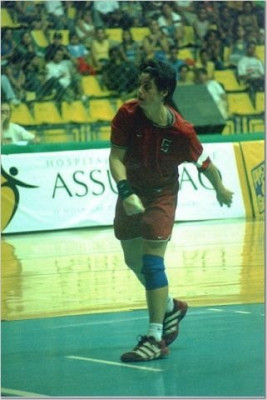 While Eagen never made it onto the Olympic track, she did represent the United States in another Olympic sport: handball. Her softball coach at Iowa State recommended she try the sport, and the rest is history. Eagen played with Team USA in the 1995 Pan American Games, where they took home the gold medal. She also played in the 1996 Olympics in Atlanta. After her Olympic appearance, she played professionally in Norway and Germany. She retired from the sport in 2003.
“After I retired, I took myself away from handball for a while — I was married to it for so long,” she says.
That changed, however, when she heard about the formation of the new wheelchair team. USA Team Handball launched the Wheelchair National Team in June, after the United States was unanimously awarded the wild card slot for the 3rd IHF Wheelchair Handball World Championship, which was held in Cairo from Sept. 16 to 21.
One of the assistant coaches for the wheelchair team, Reita Clanton, was one of Eagen’s coaches in the ’96 Olympics. Clanton invited Eagen to watch tryouts, which led to an offer to join the coaching staff. The whole process helped Eagen fall in love with the sport all over again.
“It got my heart back into handball, and it was just neat teaching the athletes,” Eagen says. “These athletes are spectacular. Most of the athletes are either current or former college wheelchair basketball athletes. Some play multiple sports, like wheelchair football or lacrosse.”
Johnson and Wolf both had stellar athletic careers even before joining the handball team. Wolf was an All-American wheelchair basketball player at Edinboro University before playing professionally in Germany. Johnson was a wheelchair basketball star at Auburn and participated in the Challenged Athletes Foundation’s Million Dollar Challenge, handcycling part of a 620-mile route in California. Most recently, the two played for the Charlotte Rollin’ Hornets wheelchair basketball team in Charlotte, North Carolina.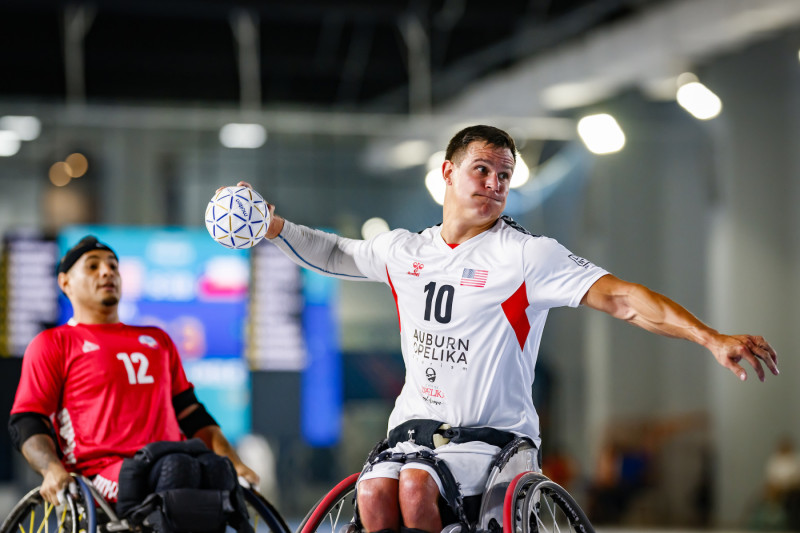
When they heard about the new handball team, they were up for the challenge of trying something new.
“I heard about the opportunity with handball, and all I had going into it was watching a few YouTube videos,” Johnson says. “Just like any other millennial, I looked it up on YouTube and thought, ‘I think I can do what they’re doing.’”
The training schedule moved quickly, with the team meeting over Labor Day weekend for their last group training session before their competition in Egypt. The team members came from various backgrounds, with the players’ ages ranging from 17 to 45.
Despite the summer being a whirlwind for the new handball players, Wolf says the coaching staff helped the team prepare for the tournament.
“I give props to the coaching staff and to everybody in the background that is handling all the sponsorships,” Wolf says. “The fact that they figured this out so quickly is pretty amazing.”
A tough competition
After their flight to Egypt and a couple of “friendlies” — scrimmage games against the championship host, Egypt — the competition started for the rookie USA team. After a rough first match against the reigning world champs, Brazil, the team wasn’t a favorite heading into their match against Japan. But they won, and they kept winning, beating out Brazil in the semi-finals to go to the gold medal game.
“It was just amazing,” Eagen says. “We had broken Brazil’s 11-game winning streak. At that moment, it was like, ‘OK, we’re going to be in the gold medal match. We’ve already made history.’”
The team was the first USA handball team of any discipline (men’s, women’s, indoor, beach, etc.) to medal at a world championship. But ultimately, Team USA fell to Egypt. The team, which had their eyes set on gold since their formation this summer, had to settle for silver, still a remarkable accomplishment for the fledgling team.
Despite the history-making outcome in Cairo, many of the athletes were initially disappointed. But by the time they got on the plane to come home, many of their spirits had been lifted, Eagen says. If anything, the silver medal only adds to the motivation for future competitions.
Sights set on Brisbane
The team trained for the world championship all summer, but the tournament in Cairo was anything but the finish line. Eagen says the coaching staff is already planning ways to continue developing the team through the 2032 Paralympics in Brisbane, Australia, when the wheelchair handball community expects the sport to be added to the Paralympic Games.
In the meantime, however, the coaches are planning for the more immediate future. This year, Eagen is working on identifying more athletes to join the team, including more Shepherd Center alumni. The team is also preparing to go up against Brazil again in this year’s continental championships. They’re trying to bring the 2026 IHF World Championships to Los Angeles, where handball may be an exhibition sport for the 2028 Paralympics. And they’re trying to recruit more sponsors to pay for training and travel costs.
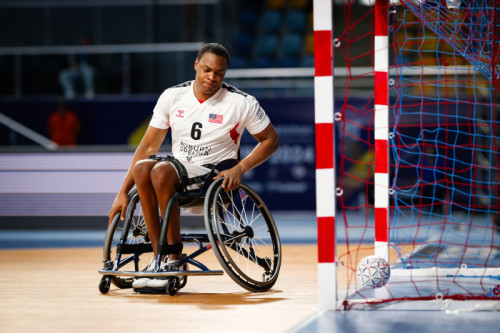 Costs add up quickly for the team, and the priority is making sure the athletes don’t have to pay for anything, Eagen says. She thanked Delta Air Lines for giving the team discounted airfare to Egypt, and for their help with everything from helping athletes unload gear at the curb to setting aside a conference room for the team to wait in before their flight. Other organizations have also stepped up to sponsor the team.
“Shepherd has always been supportive of adaptive sports, and they are helping us through this journey,” Eagen says. For more information on supporting the team, you can visit their website.
As for Wolf and Johnson, they’re eager to continue developing their own handball skills and building the team from the ground up, looking to be part of the next history-making moment for USA Team Handball.
“We have to establish that foundation — building our team and going out there and competing and seeing where we land over the next four years,” Johnson says. “I’m excited for that.”
Written By Erin Kenney
With five decades of experience, Shepherd Center provides world-class clinical care, research, and family support for people experiencing the most complex conditions, including spinal cord and brain injuries, multi-trauma, traumatic amputations, stroke, multiple sclerosis, and pain. An elite center ranked by U.S. News as one of the nation’s top hospitals for rehabilitation, Shepherd Center is also recognized as both Spinal Cord Injury and Traumatic Brain Injury Model Systems. Shepherd Center treats thousands of patients annually with unmatched expertise and unwavering compassion to help them begin again.