


'Live Happy'
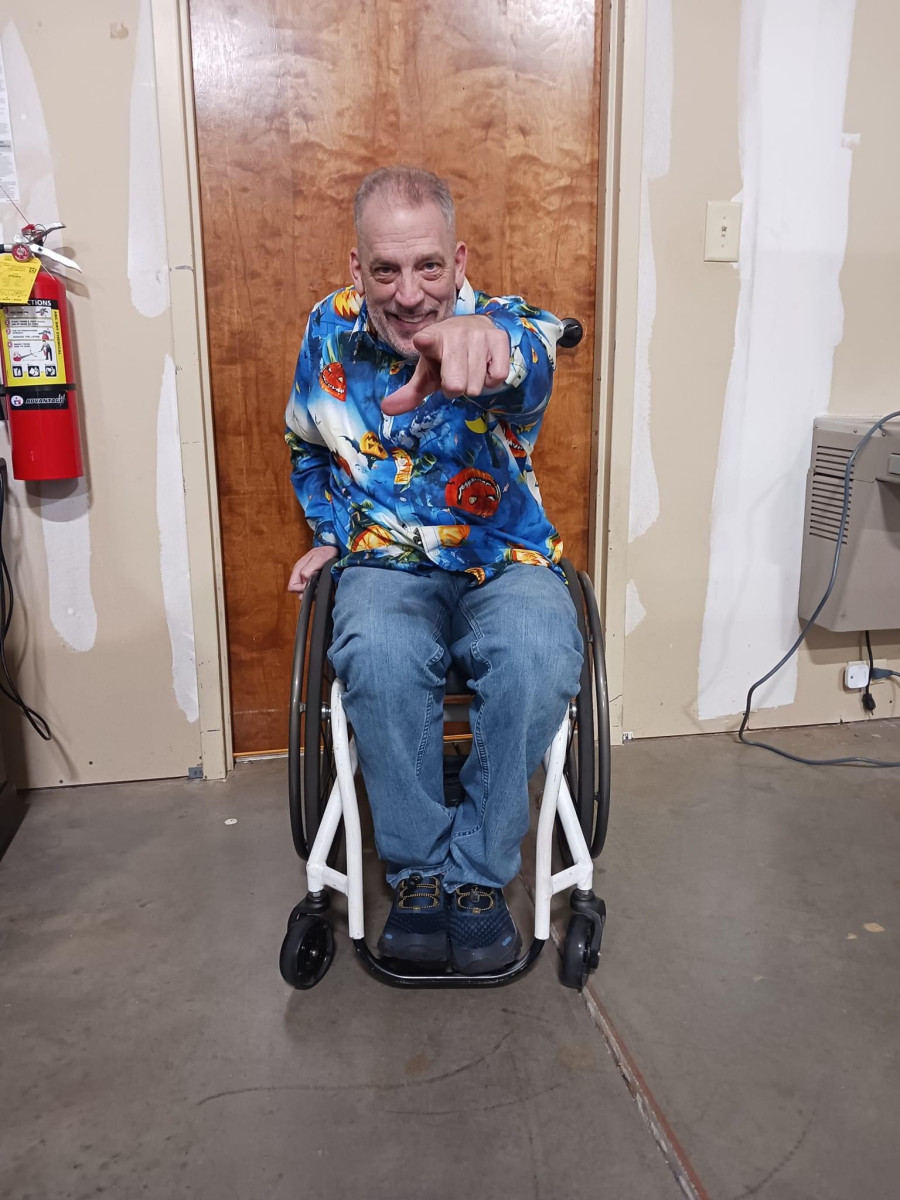
After living with a spinal cord injury for 36 years, Clint Cook reflects on his journey and the key to having a happy life.
As a young man, Clint Cook, now 56, didn’t understand one of his dad’s favorite sayings, “Son, you can’t keep it if you don’t give it away.”
“Being a materialistic person at a young age, I always thought, ‘Well, I'm not giving my stuff away!’” Clint laughs. “What my dad really meant was you’ll always feel fulfilled if you give to others. If you're someone like me who has lived with a spinal cord injury for 36 years, you need to tell someone who’s new to spinal cord injury how you got to where you are today. When I do that, it comes back to me ten-fold.”
That spirit of giving back to the spinal cord injury (SCI) community has shaped Clint’s life, and it all began on the evening of April 8, 1988.
“It was a normal day. I went to work, came home, washed my car. I was 20 years old and unfortunately decided to do the wrong thing. I had been out drinking at the pool hall and decided to race a buddy of mine in my new Trans Am.”
Clint went around a curve too fast and lost control of the car. Because he was not wearing a seatbelt, he was ejected on impact. The car continued to flip and landed on top of him, wrapping him between the front tire and engine, resulting in severe burns on his back and an incomplete C-5 SCI.
After three months in the ICU, Clint transferred to Shepherd Center. He received a skin graft at Piedmont Hospital to replace the burnt skin on his back. Once he was cleared medically, he began his rehabilitation journey in Shepherd’s Spinal Cord Injury Rehabilitation Program.
“My first memory of Shepherd was how excited and happy everybody was,” Clint says. “You are dealing with a traumatic injury, and I was amazed at how positive and professional my care was.”
After a day of physical and occupational therapy, Clint was surprised when a Shepherd staff member he hadn’t met came to his room.
“An employee around my age with an SCI comes in after he already finished his day at work to talk about life after SCI,” Clint explains. “I looked up to him as a mentor. I felt so fortunate that this guy spent his own time just to tell me that it was going to be okay. There would be life after this.”
 Clint had the opportunity to plan what life after SCI would look like with his vocational rehabilitation therapist.
“Vocational rehabilitation was life-changing,” Clint says. “The therapist helped me focus on what I was able to do today and what would make me happy.”
Clint shared that he loved music and wouldn’t mind working in the music industry but didn’t know how he would realistically be able to attend college.
“College was never a thing for me – I didn’t think I could pay for it, and I thought learning a trade was my destiny just like my father, his father, and down the line,” Clint says. “My vocational rehab therapist showed me how the state of Georgia could help me pay for school, and I said, ‘Where do I sign up?’”
Clint discharged from Shepherd in October 1988 and started college at the Atlanta Art Institute in March 1989. He obtained his associate degree in two years and began working at his dream job doing music production and research at local Atlanta radio station, 96 Rock. He now works in the medical sales industry but looks back fondly on the experience and confidence he gained in his first job after sustaining his injury.
Clint has lived a rich life since that fateful car crash. He started the first wheelchair rugby team on the East Coast at Shepherd Center, now known as the Shepherd Smash, and played on the team until 1996. He served as president of the United Spinal Association of Georgia for three years. In 2017, he even founded a nonprofit called Spinal Cord Injury USA that helps connect people with SCI to talk about all aspects of living with SCI online and during in-person events. The group started with Clint posing questions to a Facebook group to get discussions going. It has taken on a life of its own, growing to nearly 15,000 members.
Above all, Clint’s focus has been to “live happy,” and encouraging others to do the same remains his passion.
“I’ll never stop being involved in the SCI community. When you help someone, you gain so much personally, too,” Clint says. “For the newly injured or anyone who may be struggling with their situation, I just want to say, ‘Don’t wait until tomorrow to start living. Start today.’”
By Damjana Alverson
This story first appeared in the special 50th anniversary issue of Spinal Column magazine.
With five decades of experience, Shepherd Center provides world-class clinical care, research, and family support for people experiencing the most complex conditions, including spinal cord and brain injuries, multi-trauma, traumatic amputations, stroke, multiple sclerosis, and pain. An elite center ranked by U.S. News as one of the nation’s top hospitals for rehabilitation, Shepherd Center is also recognized as both Spinal Cord Injury and Traumatic Brain Injury Model Systems. Shepherd Center treats thousands of patients annually with unmatched expertise and unwavering compassion to help them begin again.