


Celebrating Over Four Years CLABSI-Free
Staff Across Hospital Programs Partner to Prevent Central Line Associated Bloodstream Infections
Central lines, or central venous catheters, are similar to an intravenous (IV) line and can be an invaluable tool for giving patients fluids, medications, and nutrition. But unlike an IV, they are much longer and travel up the vein to or near the heart, which can increase risk for infection.
Central line-associated bloodstream infections (CLABSI) can occur when microbes like bacteria or fungi enter a patient’s bloodstream through their central line. They can be extremely dangerous, as well as difficult and costly to treat. Thankfully, this summer, Shepherd Center celebrated four years of being CLABSI-free — a streak that continues today.
This streak isn’t luck, but instead the result of dedicated efforts from departments across Shepherd. One key player is Infection Preventionist Ginnie Campbell. Before coming to Shepherd, Campbell worked in acute care hospital settings across Atlanta, where she led infection prevention efforts. She says that while acute care hospitals often have more central lines to manage than Shepherd Center, Shepherd’s patients are still at a high risk of infection.
“We have some higher risk because our patients are here so long,” she says. “For example, with TPN [total parenteral nutrition, a mixture of nutrients delivered via a central line], there’s a huge risk of fungemia [fungi in the blood]. All lines can be very tough to manage, but we’ve got some good processes helping to keep [infections] under control.”
CLABSI prevention efforts have included changing central line dressings on admission, using disinfecting caps on central lines, and maintaining sterile techniques during line insertion and dressing changes. Additionally, Shepherd Center has partnered with PICC Access, a team of vascular access specialists who place peripherally inserted central catheters (PICCs), midline catheters, and perform other vascular access services.
Another key part of infection prevention is removing central lines that are no longer in use. The hospital’s nursing staff, led by Chief Nursing Officer Tiffany LeCroy, MSN, RN, CRRN, FNP-C, ACNS-BC, FARN, has been crucial in implementing these efforts.
“Nursing has really just done a great job,” LeCroy says. “When they notice a line is unused, they will approach a physician or a provider and remind them of the dormant line that potentially could be an avenue for infection. They really are the driver to ensure that lines are being used, and if they’re not, they remind the providers.”
Shepherd’s pharmacy team has also helped with CLABSI prevention by identifying when central lines can be removed, or by finding alternate methods to deliver medications, like using peripheral IVs or administering medication orally. Lauren Wilcox, PharmD, clinical pharmacist and Antimicrobial Stewardship Committee lead, says the pharmacy team rounds with physicians each week, documents medication needs, and helps identify when central lines and other IVs can be removed. She says patients also can play a key role in that process.
“There are patients who will advocate for themselves as well,” she says. “[They’ll ask] ‘When can I get [my central line] out? I don’t like this.’ I’ve been in the room when that’s happened, and I think, ‘Good idea! That’s on my list.’”
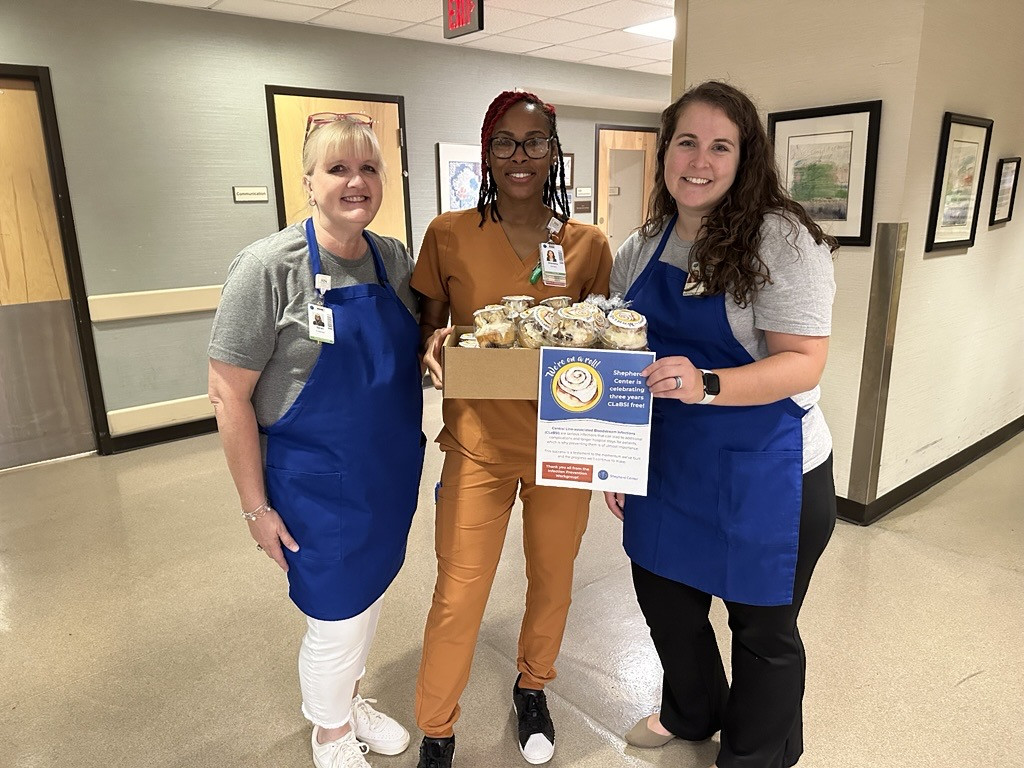
Ali Anderson, senior improvement consultant in Quality and Outcomes Management, also monitors CLABSI prevention efforts, helping with cause analysis and documenting successes along the way. She worked with Sarah Culberson, BSN, RN, CIC, Shepherd Center’s former infection prevention specialist, to celebrate three years of being CLABSI-free in 2024. Using the theme “We’re On a Roll,” they worked with Food and Nutrition Services to bake and deliver over 800 cinnamon rolls for staff as a token of appreciation for their hard work.
“We gave out the cinnamon rolls for a week straight — including night shifts and on the weekends — because the staff here at those times are helping with this effort,” Anderson says. “They change central line dressings on Sunday, so we wanted to be there to celebrate them, not only the daytime weekday staff who are here when we’re working.”
Written by Erin Kenney
With five decades of experience, Shepherd Center provides world-class clinical care, research, and family support for people experiencing the most complex conditions, including spinal cord and brain injuries, multi-trauma, traumatic amputations, stroke, multiple sclerosis, and pain. An elite center ranked by U.S. News as one of the nation’s top hospitals for rehabilitation, Shepherd Center is also recognized as both Spinal Cord Injury and Traumatic Brain Injury Model Systems. Shepherd Center treats thousands of patients annually with unmatched expertise and unwavering compassion to help them begin again.