


A Unique Journey
If you ask anyone with personal or professional experience with recovery following a brain injury, they’ll tell you that every injury and every path to recovery is as unique as the person affected. In recognition of Brain Injury Awareness Month this March, we tagged along to therapy with a few patients who sustained brain injuries to learn about their goals and what they’re doing in therapy to reach them.
Landon Simpson
OT Goals – Cervical control, increased arm movement, sitting upright
PT Goals – Walking
19-year-old Landon Simpson transferred from Vanderbilt University Medical Center in Nashville, Tennessee, to Shepherd Center’s Disorders of Consciousness Program in October after sustaining a brain injury in a car crash in August. His therapy team has been working with him ever since his arrival at Shepherd. He emerged in January, and today, he has back-to-back occupational and physical therapy sessions.
His occupational therapist, Corrie Samples, MS, OTR/L, and PT/OT aide Fred Tuppings, are helping Landon position himself over a peanut-shaped ball for an exercise on the therapy mat.
Corrie explains that Landon has bilateral tone in his arms and a preference for a flexed position with his arms, neck, and trunk. In therapy, the focus is on strengthening the antagonist (opposing muscles) to assist him with improved head position, sitting balance, and upper extremity strength and movement.
Landon’s mom, Ashlie, attends most of his therapy sessions, encouraging him and jumping in to help when she can. She’s been at Shepherd with Landon ever since he arrived, sleeping in his room at night, and sometimes heading to the family’s apartment in the Arthur M. Blank Family Residences between therapy sessions to do laundry or take a break. Other family members — Landon’s dad and his grandmother (Ashlie’s mom) stay in the apartment for weeks at a time to support Landon and Ashlie.
“It's very hard,” she says. “But he has improved a lot, so just praying every day that he continues to improve.”
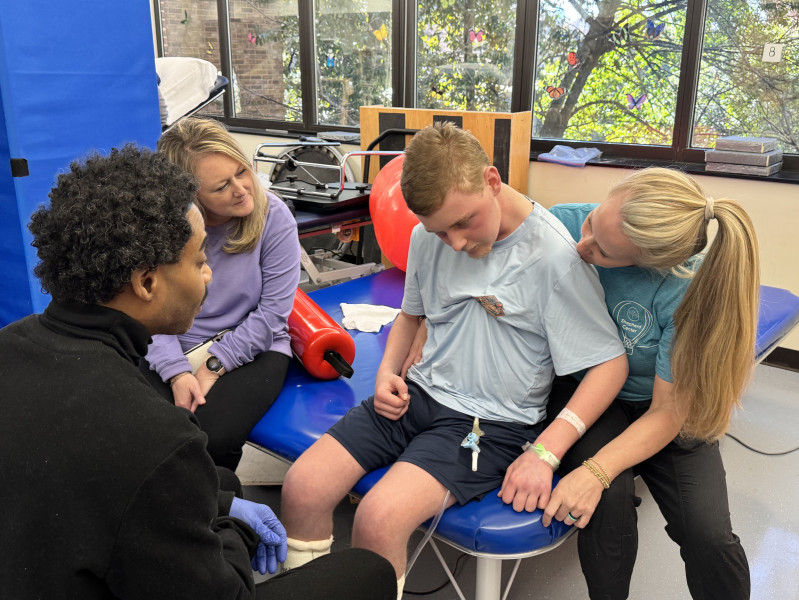 During his OT session, Corrie challenges and cajoles Landon, sometimes using reverse psychology to motivate him.
“Take a break if you need a break, but put your arms down,” she tells him. Then, when Landon leaves his arms folded against his chest, she jokes, “Okay, don't put your arms down. Whatever you do, keep them up on your chest. Right under your chin.”
Landon works on sitting up at the edge of the mat. Corrie guides him to lift his head, put his hands on the mat, and engage his core to support himself. Sometimes Landon says “no” to Corrie’s instructions, and you can see his frustration. Other times, he shares an impish grin.
“I want to see that handsome smile,” Ashlie tells him. “Lift your head up. This is going to make you stronger.”
Ashlie says Landon loves being outside — playing golf, duck hunting, and fishing. He’s also always had a strong work ethic, and before his injury, he was working with an electrician and training to become one himself. She and Landon FaceTime with his girlfriend back home in Clinton, Kentucky, every day, and her name comes up as motivation during therapy.
Sometimes, to better understand what Landon is trying to communicate, Ashlie brings a letter board so he can point to the first letter of the word. The day before, he was saying his dad’s name a lot. Today, he’s saying his girlfriend’s name.
At the end of a session filled with sitting, standing, and stretches, Corrie gives Landon a few minutes to rest on the mat before his physical therapy session begins.
He has casts over his feet and lower legs since he recently had surgery to release his contracted Achilles tendons. The surgery will allow him to keep his feet flat when he walks, rather than walking on tiptoes.
After OT, Landon heads across the gym for physical therapy with Ryan Gill, PT, DPT, NCS. Today, he’s going to be walking using the ZeroG Gait and Balance System, which provides body-weight support so he can safely practice walking. Beth DeBee, PT, DPT, NCS, and Matthew Yin, a PT/OT aide, join to help with the session.
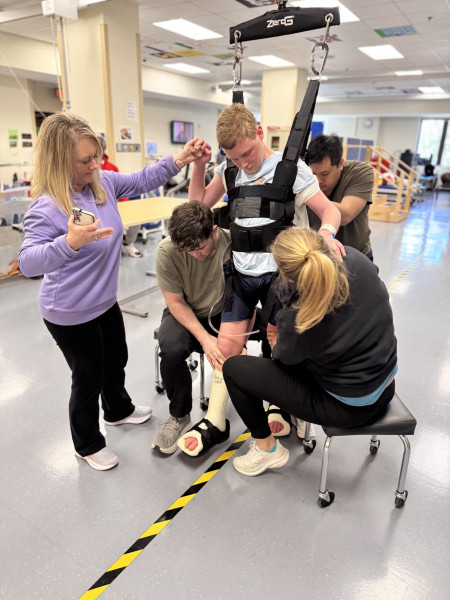 Once Landon is harnessed into the ZeroG, the team guides him through the motions of walking several yards along a black-and-yellow line that runs across part of the gym. Landon’s grandmother, Rosemary, joins the group and shares encouraging words.
They support Landon as he moves down the line, let him stop for a brief rest, then head back in the opposite direction. Sometimes Ashlie joins in, holding Landon’s hands steady and encouraging him.
Ashlie and Ryan talk about the boots they have on order for Landon’s feet after the casts are removed, as well as a new wheelchair.
In a week or two, Landon will head to Shepherd Pathways to continue therapy on an outpatient basis there. Ashlie is grateful for his progress up to this point and the therapists who have worked with him.
“We've always had Corrie, Ryan, and Aubrey (Landon’s speech-language pathologist), and Landon’s nurse, Carrie, from day one, and they've been great,” Ashlie says. “We've gotten this far because of them.”
Laura Snyder
PT Goals – transfers, standing, walking
“Stunning.” That’s physical therapist Payton Pulver’s recent word of choice to describe impressive progress by her patient, Laura Snyder.
On the day of this therapy session, Laura has been at Shepherd Center for almost three weeks.
“My husband Bill is going to join us,” she says before the therapy session begins. “He is definitely my partner. It would be a mess if I didn’t have him here.”
In December, Laura fell and hit her head, which led to a brain bleed, causing weakness on her left side. After brain surgery and five weeks at East Carolina University Health in Greenville, North Carolina, she transferred to Shepherd. She has been using a manual wheelchair, but in physical therapy, she’s working on standing and walking.
Since surgeons had to remove part of her skull to address the brain bleed, Laura wears a protective helmet. She also wears prism glasses to help adjust her perception of where she is in space and correct her posture. The glasses are an important intervention for people with visual impairment due to a brain injury and can help with balance and peripheral awareness. Payton also puts a brace on Laura’s ankle.
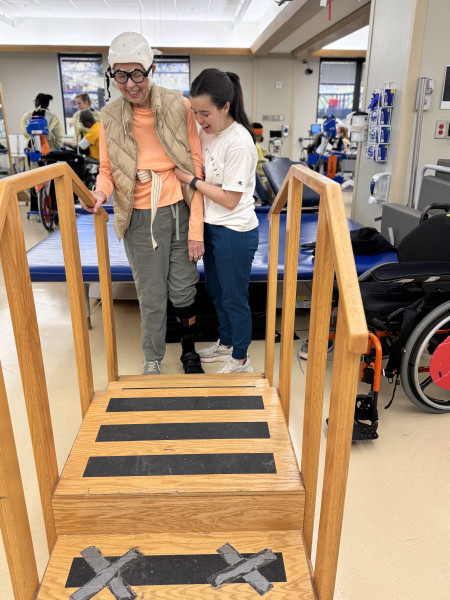 “It works with her knee, too, to help her lift up her toes, and also keep her knee bent, because she tends to hyperextend her knee,” Payton explains. “So, I’m trying to give a little more support at the ankle and the knee.”
Laura’s shoe doesn’t fit over the brace, so she wears a larger one, which she calls “the big goober.”
First, Laura works on “sit and stands” with Payton. Then, while Laura is standing, Payton asks her to shift her weight to the right and raise and lower her left foot. From there, they try a set of portable stairs, and Laura makes it to the top.
“I can get into my house!” she exclaims with a grin.
Bill looks on. He says that Laura has that smile “every minute of every day. She lights up a room.”
In therapy, Laura is working on transfers, walking, and standing.
“You know, just all those very basic things, but I'm getting there. It just takes time. You work on little things, you go to this therapy, and you work on this particular thing, and you go to this [therapy], and then you begin to see how they all come together.”
Laura has conquered the stairs, but she and Payton aren’t done for the day. They move to the hallway where Laura will practice walking while holding onto a wall rail, which Laura says she doesn’t particularly like.
Laura holds onto the railing, Payton stands in front of her for support, and Bill follows behind with the wheelchair ready if needed.
She takes one step, then another, moving the “big goober” of a shoe forward. Payton reminds her to focus and not to lock her knee.
“Laura, you’re walking!” Payton says.
Laura’s husband Bill chimes in, “Yeah, you are!”
Laura lets out a big “YeeHee!” All with the broad smile she’s worn for most of her physical therapy session.
Stunning.
Aaron Hurd
SLP Goals – word retrieval, sentence structure, complex conversations
Thirty-two-year-old Aaron Hurd and his speech-language pathologist, Amanda Goldman, CCC-SLP, first focus on a worksheet resembling a Mad Lib — several paragraphs in which he’ll fill in the blanks to create logical sentences. As he worked on a similar exercise in a previous session, they decide Aaron will complete the worksheet for homework, and they move on to another exercise.
Last December, Aaron had a hemorrhagic stroke, which affected his speech and caused paralysis on his right side. After a month at Wellstar Kennestone Regional Medical Center in Marietta, Georgia, he transferred to Shepherd’s inpatient Brain Injury Rehabilitation Program. There, he worked with therapists on improving his vision, walking, and speech.
He graduated from the program at the beginning of March and is in his second week at Shepherd Pathways to continue therapy on an outpatient basis. Therapy will continue to target his vision, mobility, and speech to support Aaron’s long-term goals of returning to work and driving.
Aaron wears prism glasses over his own glasses to improve his depth perception, balance, and posture. After putting away his homework, he scrolls on his phone for a moment until he finds a job posting with a description that resembles his own job as a senior manager for payments.
“We’re trying to get Aaron to be able to write or verbalize a job description because he’s having trouble with more complex topics,” Amanda explains. “Then, he can tell people what he does for work, because right now he uses a lot of empty words… so lots of ‘things,’ right? she says to Aaron, “And ‘ums,’ when he’s trying to figure the word he wants to say and out how all the words go together.”
Aaron reads the description aloud. He struggles with some of the more complicated words, and Amanda offers starting sounds and gives him tips on pronunciation or where to place his tongue to get the sound he’s looking for.
When, at times, the words don’t come out quite right, Aaron knows it. “Oh my gosh,” he says with some frustration. Upon listening to the high-level job description, filled with professional jargon about payment cycles, Amanda jokes with him, “I’m not going to lie, this language even goes over my head!”
Aaron tells her, “So, I know what it is. That's what I'm saying. I know what to do, I can do it. But can't talk right now.”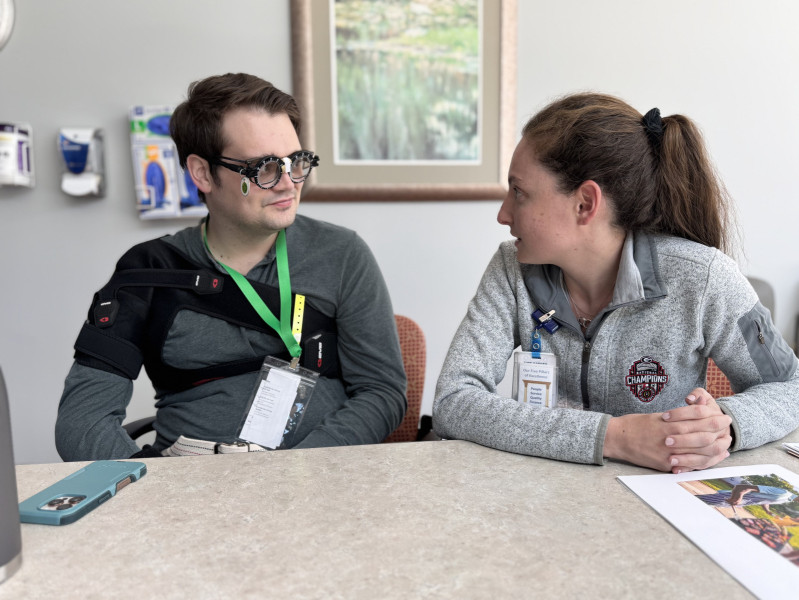
“I know,” Amanda assures him.
Aaron has anomic aphasia, which means he primarily has difficulty with word retrieval. Unlike other types of aphasia, in which people have difficulty understanding what people are saying, Aaron’s comprehension is very good.
“He’s working solely on expression,” Amanda explains.
Sometimes, that just means giving Aaron time to think to retrieve a word.
“And then once he gets it, trying to keep that word and putting a sentence together can be hard,” Amanda says. “So, it's the word retrieval, the sentence structure for it, and adding more content into his conversation.”
They move on to another exercise. Amanda asks Aaron to use complete sentences to describe who is in the picture, what is happening, where it takes place, when it is occurring, and why it may be happening. Once he says a sentence aloud, she asks him to write it down as well. As he speaks and writes, he sometimes stops to correct himself when a word doesn’t come out sounding the way he wants it to, or he isn’t sure of the right word.
“Your spelling is getting better,” Amanda tells him.
Aaron admits that he’s never been great at spelling, and Amanda tells him that it was always her worst subject in school.
“Hey, you've written two sentences, and there's only one letter that's been off,” she points out.
“I do payments, numbers,” Aaron says. “I don't talk.”
“All right. So, I should start giving you math?” Amanda jokes.
Aaron describes a picture of a group grilling. He and Amanda talk about what they like to grill and how they like their burgers. She asks him how he feels about the difficulty level of the exercise.
“I know what I want to say, I can't write the words. Those words, not coming out.”
“Your writing, though, was great,” she says. “Your spelling, there was one spelling error I had to fix, and then a little bit of the grammar, but then you fixed it yourself. But, yes, saying the sentences and putting it all together [can be difficult]. Also, do you feel on the spot sometimes?”
“Yeah,” Aaron admits.
Sometimes, Aaron leaves out a preposition or an article in his communication. Even though he can get his point across that way, Amanda encourages him to use full sentences.
“Other people might let you get away with it, but I won't,” she tells him with a smile.
It's speech. I have to make you say the whole thing.”
In a third exercise, Amanda asks Aaron to describe the similarities and differences between pairs of words, like high school and college or waffles and pancakes. When he’s struggling to find a word, she offers encouragement and sometimes gives him the first letter or sound to help him retrieve the word he’s looking for.
As the session wraps up, their waffles vs. pancakes conversation leads to talk of their go-to Waffle House orders and favorite foods.
Next, Aaron will head to recreation therapy, where he’ll continue working on words — with a fierce game of Bananagrams.
Written by Ruth Underwood
With five decades of experience, Shepherd Center provides world-class clinical care, research, and family support for people experiencing the most complex conditions, including spinal cord and brain injuries, multi-trauma, traumatic amputations, stroke, multiple sclerosis, and pain. An elite center ranked by U.S. News as one of the nation’s top hospitals for rehabilitation, Shepherd Center is also recognized as both Spinal Cord Injury and Traumatic Brain Injury Model Systems. Shepherd Center treats thousands of patients annually with unmatched expertise and unwavering compassion to help them begin again.