


'A Tight-Knit Little Team'
Family housing helped the Butler family embrace change during brain injury rehabilitation
Butch and Debra Butler were exhausted by the time they arrived in Atlanta late on a Friday evening in November 2023. They’d spent the past month in a hospital in Greensboro, North Carolina, hoping and praying for their 39-year-old son to awaken.
Brent Butler, a longtime cyclist, sustained a traumatic brain injury — among a litany of other injuries — in a collision with a car while he was biking. By the time the Butler family got to Shepherd Center, Brent had yet to emerge from a minimally conscious state.
“Physically and emotionally, we were pretty low at that point,” Butch recalls.
Thankfully, after the parents saw Brent checked in, all they had to do was head next door to the Irene and George Woodruff Family Residence Center for some much-needed sleep.
“That may not seem like much, but in that moment, it was a blessing,” Butch says. “Especially for me. I’ve been a paraplegic myself for 20 years. I know how hard it is to find a truly accessible hotel room. At Shepherd Center, we had it waiting for us, right next to where our son would be.”
The next morning, Butch and Debra were told to come over to Brent’s room at 8 a.m. A quick roll through the parking deck and an elevator ride later, they were back by Brent’s side. But not his bedside. That’s because Brent’s care team already had him up and sitting in a wheelchair.
“He still wasn’t even awake, and they had to strap him in to stay upright,” Butch says, “but he was upright. He hadn’t been out of a bed for a month. I said something to one of Brent’s nurses, and they said, ‘Oh, we don’t stay in bed at Shepherd Center.’ I turned to my wife and said, ‘Yeah, we’re in the right place.’”
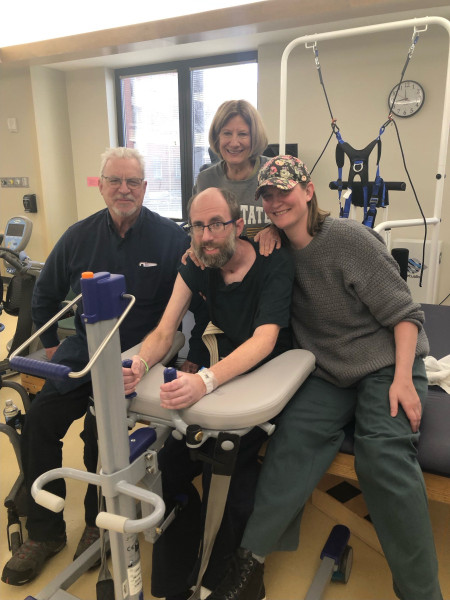
Family housing is one piece of the puzzle at Shepherd Center when it comes to helping families stay together, learn together, and prepare to return home together — all during what’s likely the most trying and tiring time in their lives. This fall, Shepherd Center more than doubled its family housing capacity with the opening of the new Arthur M. Blank Family Residences — in part due to stories like the Butlers’, that demonstrate the importance of family housing.
“The residences are a game-changer,” says Lauren Ross, OTR/L, MS, an occupational therapist in Shepherd Center’s Brain Injury Rehabilitation Program. “They help these new caregivers take care of themselves, too. And that’s huge. Because when they’re rested, they’re able to spend more quality time with their loved one. They’re able to participate fully and learn what they need to learn as caregivers.”
Ross witnessed that first-hand with the Butler family — Butch and Debra, as well as Brent’s sister Maggie — when she worked with Brent during his inpatient stay at Shepherd Center. “They were so wonderful to work with and super open to being educated,” Lauren says. “We did a lot of exercises to simulate their home environment in order to get them thinking about their needs at home and how they would navigate things returning to their daily lives.” When Brent was discharged to Shepherd Pathways, a comprehensive outpatient rehabilitation program for people recovering from brain injury, he “moved in” with his family in the Woodruff Residence residence — getting a taste for the transition home. Today, the Butlers still live together — a development that would have been quite unexpected a little over a year ago. Butch and Debra moved Brent in with them, to their home in Blowing Rock, North Carolina. Maggie is there almost all the time, too, essentially moving in from her home in Asheville.
“We’re a tight-knit little team,” Butch says.
They’re thankful that Brent is active and engaged, with his sense of humor fully intact. His short-term memory, while spotty, continues to improve. And they recently took a road trip to a big car show — a treat for Brent, who is a massive Formula 1 racing fan. The transition has been smoother than anticipated, something the family attributes to being fully engaged in Brent’s rehabilitation at Shepherd Center.
“It all started with the housing,” Butch says. “That took off so much worry and stress, and we were just able to be engaged in the rehab process. That made all the difference in the world. When you’re in it right alongside him, you’re learning so much. You’re learning how to be the caregiver. You’re getting a sense of what to be prepared for back home.”
By Phillip Jordan
With five decades of experience, Shepherd Center provides world-class clinical care, research, and family support for people experiencing the most complex conditions, including spinal cord and brain injuries, multi-trauma, traumatic amputations, stroke, multiple sclerosis, and pain. An elite center ranked by U.S. News as one of the nation’s top hospitals for rehabilitation, Shepherd Center is also recognized as both Spinal Cord Injury and Traumatic Brain Injury Model Systems. Shepherd Center treats thousands of patients annually with unmatched expertise and unwavering compassion to help them begin again.