


The Way Home
How Shepherd Center prepared a Tennessee couple for their move back home after an inpatient stay
Amanda Lyon has been an ER trauma nurse. She has provided hospice care in a Veterans Affairs hospital. Her husband Earl is a Marine Corps veteran, nurse, and paramedic.
In short, they have seen and heard some things when it comes to life-changing situations. But even they had never witnessed the trifecta of traumas Amanda experienced on Nov. 4, 2020.
First, a heart attack. Compounded by an anoxic brain injury suffered during her resuscitation. And then a T-10 spinal cord injury — likely caused by a blood clot moving to her spinal cord during CPR — that resulted in paraplegia.
Thankfully, Amanda stabilized during a two-week stay at Johnson City Medical Center, near the Lyons’ home in Gray, Tennessee, and soon transferred to Shepherd Center. Shepherd’s family housing was an “absolute godsend,” she says, as both Earl and her mom were able to be near while she was inpatient.
Later, Amanda was able to join them there once she graduated from inpatient to the SCI Day Program.
Throughout her journey, Amanda appreciated that her complex case was one that still fit easily within Shepherd’s expertise and collaborative team approach to patient care.
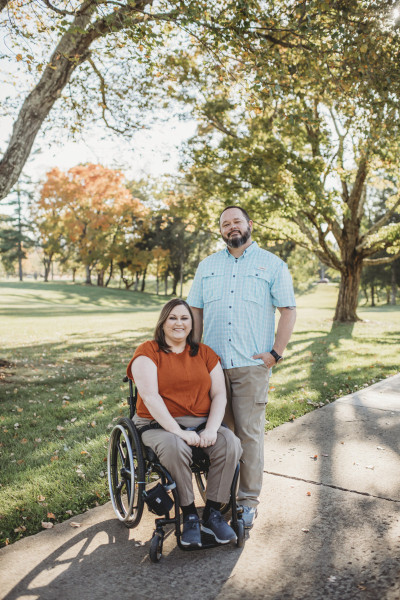 “That’s what’s great about Shepherd Center,” she says. “They’ve seen it before, and they’ll see it again. Everything they did was about anticipating what life would be like at home, preparing me to be as independent as possible, and to learn how to adapt in order to achieve that.”
Amanda is right about that intentionality at Shepherd Center. In fact, each family receives a form when their loved one is planning to return home. The form has questions about the housing the patient will return to once they leave. Families can supply pictures, too. That information helps Shepherd staff tailor their therapies for specific challenges.
It also enables staff members to give practical advice for home modifications and safety strategies.
“We can provide information that’s as simple as where to buy a grab bar to something as detailed as the ratio needed to build a ramp or instructions on widening doors,” says Lauren Ross, OTR/L,MS, an occupational therapist in the brain injury program. “Or even share advice on where families can find more aesthetically appealing modified furniture if that’s a mental boost for a loved one.”
Shepherd Center also offers home modification classes and home lab classes that recreate home-transition scenarios. Classes dive deep into assistive technologies — such as smart devices, home automation systems, and Bluetooth features — that can make life easier at home.
“We try to get families to think about these things early on so that they’re ready by the time they leave,” Ross says. “It’s about supporting the caregivers and amplifying patients’ long-term independence. We want them safe and confident at home, not back in a hospital.”
In Amanda’s case, early conversations at Shepherd Center helped her and Earl realize what home modifications they would need to have ready.
Amanda also credits her recreational therapy team with helping her figure out new ways to achieve things that used to come easily.
“As much as possible, they prepared me for what life would really be like at home,” Amanda says. “In OT, I learned skills to navigate our bathroom, brushing my teeth, getting dressed. At our Shepherd family residence, we got that first little feeling like we were really living at home. There were things we could figure out for ourselves, but know that help was still nearby if we needed it.”
Of course, all of the housing and technology and know-how don’t matter if the human element is missing. And beyond all else, it’s the people at Shepherd Center who impressed the Lyons the most.
“You know how every once in a while you meet someone and they’re just a phenomenal human being, and it really blows you away?” Earl asks.“Think about how often that happens. Every once in a blue moon? At Shepherd, it was a daily occurrence. Somebody every day impressed me there. And I’m not too easy to impress. Everybody was kind. Everybody treated you like a human — not a patient or an account number. And I know there’s a lot else that goes into it, but when you’re in that kind of situation, how you’re treated means an awful lot.”
By Phillip Jordan
With five decades of experience, Shepherd Center provides world-class clinical care, research, and family support for people experiencing the most complex conditions, including spinal cord and brain injuries, multi-trauma, traumatic amputations, stroke, multiple sclerosis, and pain. An elite center ranked by U.S. News as one of the nation’s top hospitals for rehabilitation, Shepherd Center is also recognized as both Spinal Cord Injury and Traumatic Brain Injury Model Systems. Shepherd Center treats thousands of patients annually with unmatched expertise and unwavering compassion to help them begin again.