


Staff Profile: Wheelchair Rugby Coach Rain Corbett
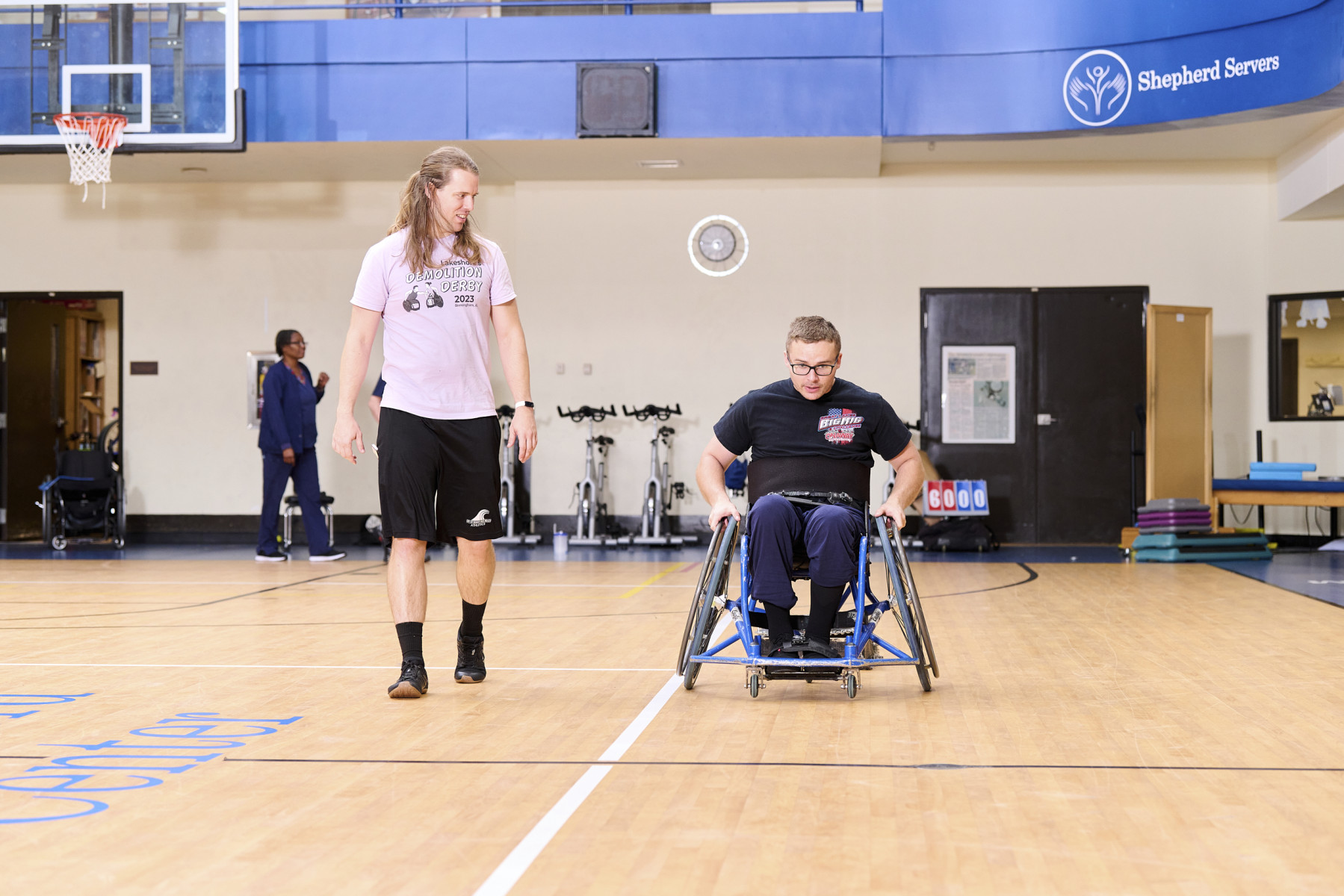
A Shepherd Center exercise physiologist shares on working with patients, community sports, and finding movement that brings joy
When did you first learn about Shepherd Center and how long have you been in your role?
My godfather, basically he’s like an uncle to me, is Bill Furbish. He is the coach of the waterski team here. He and my dad grew up on the same street, so they were very close. He was a patient here in the ’80s, and so growing up, I always just knew about Shepherd Center through him because we went to different events. Originally, my goals were to work with professional and collegiate athletes. But I realized it wasn't the right client population for me. Then I had that late-20s moment of, “Oh shoot, what do I want to do?” It just so happened when I was moving up to Atlanta from Florida that a position was opening up here, and Bill and his wife, Cathy [Furbish, PT, DPT, CLT, CCRP], who works here as a research physical therapist, thought I’d be a good fit, so I applied, and I started in February 2020.
What does a typical day in your role look like?
I'll come into work and see patients throughout the day. I work in a hybrid position, working in Beyond Therapy® and working with patients from other departments in a community-based gym setting. During rugby season, our practices are Mondays and Wednesdays from 6 p.m. to 8 p.m., so I will stay here, help wrap up with stuff, work out before practice, and then go through practice.
Did you know when you started at Shepherd that you wanted to work with the rugby team?
I was hoping that there'd be an opportunity when I started. My managers knew about my background — I started getting involved with a wheelchair rugby team in South Florida, just north of Miami, in 2017. I had worked with them for about two years before coming up here. It was definitely on my radar to get back into it.
What are your favorite parts of your role?
One of the most rewarding things is when you have patients return that you haven't seen for a while. Seeing them come back with more independence or seeing that they’ve improved since they’ve been here. Rugby is kind of the same. I like seeing our newer players learning and developing. Some of the athletes on the team now, they were some of my first patients that I worked with here. So, it's really cool to have seen them in inpatient, and now they're on the team playing. I also just enjoy seeing athletes get their due. One of our athletes who had been playing for a long time was named MVP at Nationals a few years ago, that was very cool for him. He definitely earned that. And then one of the other players — generally players with lower function in their extremities don't get as much attention — and he was voted MVP for one of the major tournaments last year. And he had even said before the award ceremony, “Yeah, we do all the grunt work, but we never get recognized.” So, it was very cool to then see him win that award. I just enjoy seeing athletes get recognized for what they're doing, because ultimately as a coach, my goal is to facilitate and allow them to show their performance. Whatever they're doing on the court, it's them, and we just try to put them in a position to show that.
What else should people know about sports programming at Shepherd Center or more widely?
Having grown up around Bill and just seeing what adaptive sports can do for people, I would encourage people to think about finding ways to stay active — it doesn't have to be rugby, it doesn't even have to be a team sport. Sports and hobbies can give people a sense of normalcy [after injury or illness]. My philosophy is that therapy, what patients are doing with physical therapists and occupational therapists, is very important for them. But replenishing the spirit and the soul is another important part of recovery. I think it's very easy for patients to get focused on the physical side, and they may not realize that by nourishing their spirit, they could improve in ways that may carry over into therapy. You need to have those pursuits that are just for you, not necessarily toward an end goal, just something that fulfills you, whether it’s sports or something else.
Responses have been edited for length and clarity.
Interview by Erin Kenney
With five decades of experience, Shepherd Center provides world-class clinical care, research, and family support for people experiencing the most complex conditions, including spinal cord and brain injuries, multi-trauma, traumatic amputations, stroke, multiple sclerosis, and pain. An elite center ranked by U.S. News as one of the nation’s top hospitals for rehabilitation, Shepherd Center is also recognized as both Spinal Cord Injury and Traumatic Brain Injury Model Systems. Shepherd Center treats thousands of patients annually with unmatched expertise and unwavering compassion to help them begin again.