


Shepherd Center Partners with Kinemo for Assistive Technology Testing
User testing shows Kinemo’s wearable input controller can increase independence for people with higher levels of paralysis
When Delaney Cowart, the program manager for Shepherd Center’s Accessibility User Research Collective (AURC), first reached out to Atlanta attorney Earle Burke about testing a Kinemo device, he was immediately interested.
Kinemo, a wearable input controller, aims to combine controls for power wheelchairs and devices like phones, computers, tablets, and smart TVs into one easy-to-use device. The device allows people with limited upper body mobility, including those with high-level paralysis, to access digital devices and drive their power wheelchairs using small tracers that detect body gestures. These tracers can be worn anywhere on the body, from the back of the head to a finger, and translate subtle movements to move a cursor, send a mouse click, scroll through a document, drive a wheelchair, or even perform a weight shift in a wheelchair, among other capabilities. Kinemo’s core technology was developed with funding from the Georgia Research Alliance, National Institute on Disability, Independent Living, and Rehabilitation Research (NIDILRR), Georgia Tech Create-X, Biolocity, and with the support from the MIT’s The Engine Accelerator and TiE Atlanta.
For Earle, a lawyer who completed rehabilitation for a spinal cord injury at Shepherd Center, the device sounded like an upgrade from his current assistive technology device that relied on a bite switch.
“The idea that I wouldn’t have to have something in my mouth appealed to me. That immediately sparked my interest,” Earle says.
Earle, along with three other former Shepherd Center patients, signed up for a user study to test the Kinemo device with the AURC. This user testing, which was made possible by a Small Business Innovation Research grant funded by the NIDILRR, was done in collaboration with Kinemo’s co-founders: chief executive officer Nordine Sebkhi and chief technology officer Arpan Bhavsar. Both were previously research engineers at the Georgia Institute of Technology, but their decision to partner with Shepherd Center was more than just geographical.
“Shepherd is really good about having a holistic perspective on what a patient [with paralysis] should be going home with,” Bhavsar says. “They shouldn’t just be going home with a wheelchair, they should also be going home with personalized assistive technology solutions to help them become more independent. Shepherd is great about having access to the latest assistive technology to recommend to their patients.”
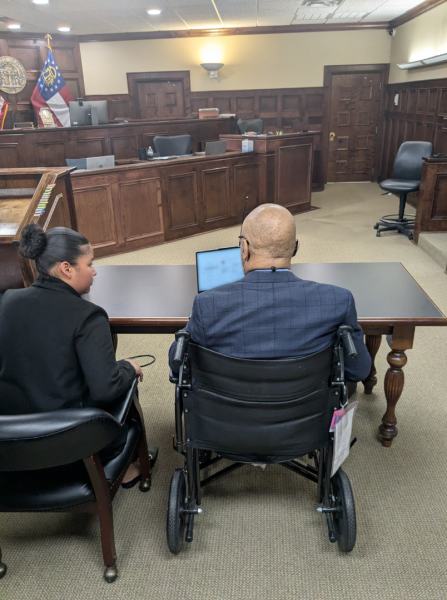 After an initial session to calibrate the device, Earle could use it for much of his digital activity at work — he says with the device, he can create a legal document from start to finish, check his calendar, and draft and respond to emails.
As the four-month testing neared its end, Earle used the Kinemo device in one of his cases during a court proceeding. The results were a game-changer. Earle says the device allowed him to freely move between his legal documents on his laptop while arguing his motion. Because he didn’t have a bite switch in his mouth to control his computer, Earle says he was able to argue his motion freely.
"I was able to argue my motion and respond to questions from the judge without having the bite switch in my mouth, which directly affected my ability to speak clearly, so that the judge and opposing counsel could hear me and understand what I was saying,” he says. “[The Kinemo device] allows me to be able to practice law — I’m grateful to have had the opportunity to be part of the user testing."
Other former Shepherd patients who tested the device had a similar experience — one participant in the study can now navigate his smart TV without assistance. Participants and clinicians alike enjoy the device because of its low profile and wearability — it doesn’t require as many adjustments as similar devices mounted to power wheelchairs. And because it doesn’t use a mouth switch, it’s more compatible with voice-activated assistants like Siri or Alexa.
“We don’t want to say that users should control all of their devices with our system — we want it to work with other types of alternative device controls,” Sebkhi says. “That’s the beauty of Kinemo. It works well with other systems to augment the user’s independence in device control.”
Earle continues to use the device, and Sebkhi and Bhavsar are set on making more improvements based on his feedback. They’ll need more rounds of testing, especially with using the Kinemo for wheelchair controls, but they’re hopeful about the future and making the device more widely available.
“Everything we learned from this user testing with Shepherd will be used to refine our device,” Sebkhi says. “This user testing showed us people love the system … there’s a value to it they haven’t found with other assistive technologies.”
By Erin Kenney
With five decades of experience, Shepherd Center provides world-class clinical care, research, and family support for people experiencing the most complex conditions, including spinal cord and brain injuries, multi-trauma, traumatic amputations, stroke, multiple sclerosis, and pain. An elite center ranked by U.S. News as one of the nation’s top hospitals for rehabilitation, Shepherd Center is also recognized as both Spinal Cord Injury and Traumatic Brain Injury Model Systems. Shepherd Center treats thousands of patients annually with unmatched expertise and unwavering compassion to help them begin again.