


Research Partnership with GSU Sociology Recognized with Ignite Award
Award to Provide Funding for Graduate Student Research at Shepherd Center
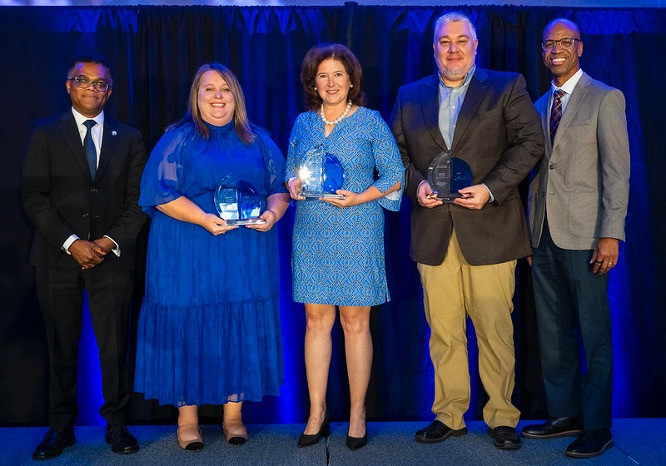
Just three years in, a partnership between Shepherd Center and the Sociology Department at Georgia State University (GSU) has yielded seven published studies, over 100 scientific outputs, and received the university’s prestigious Ignite Award for Faculty Research Partnership.
The partnership began as another chapter was ending for Raeda Anderson, Ph.D. Dr. Anderson was preparing to come to Shepherd Center as a research scientist, leaving her role as a professor in the Department of Research and Engagement at Georgia State University.
“Dr. Wright said something to the effect of, ‘So you think you’re leaving, but we’re actually going to make you an affiliate faculty member — so you can stay in the department as an Applied Sociologist as long as you’re willing,’” she remembers. “I wanted to be at Shepherd Center for a year before trying to build any bridges between the two institutions, because being a scientist is a hard profession. Being a scientist at a top-ranked non-profit hospital is even harder. So, I gave myself a year, and it was a year and one day when George Usmanov, my former graduate assistant at GSU, came over to Shepherd Center as a graduate assistant.”
What started as one graduate student working at Shepherd Center grew into a formal partnership between the two institutions. The GSU department provided funding for two more of Dr. Anderson’s graduate research assistants from the university to come work with her at Shepherd. Dr. Anderson, along with Dr. Daniel Pasciuti, associate professor of Sociology at GSU, and Dr. Patricia Lawrence, research assistant professor of Public Health and Interim Associate Director for the Center for Leadership and Disability, co-founded and lead GSU’s Interdisciplinary Community Research on Disability Lab (iCORD Lab). The iCORD Lab focuses on actionable research grounded in the belief that people with disabilities should thrive, not just survive, in their communities.
“Shepherd Center and GSU Sociology’s partnership has taken off.” Dr. Anderson says. “Social scientists are now making a real effect in clinical research. Our highly trained students work at Shepherd, contribute to publications, and excel at turning research into action. It’s a wonderful partnership that benefits everyone, most importantly our patients.”
Ford Vox, M.D., a doctor in Shepherd’s Brain Injury Rehabilitation Program, was so impressed by the partnership that he approached Deborah Backus, PT, Ph.D., FACRM, the hospital’s vice president of research and innovation, about funding the partnership to work on a project with local brain injury day program, Side by Side Brain Injury Clubhouse.
Side by Side is a member-led community providing growth opportunities for brain injury survivors. Dr. Anderson and her team have helped the program answer a myriad of questions about membership, participation, transportation, housing, and potential barriers to services. The multi-mode and multi-phase study is also helping prepare the program for Side by Side’s upcoming expansion. 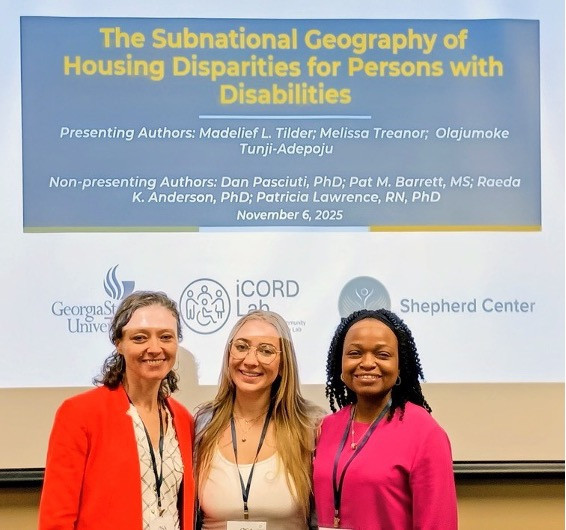
In addition to the project for Side by Side, the partnership has helped drive quality improvements at Shepherd Center. In one recently published study, Madelief Tilder, a former GSU graduate research assistant, examined factors influencing telehealth appointment completion. The study, driven by questions from clinical leaders here at Shepherd Center, analyzed over one million Shepherd Center appointments to examine patterns of appointment completion, focusing on the role of insurance, appointment structure, and access barriers.
“This experience helped me envision a future as an applied sociologist and showed me that interdisciplinary, collaborative research is not just possible — it’s powerful,” Tilder says. “The supportive environment fostered through the partnership helped me see that my voice matters, that I bring valuable insight and belong in research spaces. It gave me the confidence to ask questions, share my ideas, and meaningfully engage in scholarly conversations.”
In another study, Melissa Treanor, the current GSU graduate research assistant, examined all Georgia State Parks for accessibility information and is in early stages with Rec Therapy to identify how to use the data here at Shepherd Center.
“The GSU and Shepherd Center partnership has taught me that rigorous methods are most valuable when they are put in service of the community rather than kept inside the academy,” Treanor says. “Through this work, I have learned to ask not only whether a finding is significant, but what it means to the people the research is meant to help.”
Another recent study, “Disabled and left behind: U.S. poor housing through a social determinant of health lens,” uses national data from the U.S. Census Bureau to examine social determinants of health for people with disabilities. Social determinants of health are conditions in the environments where people are born, live, learn, work, play, worship, and age that affect a wide range of health, functioning, and quality-of-life outcomes and risks for people with disabilities.
“We never say in science that we were the first ever, but to our knowledge, it is the first publication that has examined this many areas of social determinants of health for people with disabilities,” Dr. Anderson says. “So, we intentionally published it as open access, so more people could have access to it, and Drs. Lawrence and Pasciuti covered those fees for us.” 
The partnership, while relatively new, has already made a tremendous effect on research at Shepherd Center and more widely in the field of rehabilitative medicine and disability advocacy. Fittingly, Georgia State recognized the partnership with its Ignite Award for The Faculty Research Partnership Award. The partnership was one of three chosen out of all partnerships across GSU’s seven campuses and hundreds of research areas. On top of the recognition, the award comes with a cash prize — enough to fund another graduate research assistant for the next academic year.
“The GSU Sociology department has funded three years of students, however, with budget cuts they are not able to fund a graduate assistant this upcoming year,” Anderson says. “This will fund a student for the entire next academic year, so Shepherd Center will get another great research assistant, and a sociologist will get a full ride work-study position. All the money that we won from the award is going back into the partnership to help strengthen it even more.”
Written by Erin Kenney & Ruth Underwood
With five decades of experience, Shepherd Center provides world-class clinical care, research, and family support for people experiencing the most complex conditions, including spinal cord and brain injuries, multi-trauma, traumatic amputations, stroke, multiple sclerosis, and pain. An elite center ranked by U.S. News as one of the nation’s top hospitals for rehabilitation, Shepherd Center is also recognized as both Spinal Cord Injury and Traumatic Brain Injury Model Systems. Shepherd Center treats thousands of patients annually with unmatched expertise and unwavering compassion to help them begin again.