


'Rec Therapy Gives You the Hope Back'
2026 Derby Day Chairs Share the Impact of Recreation Therapy
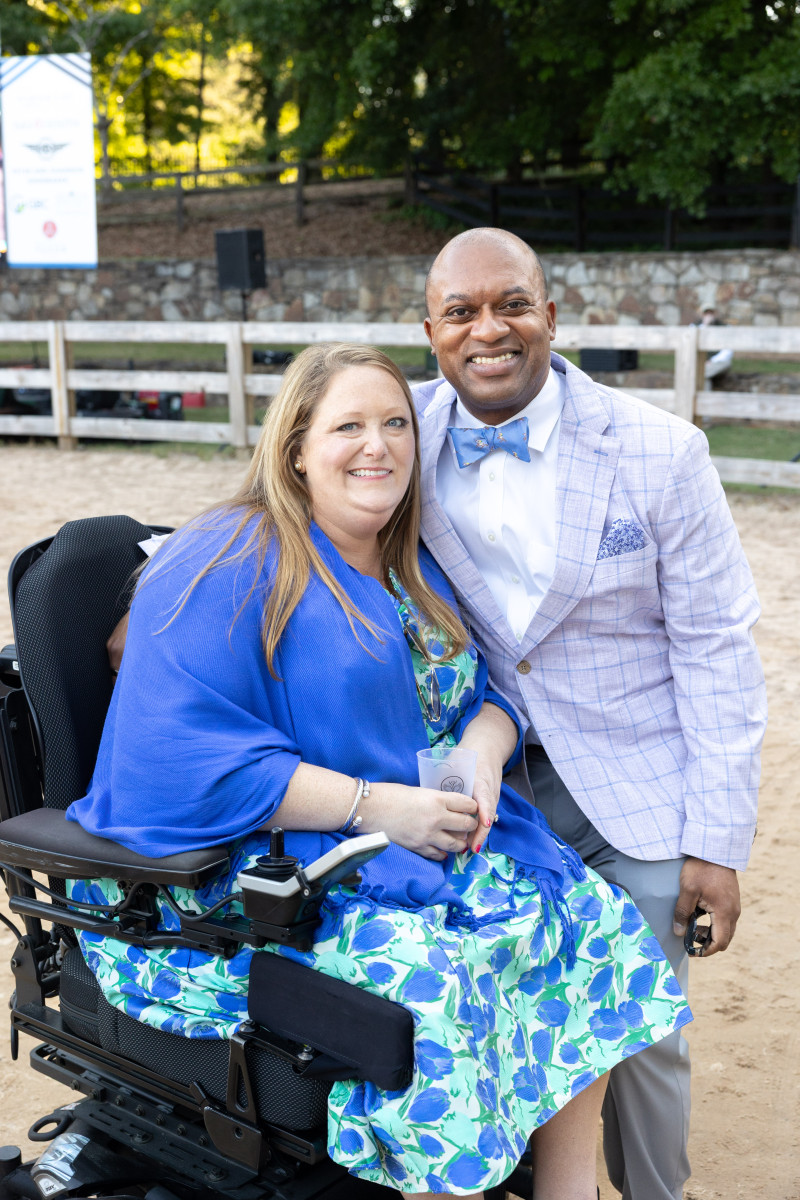
Derby Day is one of Shepherd Center’s most iconic annual events, raising money for one of its cornerstone programs, the Recreation Therapy Program. On May 2, attendees gathered at Chastain Horse Park to celebrate the race, bringing in over $315,000.
This year’s Derby Day event chairs, Stephanie Surbaugh and Greg Payne, shared why they took on the role, what they love most about the event, and what people should know about the cause it supports.
How did you first come to know about Shepherd Center?
Stephanie Surbaugh Payne: I have a very rare progressive neuromuscular disease. About six years ago, I had a fall and sustained a fracture in my back, but was able to rehab myself within the next year. But then one year after my first fall, I fell again and broke my back again, and this time it shattered the vertebrae. So, all of that landed me a sweet little bed at Shepherd Center after being at Piedmont for 14 days. And I was inpatient for almost two months, and then I did day program for about five months, and then outpatient physical therapy and occupational therapy, and then I did Beyond Therapy® for about two years. So, we first got involved when I was a patient, and then Greg was asked to join one of Shepherd’s boards.
Greg Payne: Catherine Callaway, a former classmate of ours at Westminster, asked if I would be interested in serving on the Shepherd Impact Council. It started in hopes of getting more people involved at Shepherd Center earlier on in their careers and building a stronger pipeline for some of the other boards. So, I’ve been on the Shepherd Impact Council for three years, and it has been a great experience.
What was it like to chair this year’s Derby Day? What was your favorite part of the event?
GP: I think my favorite part of the event was being able to go out and promote Shepherd Center and Derby Day within our networks. We were able to talk to friends, family members, people who go to church with us, coworkers. It was nice to really share what Shepherd means to us on a personal level: what [rehabilitation] means, what it looks like, why it’s important. So, sharing something we are so passionate about with our extended networks, not just the people who are closest to us, was very meaningful.
SSP: One piece that was fun for me was the education piece. When I arrived at Shepherd Center, I had no idea what rec therapy was. And I think a lot of people don’t know what it is, because it’s not necessarily a standard of care at most hospitals because it’s not covered by insurance. So, I think a lot of people go to Derby Day because it supports Shepherd and it’s a fun event, but they may not know the specific area within Shepherd that it supports. Getting to teach people what the rec therapy program is — explaining that it’s fully donor-funded and also sharing my personal experiences within rec therapy, was really cool.
What did recreation therapy look like for you, Stephanie, as a patient here? And what should people know about the program?
SSP: Like I mentioned, I had never heard of rec therapy before. I just remember on one of my first days at Shepherd, it showed up on my schedule. And I had zero clue what I would be doing for that hour. I came to enjoy rec therapy so much, because it teaches you how to do all of the normal, day-to-day life stuff. Like, ‘How do we go to a restaurant?’ ‘How do we travel?’ ‘How do we go get our nails done?’ All of these little things that wouldn’t typically be part of a hospital stay. They wanted to make sure that I was set up for success and able to enjoy my life post-Shepherd. I was a tennis player growing up, and 10 years before I entered Shepherd, I had hung up my racket because I wasn’t steady enough on my feet. But in getting to know me, my rec therapists found out I still had a love for tennis, and they got me back out on the tennis court. Now Greg and I, we get on the tennis court and play.
GP: I think beyond being part of the healing process, recreation therapy makes patients feel less like patients. It’s one part of Shepherd that touches basically everybody who comes through the facility. It was great to host Derby Day, because we got to contribute to something that touches every single person who comes through those doors.
SSP: For many of those people, recreation therapy helps them build confidence and excitement about their lives. Right after your injury, most people look through some not-so-rosy glasses, thinking, ‘My life is forever different. There are all these things I’m now not going to be able to do.’ But rec therapy gives you the hope back. It lets you imagine an enjoyable life and live a fulfilling life after you leave the hospital.
Responses have been edited for length and clarity.
Interview by Erin Kenney
With five decades of experience, Shepherd Center provides world-class clinical care, research, and family support for people experiencing the most complex conditions, including spinal cord and brain injuries, multi-trauma, traumatic amputations, stroke, multiple sclerosis, and pain. An elite center ranked by U.S. News as one of the nation’s top hospitals for rehabilitation, Shepherd Center is also recognized as both Spinal Cord Injury and Traumatic Brain Injury Model Systems. Shepherd Center treats thousands of patients annually with unmatched expertise and unwavering compassion to help them begin again.