


Q&A: Rebecca Shearin Gives Families a Helping Hand
Shepherd's Family Support Services Coordinator Shares About Her Role
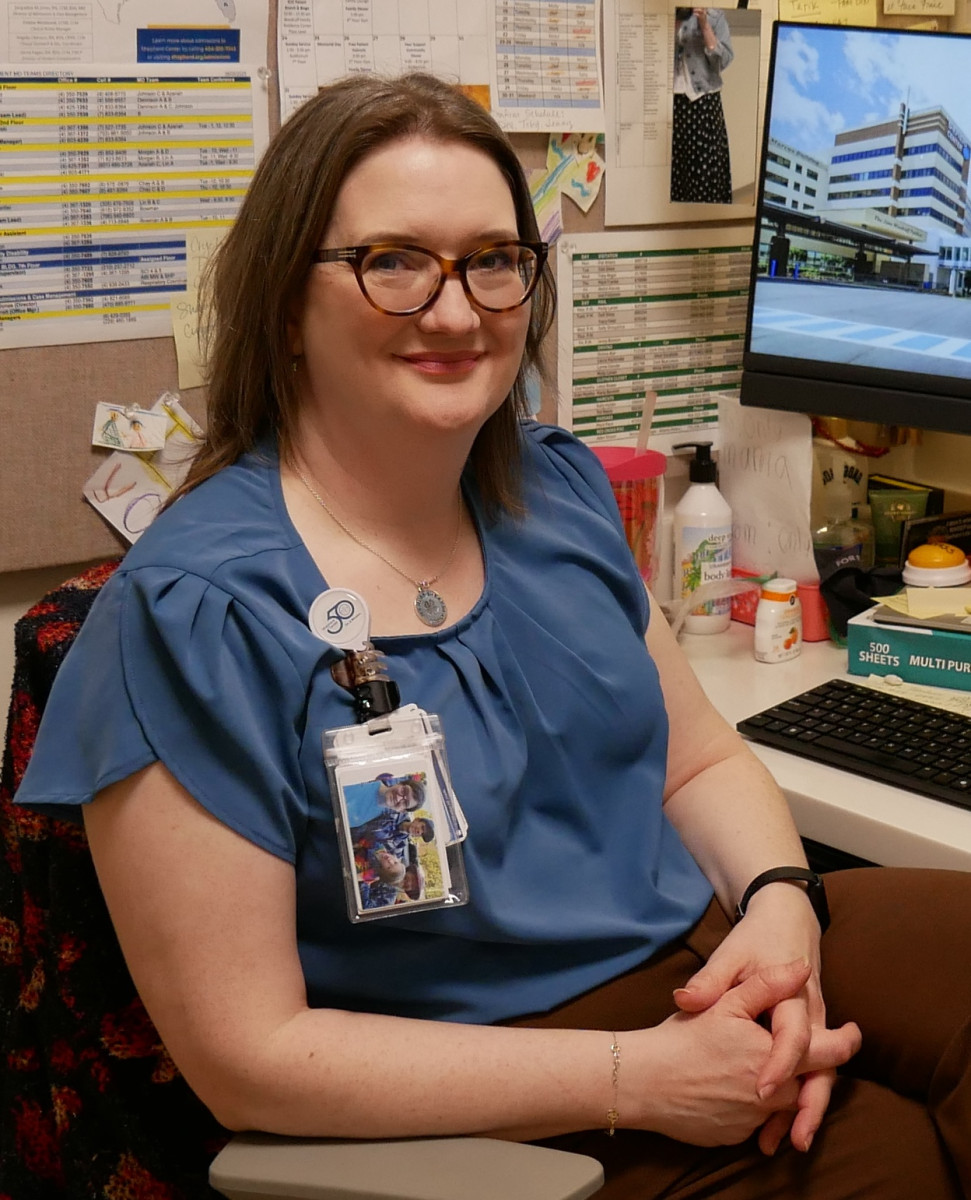
When families arrive at Shepherd Center, their number one priority is their loved one's rehabilitation. But day-to-day tasks and needs don't stop, even in the face of a life changing injury. Shepherd Center's Family Support Services Coordinator Rebecca Shearin helps families balance these needs, get to know their new environment, and even find time to carve out for themselves. Here, she answers a few questions about her role.
How do you explain your role to families who are new to Shepherd Center?
The first time I introduce myself to a patient’s family member, I tell them to think of me as their admin and concierge. For many of them, it’s like they’ve moved to a new city, but they didn’t pick it out or choose to come here. Anybody who has moved to a new city knows those struggles — you don’t know where things are, you don’t feel comfortable going places. I let them know they can ask me about things in the area, from family-friendly places to visit, to good hair or nail salons, to grocery stores and restaurants.
With the admin part, I stress to them that I’m not the person to help them fill out their disability paperwork, but once it is complete, I can scan it, fax it, copy it, notarize it, whatever is needed. I also take care of inpatient mail.
I also help connect families with extended stay hotels and apartments in the area. We provide family housing at the Arthur M. Blank Family Residences for those who live over 50 miles from the hospital, but often extended family or friends will visit during a patient’s rehabilitation, and I’m able to help those visitors find lodging nearby.
Day-to-day, my role can be a hodgepodge. I also manage the patient and family event calendar, and the family lounge is my home base. I take care of the lounge area and restock anything in there that’s needed. I also assist with our Tuesday night family dinners.
What initially drew you to Shepherd Center?
So, I ended up at Shepherd because I was job searching and I had recently graduated from Georgia State [University] as a film major with a minor in art. I was striking out finding work, and I had student loan payments coming, so I thought, “OK, let me pivot. What else do I like to do?” My husband and I really enjoy volunteering, and so I started looking at jobs at nonprofits, and then I applied for some roles at Shepherd.
I heard back from Alex [Seblatnigg, Shepherd’s Director of Volunteer Services] right away, which I initially was nervous about. We set up an interview, and my first question was “How long did the person previously in the role work here?” and she said 15 years. That got me really interested — and when I came in for an in-person interview, people were saying hello to me in the hallways already. I just thought, “These are my people!”
I joked with friends who asked me about my job at Shepherd Center, “Who knew my ability to talk to strangers in grocery stores would be valued anywhere?” That’s pretty much what I do — talk to strangers all day. And I love it. I love the purpose that we have here, and being able to help people.
What are some of the biggest challenges of your role?
The hardest thing is whenever I have to tell somebody no. I don’t like telling people no, but occasionally that’s the answer. For example, we can’t give people rides to and from the airport. We’re not too far, but it would be too much for our volunteers to ask them to pick up and drop off people at the airport.
Another challenge is helping people get used to our area. A significant number of our patients and families are from rural areas, and they haven’t spent an extended amount of time in the city before. That can be intimidating and nerve-wracking, which I understand.
This isn’t necessarily a challenge, but another difficult thing I face is seeing how patient family members and caregivers are usually the hardest on themselves. They don’t give themselves enough grace, or even think about themselves at all. One time, I was helping a woman who was almost in tears because she couldn’t remember how to attach something in an email. She kept saying she felt stupid, and I had to say, “You’re not stupid, you’re tired.” I try to help them be kind to themselves because they’re sleep deprived, they’re stressed out, and they’re receiving tons of information. It’s not the best example, but it’s almost like when you have a baby for the first time. You’re learning all this stuff, and you’re waking up every few hours. When I say this to parents I’m working with, they go “Oh yeah,” because every parent remembers how exhausting that was, and I hope it helps them be a little kinder to themselves in their current circumstances.
What else is unique about your role at Shepherd Center?
I absolutely love what I do. Every now and then, I have a family member or patient who will come say goodbye to me before they leave. I am so honored that they think of me to do that. I just love this place. I really do. The fact that we even have a role like mine — I think Shepherd is pretty unique in having that. I think it’s because we were started by a family who had to travel hundreds of miles for their son’s care. They knew what it was like to be far from home. All those little things we provide, I can’t help but think they stem from their own personal experience.
Responses have been edited for length and clarity.
Interview by Erin Kenney
With five decades of experience, Shepherd Center provides world-class clinical care, research, and family support for people experiencing the most complex conditions, including spinal cord and brain injuries, multi-trauma, traumatic amputations, stroke, multiple sclerosis, and pain. An elite center ranked by U.S. News as one of the nation’s top hospitals for rehabilitation, Shepherd Center is also recognized as both Spinal Cord Injury and Traumatic Brain Injury Model Systems. Shepherd Center treats thousands of patients annually with unmatched expertise and unwavering compassion to help them begin again.