


On a Mission to Innovate
As Shepherd Center looks toward its next half-century, innovation will remain at the heart of its mission.

As Shepherd Center looks toward its next half-century, innovation will remain at the heart of its mission. The aim is to improve the quality of life for people with disabilities at Shepherd Center and around the world — for generations to come.
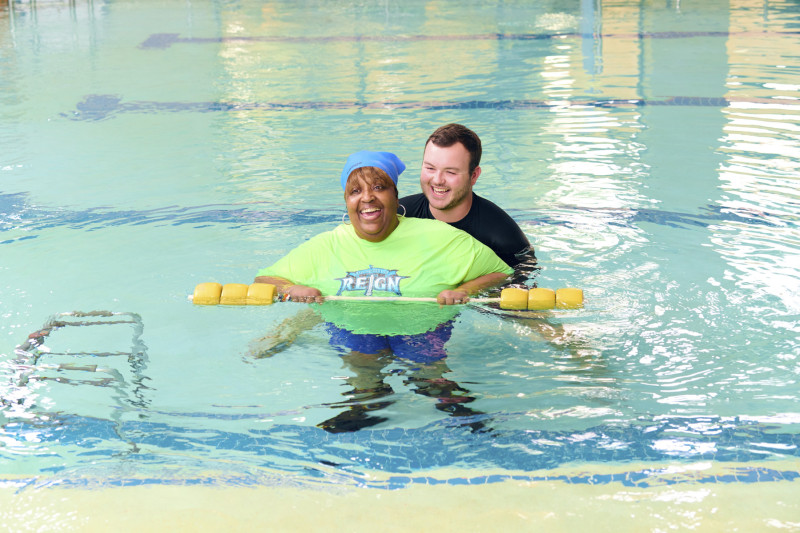 An inspiration for this approach is rooted in the creation of Beyond Therapy®, a rigorous, activity-based program designed in the early 2000s to help people with neurological disorders improve their lifelong health, minimize secondary complications, and get the most from any new neural links to their muscles and other organs, like the bladder. The concept was radical at the time. Activity-based therapy was still an emerging field; most rehabilitation hospitals at the time didn’t offer it. That’s because, back then, the prevailing opinion in the field was that the brain and nervous system simply couldn’t regenerate — couldn’t re-learn or adapt — after an SCI, stroke or traumatic brain injury. Shepherd Center, however, believed otherwise.
Its researchers and medical staff also made a commitment to ensure Beyond Therapy® would never be a static program. Instead, Shepherd Center would constantly apply evolving evidence — and generate new evidence through its own work — that could lead to better outcomes. Implementing this strategy required another novel idea: Everyone would work collaboratively — researchers, clinicians, patients, families — to consider all needs and all perspectives.
“That’s become a hugely successful model for us,” says Deborah Backus, PT, Ph.D., FACRM, Shepherd Center’s vice president of research and innovation. “It’s a model based on engaging all stakeholders from the very start and working together to identify meaningful problems and come up with collaborative solutions.”
Soon, Shepherd’s research and innovation efforts will have a new home inside the Marcus Center for Advanced Rehabilitation (MCAR), which is scheduled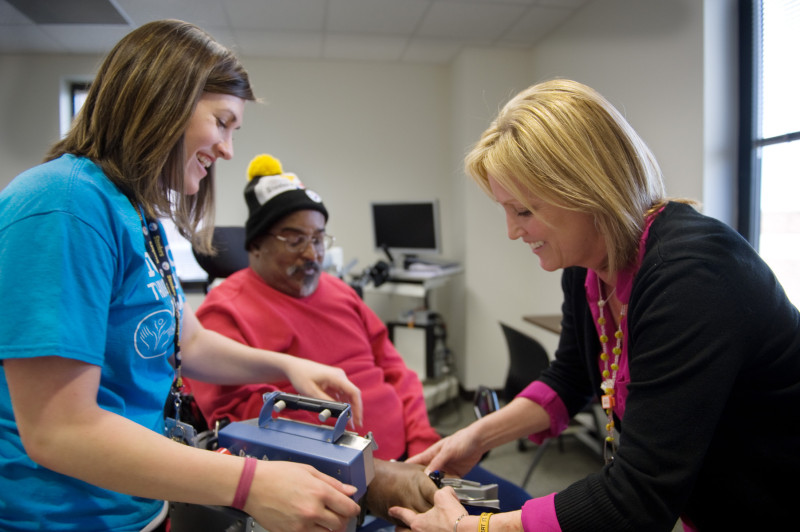 to open this spring. The 30,000-square-foot James M. Cox Foundation Innovation Institute, located inside MCAR, will cement Shepherd’s reputation for cutting-edge research and unparalleled clinical care. It will also allow for greater collaboration, bringing existing research and technology teams from throughout the hospital into one space.
“This is really exciting, especially the additional capabilities and resources for everyone working together,” Dr. Backus says, “from researchers and clinicians to patients and families, and industry and academic partners.”
Three new spaces will be added to the Innovation Institute, too, including a state-of-the-art Human Performance Lab to help Shepherd Center develop precise, data-informed rehab plans for each patient. The Innovation Institute will also house a new tech showroom that connects patients directly with product developers — allowing people with disabilities to test new technologies and smart home solutions before buying them. Finally, a Best Health Suite will enable staff to offer live and on-demand wellness and fitness classes to patients, partners, and the broader public. Shepherd Center will also begin testing “smart home”-style inpatient rooms that will give patients greater control, comfort, and independence. That effort includes Shepherd’s Access Technology team, whose broader services — including adaptive devices and assistive technologies to help people safely and more independently return to home, work, and school — are open to all, not just Shepherd Center patients.
Any technological advancement, of course, is only as good as the people it’s paired with. Thankfully, the human element — the hope element — isn’t going anywhere after 50 years at Shepherd Center. “Shepherd Center is so good at taking a holistic look at things,” Dr. Backus says, “and keeping the patient at the center of everything. When we say we’ve integrated research into clinical practice, we truly have. It’s a total team effort. It’s never effortless, and there are always new challenges. But being able to do that is what helps us come up with novel solutions for our patients. “It’s been so fun to be part of this through the years and to see how far we’ve come. The outcomes are so rewarding. I can’t wait to see what’s ahead.”
By Phillip Jordan
This story first appeared in the special 50th anniversary issue of Spinal Column magazine.
With five decades of experience, Shepherd Center provides world-class clinical care, research, and family support for people experiencing the most complex conditions, including spinal cord and brain injuries, multi-trauma, traumatic amputations, stroke, multiple sclerosis, and pain. An elite center ranked by U.S. News as one of the nation’s top hospitals for rehabilitation, Shepherd Center is also recognized as both Spinal Cord Injury and Traumatic Brain Injury Model Systems. Shepherd Center treats thousands of patients annually with unmatched expertise and unwavering compassion to help them begin again.