


Mission Moment: Sometimes Real Life Is Better Than Science Fiction
Advancing research and technology with real-life applications is an integral part of Shepherd Center's culture.

Shepherd Center thrives on the cutting edge of research and innovation, partnering with leading experts and institutions on clinical trials to push the limits of what’s possible in recovery by retooling, recoding, and rethinking. In 2010, Shepherd teamed up with engineers from Vanderbilt University to perform clinical trials for a robotic exoskeleton that would someday help people with significant paralysis to walk.
Eight years earlier, Michael Gore, a maintenance technician at a vinyl siding plant in Whiteville, North Carolina, had sustained a T-10 spinal cord injury after falling at work. Since going through rehabilitation at Shepherd Center, he had returned home to his wife and new life. But in 2010, he got a call from Shepherd, asking if he was interested and available to take part in clinical trials for the Indego® exoskeleton. He was all in.
“I wanted to see how this thing works,” Michael says. “But the main reason I agreed to be part of the trials is to see how this could help people.”
What followed was a marathon of trial and error, with technological advancements fueling this new partnership between Vanderbilt and Shepherd. Clare Hartigan, PT, MPT, was project manager, eventually spending almost 10 of her 33 years at Shepherd on the Indego project. “It was an incredible opportunity for us, but also for the patients,” she says. “The device allowed them to stand up and walk and exercise. It was such a thrill.”
The concept sounds a little like the movie “RoboCop,” but the technology is more akin to the Segway® scooter. Essentially, the Indego is a lightweight modular device with components for the lower legs, upper legs, and hips/waist. Electric motors drive the hip and knee joints, while gyroscopes and accelerators anticipate a patient’s steps by subtle upper body motion—similar to how a Segway works: Lean forward, go forward; lean back, stop or sit down.
Every month, Michael Goldfarb, Ph.D., who invented the Indego technology, and his engineering team from Vanderbilt would come to Shepherd, and Michael Gore would travel from North Carolina for a week of intensive testing. “We would spend all day with Michael, from 9 a.m. to 5 p.m.,” Clare recalls. “Then the engineers would be up until 3 a.m. recoding things. Sometimes they would sleep in the gym. It was a tremendous amount of work.”
Within two years, the team had a fully functional prototype. In 2013, Parker Hannifin, a global leader in motion technologies, bought the Indego and began the extensive process of bringing it to the market, first in Europe and, in 2016, the U.S. Initially, the FDA approved Indego for people with paraplegia or tetraplegia and, two years later, approved it for people recovering from strokes. In 2022, a company called Ekso Bionics bought Indego from Parker Hannifin and continues to market it for personal and therapy use.
Ultimately, about 50 patients at Shepherd took part in the Indego clinical trials, along with hundreds of other people across the country. Shepherd Center was in the national and international spotlight during the research, and Clare and Michael were in demand all over the world to demonstrate how Indego works.
“This was my heart, this project,” Clare says. “It was eight years of hard work, but we had such a good time and learned so much. In the end—the whole team would say this—the motivation was to do this for the patients. The fact that we were able to succeed meant everything.”
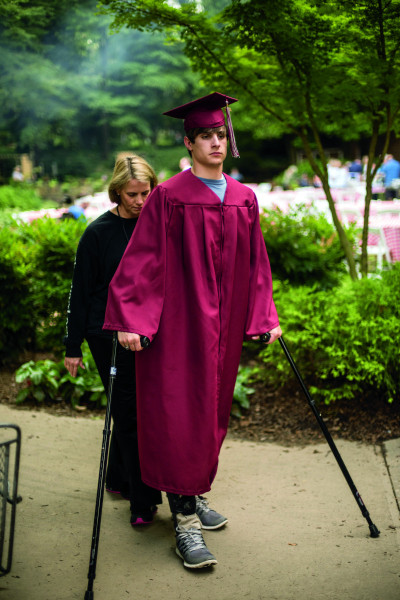
Success may be best measured in the real-life moments that follow clinical trials, like when Will Hutchins, who sustained a T-7 spinal cord injury in 2013 in a vehicle crash, was able to walk into the football stadium at Heard County High School in Franklin, Georgia, two years later to receive his diploma. Using forearm crutches and wearing the Indego, with Clare walking a half-step behind, Will was able to make the long walk into the stadium, up a ramp, across the stage, and down another ramp. “I was very emotional that day,” Clare says. “There have been a lot of incredible, amazing firsts with this device.”
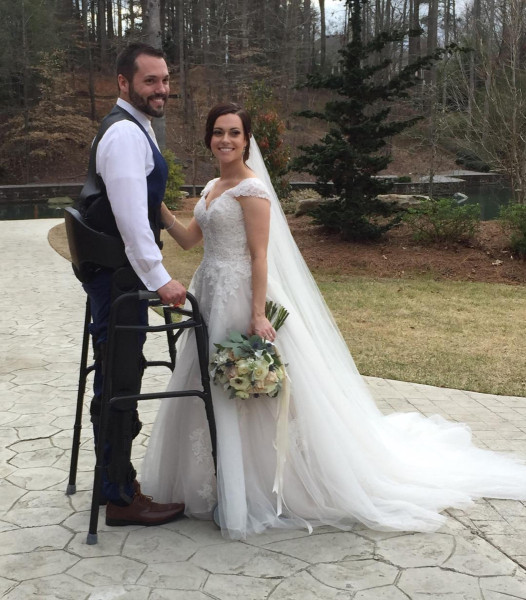
David Carter, who has used a wheelchair for mobility since sustaining a T-7 injury in a motorcycle crash in 2010 and works now in Peer Support at Shepherd, was able to walk down the aisle at his wedding while wearing the Indego. The device cannot heal a spinal cord injury, of course, but it allows people to experience these moments—celebratory and mundane—in a different way.
At home in North Carolina, Michael Gore doesn’t wear his Indego every day. “Just when I want to get up and walk around a little,” he says, quietly acknowledging what a remarkable option that is.
Written by Teresa Weaver
This story is an excerpt from “Mission Moments: 50 Years of Rebuilding Lives One Moment at a Time,” a book celebrating Shepherd’s 50th anniversary in 2025.
With five decades of experience, Shepherd Center provides world-class clinical care, research, and family support for people experiencing the most complex conditions, including spinal cord and brain injuries, multi-trauma, traumatic amputations, stroke, multiple sclerosis, and pain. An elite center ranked by U.S. News as one of the nation’s top hospitals for rehabilitation, Shepherd Center is also recognized as both Spinal Cord Injury and Traumatic Brain Injury Model Systems. Shepherd Center treats thousands of patients annually with unmatched expertise and unwavering compassion to help them begin again.