


Mission Moment: Putting Success Within Reach
Shepherd Center’s Accessibility User Research Collective (AURC) partners with companies to improve access for everyone.
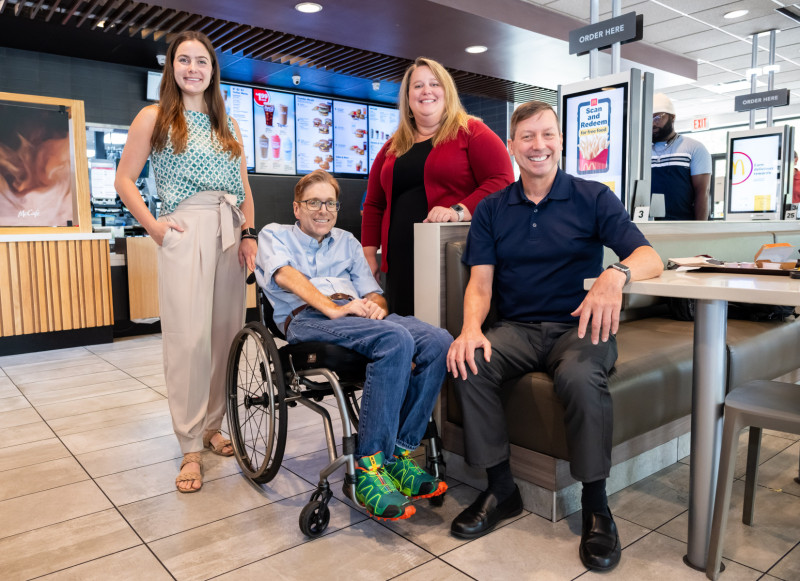
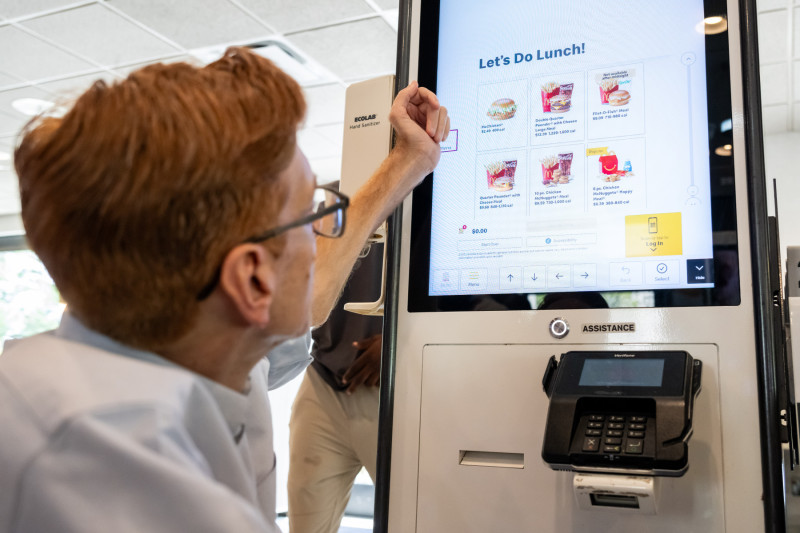
Sasha Elizabeth Sumlin, a 6-year-old princess with a plastic tiara and a gap-toothed grin, knows nothing about Shepherd Center. But because of a partnership between the hospital and McDonald’s restaurants, she was able to order her own chicken McNuggets and drink for lunch.
McDonald’s kiosk design, developed in collaboration with Shepherd to make ordering easier for people who use wheelchairs and scooters, also makes the touch-screen menu reachable for little princesses and princes. Sasha Elizabeth’s mother, Sharon, says she noticed the accessibility prompt on the kiosk immediately. “And that’s a good thing,” she says.
The McDonald’s connection is just one of many relationships between Shepherd Center’s Accessibility User Research Collective (AURC) and numerous name-brand corporations, including Samsung, Microsoft, Nike, Intel, LinkedIn, Roku, and the Tinder dating app.
The AURC connects companies with consumers who live with various disabilities and who can provide feedback about products and services. The network of more than 1,500 consumers is not restricted to people who have conditions specific to Shepherd Center’s patient population. It also includes individuals with low vision, hearing loss, attention deficit disorder, autism, dyslexia, and other conditions. Their observations lead to improvements in accessibility that can benefit everyone.
The AURC research team works with companies to design studies, recruit participants, and collect and analyze results. When Microsoft wanted to develop a new process for providing testing accommodations, for instance, it turned to the AURC. Each time the company wanted to update the material, the AURC was there to advise.
“Shepherd’s imprimatur provides confidence to research participants and AURC corporate partners that studies will be conducted with rigor and professionalism,” says AURC director John Morris, Ph.D., FACRM.
The AURC was formally established in 2017, building on years of work providing research services to corporate partners. This work grew out of federally funded grants to support development of new assistive technology under the leadership of Mike Jones, founding director of Shepherd’s Virginia C. Crawford Research Institute and retired vice president of research and technology of Shepherd Center.
Although much of the AURC’s work is proprietary and confidential, some businesses promote their Shepherd connection. Samsung, for instance, has regularly featured its partnership with the AURC and Shepherd Center at industry conferences and the company’s own events.
“The AURC provides an opportunity for us to help mainstream companies build better products,” says Ben Lippincott, project manager and consumer engagement strategist.
“We’ve done work for some big, big companies whose products touch the lives of literally tens of millions, even hundreds of millions of people,” says Delaney Cowart, AURC program manager. Sasha Elizabeth, leaving McDonald’s with drink in one hand and her mother’s hand in the other, is one of them.
Written by Gayle White
This story is an excerpt from “Mission Moments: 50 Years of Rebuilding Lives One Moment at a Time,” a book celebrating Shepherd’s 50th anniversary in 2025.
With five decades of experience, Shepherd Center provides world-class clinical care, research, and family support for people experiencing the most complex conditions, including spinal cord and brain injuries, multi-trauma, traumatic amputations, stroke, multiple sclerosis, and pain. An elite center ranked by U.S. News as one of the nation’s top hospitals for rehabilitation, Shepherd Center is also recognized as both Spinal Cord Injury and Traumatic Brain Injury Model Systems. Shepherd Center treats thousands of patients annually with unmatched expertise and unwavering compassion to help them begin again.