


Let's Do Lunch
In recognition of Spinal Cord Injury Awareness Month this September, Tom Elkin let us tag along on a tasty occupational therapy session.
Tom Elkin cruises into Shepherd Center’s cafeteria during the busy lunch hour. He’s eaten many meals at Shepherd — he completed 10 weeks in the inpatient Spinal Cord Injury (SCI) Rehabilitation Program after sustaining an SCI in a cycling accident. Now, he’s in his third week of Shepherd’s SCI Day Program. His wife, Norma Elkin, is by his side, as she has been throughout his recovery. But today isn’t any ordinary lunch. Today, Tom will work with Norma and his occupational therapist, Marie Alexander, MSOT, OTR/L, to feed himself for the first time.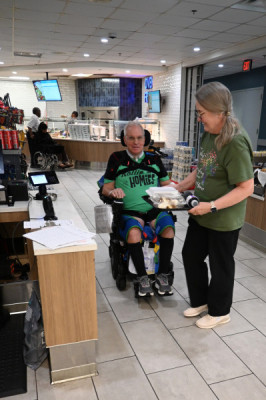
The group peruses the day’s cafeteria offerings. Tom is focused on foods that could be considered “stab-able,” and Marie encourages him to choose whatever he’d like (except maybe soup!) Tom decides on baked chicken, mac and cheese, and roasted cauliflower. They pick up his food and head to a table.
Marie suggests that Tom pull up to the corner of the table — that way, he can get close to his plate without his armrest bumping into the table. Once he’s situated and the table height is set, Marie puts down a non-slip placemat and helps Tom fit a 3D-printed universal cuff over his right hand. Into that, she places a fork that she has bent at an angle to give Tom, who has limited mobility in his arms and wrists, a better angle to “stab” the food on his plate and get it to his mouth.
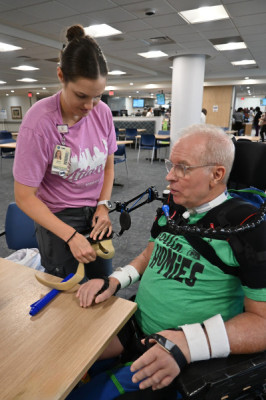 The mobile arm support Marie attaches to his wheelchair helps Tom lift his arm as he regains strength. “So, we fitted this early on in day program so that he could easily use it in different therapy sessions,” Marie explains. “So, he's used it in rec therapy before, for playing cards; he uses it with me for working on feeding himself. And then we've been problem-solving different fork setups. I feel like this is the one that we thought was the best, right, Tom?”
“The trick is the right position to both get the food and bring it up, and be able to eat it,” Tom says.
“It's finding the balance … because sometimes it looks great for stabbing, but then he brings it here [to his mouth], and the fork is turned sideways,” Marie demonstrates.
Norma cuts the baked chicken into bite-sized pieces, and Tom starts poking at the various foods on his plate. The process could lead to frustration — sometimes the angle isn’t quite right to get the food onto the fork, other times it slides off before Tom can get it to his mouth, or he gets only a partial bite. But Tom approaches the task with determination and humor — and Norma and Marie do the same, offering encouragement, laughter, and troubleshooting tips.
They try different forks and different angles. Marie reminds Tom to sit up straight while he eats, bringing the food to his mouth instead of vice versa. She tells both Tom and Norma that a plate with edges can be helpful, giving him something to push the food against.
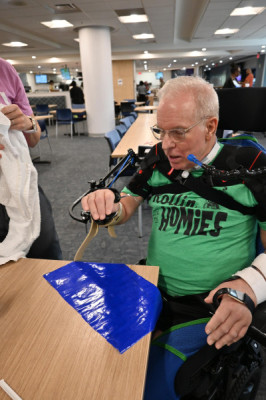
“As my mobility gets better, strength gets better in this right arm; this should become easier,” Tom says. Marie agrees.
“But I'm happy to work on it at this phase,” he continues, “because I won't get stronger if I don't.”
“And it's not only strength,” Marie explains, “it's also coordination, learning how to turn on which muscles, when.”
Before today, Tom has been practicing using a fork in the day program gym. Sometimes with therapy putty, and once, with a special treat — coffee cake Marie brought from home. Norma laughs that Tom was just as excited about the coffee cake as he was about feeding it to himself.
Since Tom began the day program, he and Norma have made the drive from Kennesaw every weekday, which makes for long days, but they both say it’s worth it.
“I love the combined approach that Shepherd gives you,” Tom says. “An occupational therapist, physical therapist, a rec therapist, speech therapist, and it's asking me, ‘What do you need? What are your goals?’ You know, my goals are to get stronger, get where I can do more things for myself, get where she [Norma] doesn't have to do as much for me. so that I can just enjoy.”
Tom also says it’s great to have Norma there with him.
“I am a lucky person, that I got my wife Norma as my caregiver, she got trained up early and often on all the things,” he says. “And she got a lot of high marks from nursing.”
“And the staff is so great about training us, and letting us do it, so I got comfortable,” Norma explains.
“But she wanted to learn stuff as quick as she could and then it’s on to the next thing,” Tom says. “I heard that some family members were a little apprehensive, and it's like, ‘No, you're going home, so you need to know this stuff.’”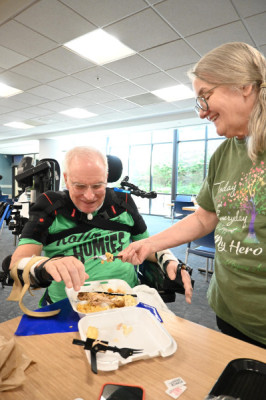
You can tell that Tom and Norma are a great team. They’ve been married for more than 40 years and even worked together in recent years. Sometimes they complete each other’s sentences. They have learned a lot at Shepherd about adapting to life at home, including little tips and tricks to make daily tasks go more smoothly. When Marie shows them how to put two straws together to create an extra-long straw that’s easier to reach, Norma has already experimented with it. She’s even developed her own technique for bending the bottom of the straw, so it balances a little better in the drink.
Tom returns his focus to the task at hand.
“The rotation of my wrist is not where it needs to be quite yet. It's getting there. I mean, in a short amount of time, we went from pretty much nothing to some activity … I am so determined to get some of this cauliflower!”
“Did Marie tell you this is your last meal for today, so you better eat up?” Norma jokes. “Just trying to give him a little motivation,” she laughs.
He tries again, but sometimes the cauliflower slides off the fork. The mac and cheese and chicken are a little more cooperative. Norma and Marie cheer him on — Norma tells him to go for it, that she’ll “go for the save” if anything falls. Marie reminds him to keep his shoulder down and let his elbow come out a bit. He gets a full bite — success.
“Oh, that was tasty. Very good,” Tom declares.
Written by Ruth Underwood
With five decades of experience, Shepherd Center provides world-class clinical care, research, and family support for people experiencing the most complex conditions, including spinal cord and brain injuries, multi-trauma, traumatic amputations, stroke, multiple sclerosis, and pain. An elite center ranked by U.S. News as one of the nation’s top hospitals for rehabilitation, Shepherd Center is also recognized as both Spinal Cord Injury and Traumatic Brain Injury Model Systems. Shepherd Center treats thousands of patients annually with unmatched expertise and unwavering compassion to help them begin again.