


Open Hands and Open Heart: Sharing A Story of Resilience
Former patient Gabe Hubbard shares his story to help others with brain injury
One of the first milestones Gabe Hubbard remembers from brain injury rehabilitation at Shepherd Center was being able to uncurl his fingers. In September 2023, after a routine surgery to replace a shunt in Gabe’s brain, he woke up with his left side paralyzed, with his left palm curled into a fist. Finally opening his fingers after weeks of rehabilitation felt like a turning point.
“We spent a lot of time in speech, physical, and occupational therapy working on my hand,” Gabe says. “The first time I was actually able to open my hand was the biggest milestone for me. It made me realize the therapy is working.” 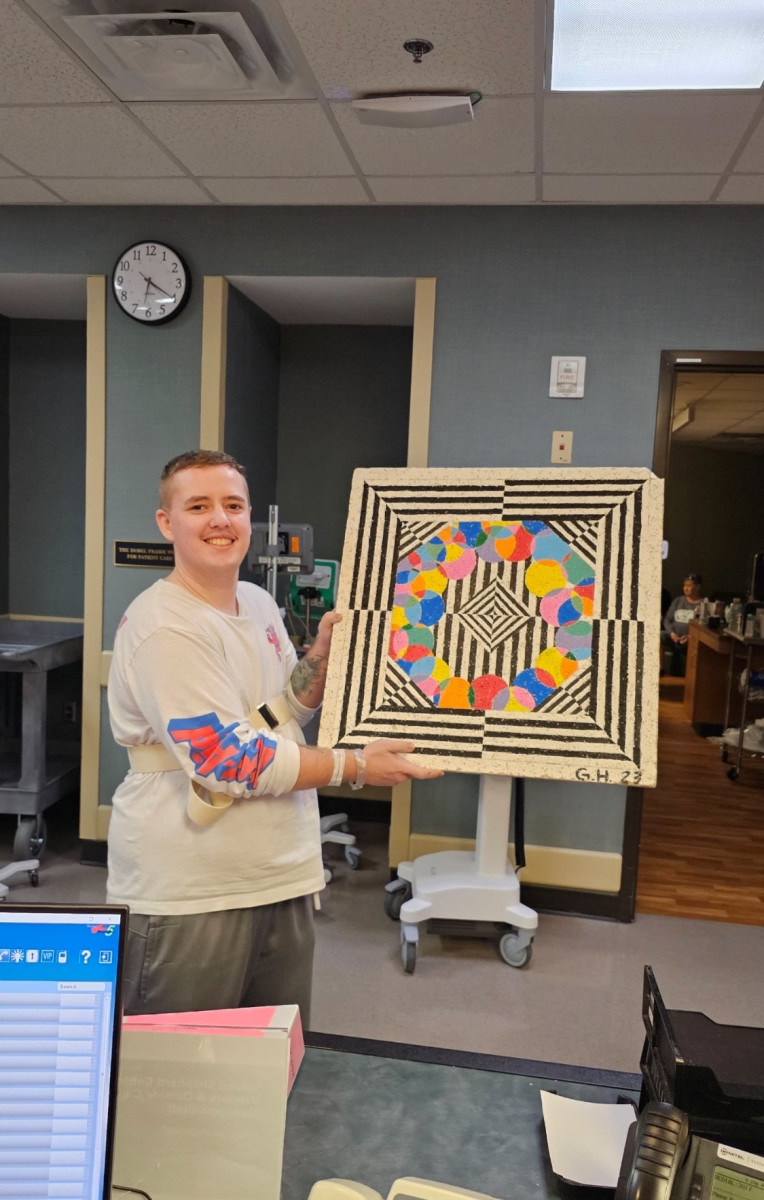 Following his surgery, Gabe spent a month at Emory Johns Creek Hospital and then transferred to Shepherd. Emotionally, he was at a low point. He didn’t have any hope to regain the mobility he lost in the surgery, and his outlook for the future was dim. The brain injury he sustained in surgery came as a big shock, in part because Gabe had previously undergone a successful shunt surgery. He says he remembers his early days at Shepherd thinking, "I’m not going to get better.”
Luckily, Gabe’s care team helped him change his mindset. Gabe says they pushed him to get out of bed in the morning and to put his full effort into each of his therapy sessions. While it wasn’t easy, the progress came — starting with opening his fingers and eventually walking again.
Like many Shepherd patients, Gabe’s time in rehabilitation came with adjusting to a new normal. Following his surgery, Gabe had gastrointestinal issues and used total parenteral nutrition (TPN), a kind of IV nutrition supplement. He also had a central line, a type of catheter used to deliver medication, fluids, and nutrition. He credits his nurses with helping make sure he got all the correct IV medications and nutrition treatments, while his therapy team helped him learn how to live with his TPN.
“Not only did occupational therapy help me with brushing my teeth and trying to learn to bathe myself with just one hand, but they also taught me the best way to wrap up my central line, make sure it doesn't get wet in the shower,” Gabe says. “They made sure I knew how to stay sterile, how to clean everything, make sure that my feeding tube was clean.”
In addition to working with therapists and nurses, Gabe also worked with one of Shepherd’s nutritionists to make sure his nutritional needs were met through TPN. He said that even after his discharge, his nutritionist continued to follow up with him for several months to make sure his nutrition plan was still meeting his needs.
Leading up to Gabe’s discharge, he began meeting more and more of his therapy goals, like being able to walk with help from a walker, and later, an ankle foot orthosis (AFO) brace. But he had one last thing to do before leaving Shepherd.
“The last week I was here, I was talking to one of my therapists and said, ‘I see these ceiling tiles other patients have painted, and I have an idea,’” Gabe says. He spent his last few days at Shepherd working on the tile, an abstract design with black and white lines and bright, colorful overlapping circles.
When it was time to leave in November 2023, on one hand, Gabe was thrilled to go home after months of being in the hospital. But at the same time, he knew he was going to miss what he described as his “home away from home.”
“Two months’ time, some people don’t think it’s a long time, but it is when you’re a patient,” Gabe says. “[The staff] started becoming like family — not just the therapists, but the nursing staff, the CNAs, there was a person who worked at the desk, and every day for a month when everybody was sleeping in the middle of the night, I’d go sit up there in my wheelchair and talk to her for hours.
“And it became like that with not just certain staff members, but almost all of them. I had a good relationship with everybody, and they made it feel more like home … it’s sad that I had to be here in the first place, but they made it seem much more doable, much more manageable.”
Now, Gabe is continuing to prioritize his health, periodically coming to Shepherd Center and visiting his surgeon for follow-up appointments. He hopes to one day go back to school, possibly to study veterinary sciences (another favorite part of his Shepherd rehabilitation? Visits with the facility dogs). No matter what comes next for Gabe, he’s not letting his brain injury define his future.
“Health issues can definitely put your life on pause … but you can’t just sit there and mope,” he says. “You’ve got to do something with your life — school, graduation, get a job. I have a disability, yes, but I can’t let that stop me.”
By Erin Kenney
With five decades of experience, Shepherd Center provides world-class clinical care, research, and family support for people experiencing the most complex conditions, including spinal cord and brain injuries, multi-trauma, traumatic amputations, stroke, multiple sclerosis, and pain. An elite center ranked by U.S. News as one of the nation’s top hospitals for rehabilitation, Shepherd Center is also recognized as both Spinal Cord Injury and Traumatic Brain Injury Model Systems. Shepherd Center treats thousands of patients annually with unmatched expertise and unwavering compassion to help them begin again.